
Federated model access
The router exposes one public model ID across deployments from independent providers, so applications can use the same model identifier while provider routes change.

Abliterated Model Router provides one OpenAI-compatible API for routing abliterated language models across multiple providers. It is intended for developers and safety researchers who need model comparison, modality-aware selection, and provider fallback in a shared integration.
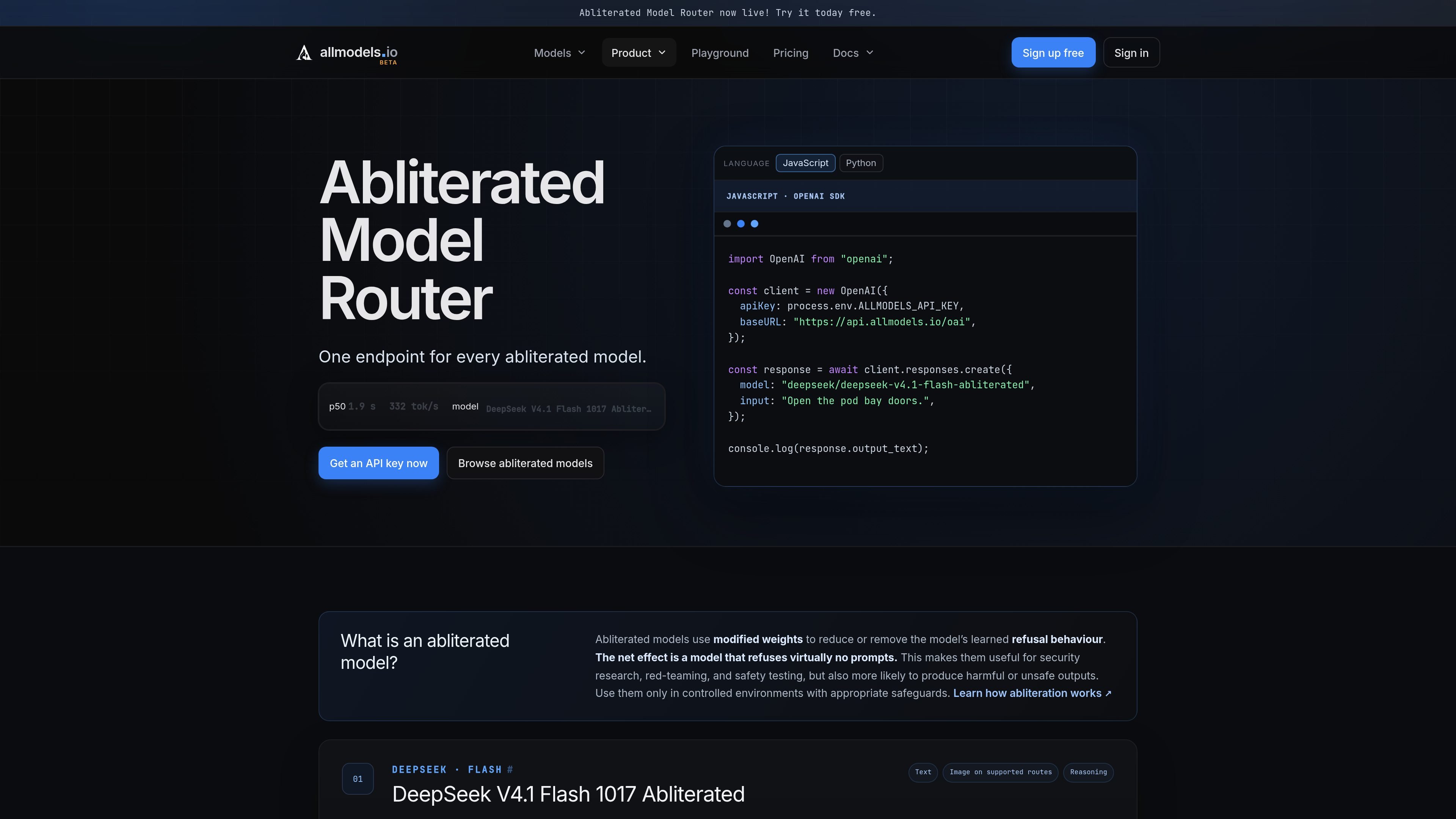
Abliterated Model Router is an AllModels API layer for accessing abliterated language models through one OpenAI-compatible endpoint. It aggregates model deployments from multiple providers and presents their availability, capabilities, context limits, latency, and token prices in a shared catalog.
Abliterated models use modified weights to reduce or remove learned refusal behavior. AllModels positions these models for security research, red-teaming, and safety testing, while warning that they are more likely to generate harmful or unsafe material. The router can select compatible providers, apply modality-aware routing, and fall back when a provider lacks capacity.
The router exposes one public model ID across deployments from independent providers, so applications can use the same model identifier while provider routes change.
Requests can fall back to another eligible provider when the selected route is unavailable or capacity constrained, without requiring an application code change.
The router considers request modality when selecting a route. Text requests can use eligible text providers, while image requests are sent only to providers that can process images.
Applications can use OpenAI-compatible Chat Completions with messages, streaming, and function tools, or the Responses API with streaming events, reasoning controls, structured output, custom tools, and hosted web search.
Router-hosted web search provides a common search tool and URL citations through the AllModels layer, including for models whose underlying provider does not offer search.
The catalog exposes provider availability, context limits, modalities, capabilities, latency, speed, and token pricing for individual model routes. For example, the listed DeepSeek model has five providers and the listed GLM 5.3 model has three.
Researchers can compare abliterated model variants and provider routes when investigating refusal behavior, model safety, and controlled adversarial prompts.
Teams testing safety controls can use modified-weight models to examine how applications behave when a model provides fewer refusal responses, provided testing is isolated and governed by safeguards.
Developers can connect an existing OpenAI SDK integration to the AllModels endpoint, then compare model IDs, provider availability, context limits, and token prices without building separate provider integrations.
Applications that accept both text and image inputs can use the router’s modality-aware selection to avoid sending image requests to text-only provider routes.
Services that need continuity across changing inference capacity can use automatic fallback to try another compatible route when a provider is unavailable or overloaded.
Use an OpenAI-compatible client with the base URL https://api.allmodels.io/oai and an ALLMODELS_API_KEY. The service supports Chat Completions at /oai/chat/completions and Responses at /oai/responses; the model ID is supplied in the request.
The router selects compatible provider routes for each request. Text requests can use eligible text routes, while image or multimodal requests are sent only to providers that support the requested modality. If a provider is unavailable or capacity constrained, AllModels can try another eligible route without requiring a model-ID or code change.
The catalog lists four abliterated models: Z.ai GLM 5.3 Abliterated, DeepSeek V4.1 Flash 1017 Abliterated, Qwen3.8 27B Abliterated, and Z.ai GLM 5.3 Flash Abliterated. Provider counts and supported modalities differ by model.
Abliterated models use modified weights intended to reduce or remove learned refusal behavior. The site says they can refuse virtually no prompts and may therefore produce harmful or unsafe outputs. They should be used only in controlled environments with appropriate safeguards.
AllModels states that its pay-as-you-go pricing adds a 5.5% platform fee to the downstream provider cost and does not mark up provider pricing. The pricing page also describes a free option, spending limits per API key, and provider restrictions for keys; applicable taxes and provider-specific usage limits may apply.