
WAL-native capture
Stream logical replication events from PostgreSQL into a searchable change history without adding triggers, middleware hooks, or schema changes to the application database.

AuditOwl is a managed PostgreSQL audit logging service that captures changes from the write-ahead log and makes them searchable. It helps teams review database history without triggers or application code changes.
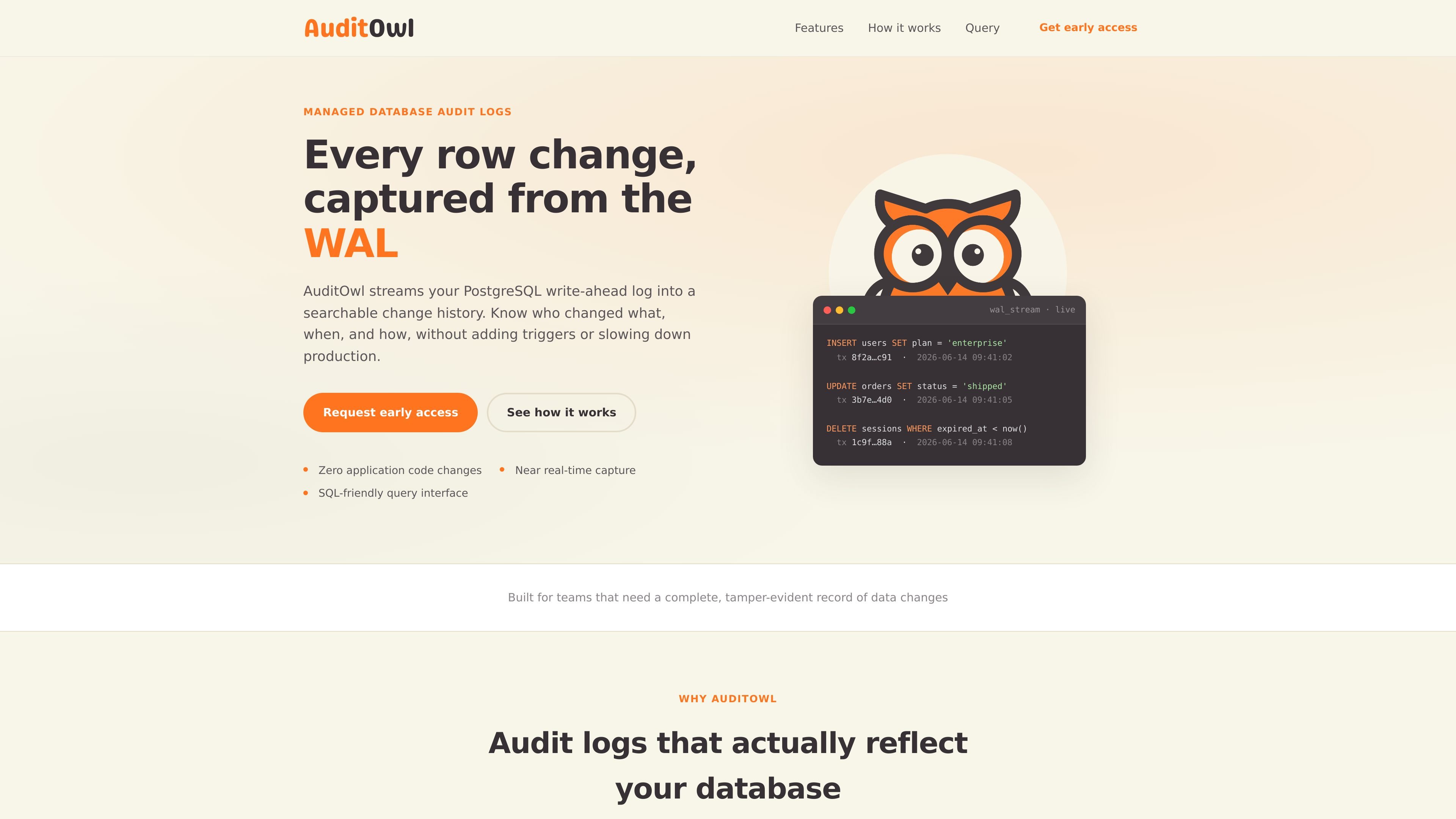
AuditOwl is a managed service for PostgreSQL that records database changes from the write-ahead log and turns them into a searchable change history. It is positioned for teams that need to review who changed what, when, and how without adding triggers or touching production writes.
The product captures inserts, updates, and deletes from the WAL, enriches them with metadata, and exposes the resulting history through a console and API. The site also emphasizes side-by-side diffs, transaction grouping, and export options for investigations, debugging, audits, and compliance work.
Stream logical replication events from PostgreSQL into a searchable change history without adding triggers, middleware hooks, or schema changes to the application database.
Filter change history by schema, table, operation, time range, or transaction, and ask audit questions against the captured data.
AuditOwl handles ingestion, storage, retention, and scaling so users can connect a database, choose what to capture, and start querying.
For updates and deletes, the product shows old and new row state so teams can reconstruct what changed and when.
Logical decoding reads the WAL asynchronously, which the site says keeps the OLTP workload fast while changes flow in near real time.
The product stores immutable, append-only change logs with retention policies for audit trails, compliance work, and investigations.
Review database history during an incident or customer support case by filtering changes to the relevant table, time range, and transaction.
Compare old and new row values for updates and deletes when reconstructing how a record reached its current state.
Use immutable change logs and retention policies to support audit trails and compliance requests such as data access reviews.
Track direct SQL, migrations, and admin scripts that application-level logging can miss, since WAL capture sees committed changes at the database layer.
AuditOwl is a managed service that records PostgreSQL database changes from the write-ahead log. The source material does not describe self-hosting or on-premises deployment options.
The setup flow shown on the site is: connect a PostgreSQL database, let AuditOwl capture changes from a logical replication slot, and then query the resulting history in the console or API.
The site says AuditOwl can be used through a console or API, and its UI is designed to filter changes by schema, table, operation, time, and transaction.
The pricing page available in the source does not show plan names, tiers, or prices. It only indicates the product is in early access and invites users to request access.

ByteAsk is a terminal-first AI coding agent for C and C++ that edits repositories and verifies changes with the real compiler, debugger, sanitizers, and tests before showing a diff. It offers a free tier plus paid plans, with editor connectors and zero-retention handling described in the source.

PromptScout tracks how ChatGPT, Gemini, Google AI Overviews, and Perplexity mention your brand or competitors, then pairs those results with source analysis and website audits. It helps teams decide what to fix in content, positioning, or site readiness next.

CreateOS Sandbox is an isolated compute environment for running code and agent workloads inside Firecracker micro-VMs. It is designed for workflows that need machine-level isolation, private networking between sandboxes, and programmatic control through SDK, CLI, or MCP.

Sleek Analytics is a privacy-friendly web analytics tool with real-time visitor tracking, Core Web Vitals, and revenue attribution. It helps site owners understand traffic and conversions without cookie banners or a heavy setup.

hob is an independent workspace for coding agents that keeps agent sessions, terminals, history, and follow-up work organized around the tools and providers you already use. It is aimed at developers who want local control over routing, history, and workspace structure rather than a bundled model stack.

Ably Chat is a chat API platform for building custom realtime chat applications. It supports room-based messaging, typing indicators, presence, reactions, and message updates, with usage-based pricing options for different deployment stages.