
Semantic paper search
Runs semantic retrieval using SPECTER2 embeddings trained for scientific papers, so queries can match papers by meaning even when the wording differs.

Cito is a semantic search service for academic papers that helps users find research by meaning, not just keywords. It also offers keyword and hybrid search, structured paper metadata, and account features for saved papers and API keys.
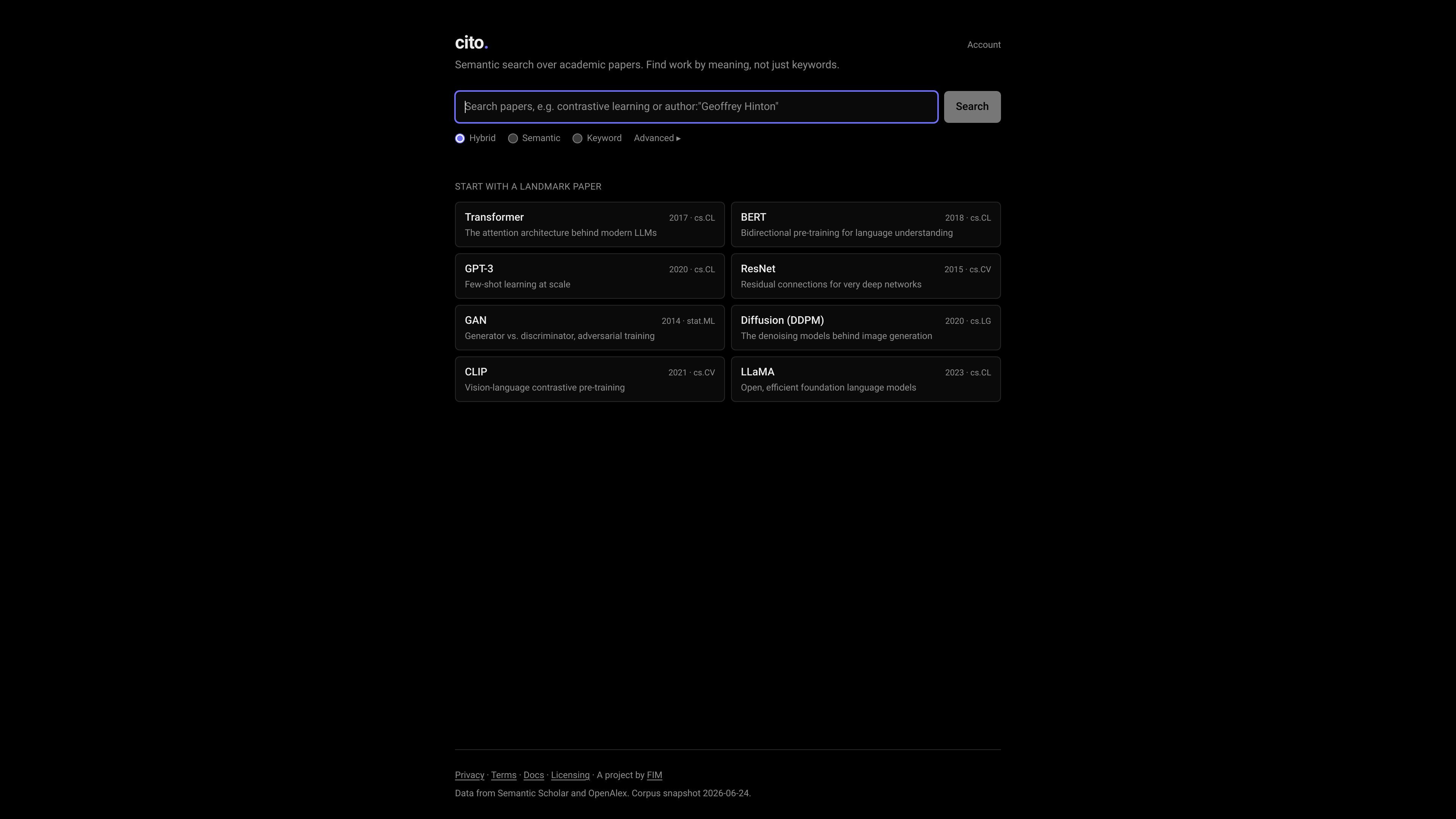
Cito is a semantic search service for academic papers. It is designed to help people find research by meaning rather than by exact keywords, and it covers a corpus of roughly 148 million papers from Semantic Scholar and OpenAlex data.
The product exposes a programmatic API and search interface that combine semantic retrieval with keyword matching. Queries can be run against Cito's own self-hosted indexes, which makes results deterministic for the same query and corpus snapshot and avoids relying on upstream API rate limits at search time.
Runs semantic retrieval using SPECTER2 embeddings trained for scientific papers, so queries can match papers by meaning even when the wording differs.
Combines classic BM25 full-text matching over titles and abstracts with semantic retrieval, then merges the rankings with reciprocal-rank fusion.
Can run either retriever on its own with mode=semantic or mode=keyword, which lets users narrow the search strategy when needed.
Searches its own self-hosted indexes rather than calling a third-party API at query time, which keeps results reproducible and avoids inherited upstream rate limits.
Returns structured paper metadata, including title, authors, venue, publication date, DOI, citation count, abstract when available, and an open-access PDF link when one exists.
Supports user accounts for saved papers, API keys, and usage viewing through GitHub sign-in or an existing API key.
Researchers can start from a landmark paper or a concept and surface related work even when the relevant papers use different terminology.
Developers can query the API from their own tools or workflows when they need programmatic access to academic search results and metadata.
Teams building research-facing products can reuse the searchable corpus and response metadata in commercial contexts, while keeping the required attribution string in republished results.
Users who need exact terms, acronyms, or author jargon can switch to keyword search, or use the hybrid mode to balance precise matching with semantic recall.
Cito is a search service for academic literature. It supports semantic search, keyword search, or a fused search mode that combines both retrievers.
The source documentation says Cito returns title, authors, venue, publication date, DOI, citation count, an abstract when available, and a direct open-access PDF link when one exists.
Yes. The licensing page says Cito can be used in commercial products, research, and publications, with the requirement to keep the attribution string that every API response carries: “Data from Semantic Scholar” when republishing results.
Cito has an account area for signing in with GitHub, saving papers, creating API keys, and viewing usage. It also says an API key can be used to view your account.
Cito does not proxy or re-host full text. PDF links point to the original publisher or repository, and access to the PDF is governed by that source's terms.

Scite ist eine KI-Forschungsplattform zum Finden von Papers, Prüfen des Zitationskontexts und für Antworten auf Basis wissenschaftlicher Literatur.

Perplexity Model Council is a multi-model research feature that runs a query across several AI models and combines the results into one answer. It is available to Perplexity Max subscribers on the web, with mobile app support coming soon.

Hype is a web tool for finding trending YouTube topics by category, time range, and scoring mode. It helps creators spot emerging ideas, inspect source videos, and decide what to cover next.

Falconer is an AI-powered company brain that keeps internal documentation accurate, searchable, and up to date by syncing with tools like GitHub, Slack, and Linear. It helps engineering and cross-functional teams centralize knowledge and answer questions from a shared source of truth.

ClayHog ist eine KI-Sichtbarkeitsplattform für die Suche, die zeigt, wie Marken in ChatGPT, Gemini, Perplexity, Claude und Google AI Overviews erscheinen.

Grok ist ein kostenloser KI-Assistent, der von xAI entwickelt wurde und darauf ausgelegt ist, Wahrheit und Objektivität zu priorisieren, während er fortschrittliche Funktionen wie Echtzeit-Informationszugriff und Bilderzeugung bietet.