
Agent connections
Connects to claude.ai over OAuth, or to Claude Code, Cursor, and Codex through MCP, so the agent can recall context inside the workflow it already uses.

ClariLayer is a context layer for AI data agents that connects to Claude Code, Cursor, Codex, or claude.ai. It keeps data definitions durable across sessions and reconciles them against source evidence instead of leaving them as unverified notes.
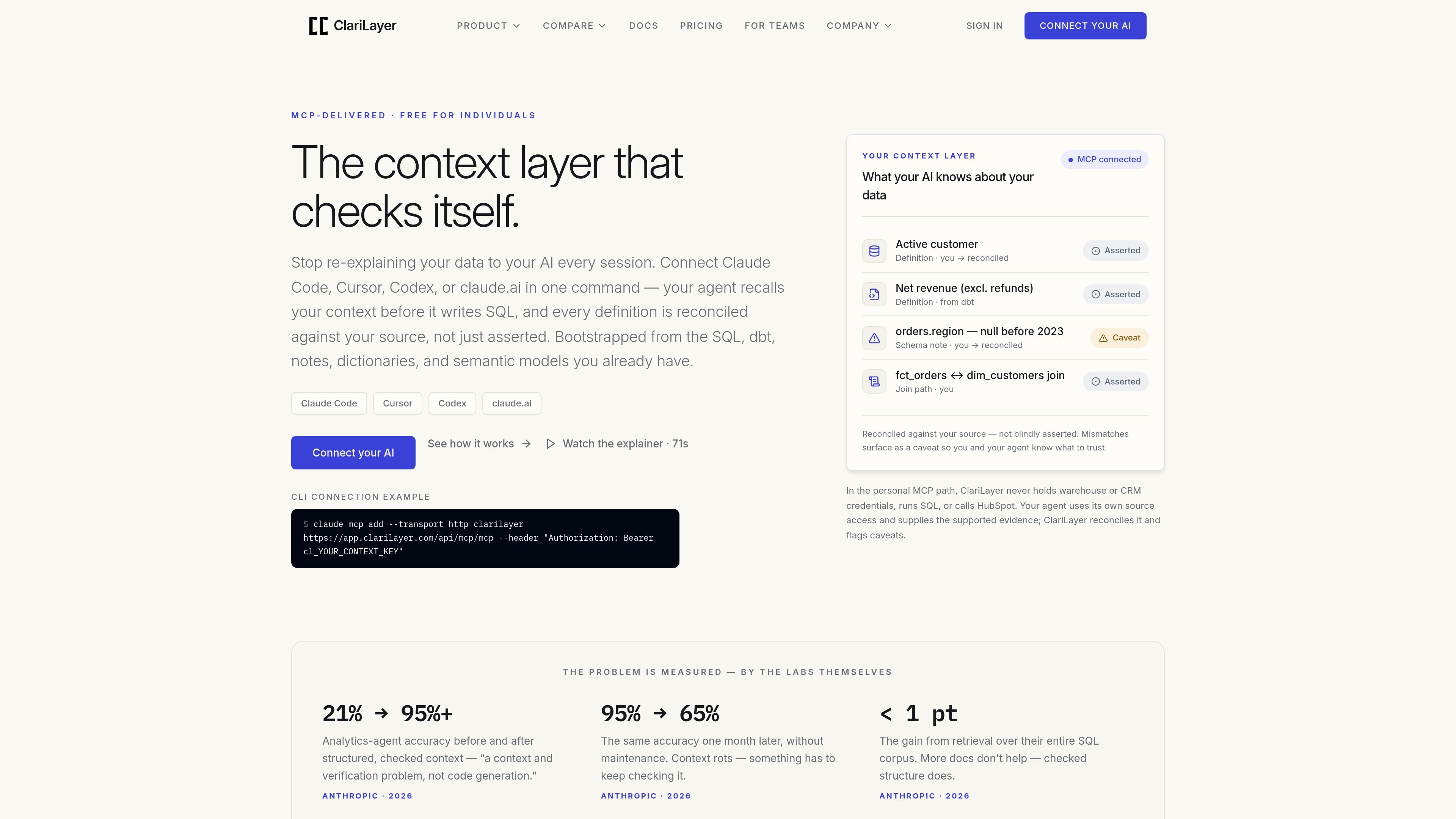
ClariLayer is a context layer for AI data agents. It connects to Claude Code, Cursor, Codex, or claude.ai and helps an agent keep durable data context across sessions instead of starting from zero each time.
The product’s core job is to preserve and check definitions such as tables, joins, and business metrics against source evidence. In the personal MCP path, ClariLayer reconciles what the agent believes with warehouse or HubSpot evidence, and a mismatch becomes a caveat rather than an unverified assertion.
The site also separates a free individual product from a team-oriented governed product. Personal use is free and unmetered, while the Governed Context Edge for teams is in private pilot with early access available by request.
Connects to claude.ai over OAuth, or to Claude Code, Cursor, and Codex through MCP, so the agent can recall context inside the workflow it already uses.
Starts from five source kinds — SQL, dbt, CLAUDE.md or notes, a data dictionary, and semantic models — so existing context can be imported instead of rebuilt manually.
Lets the agent recall saved context mid-task and remember corrections across sessions, reducing the need to re-explain table names, joins, and definitions.
Checks a saved definition against source evidence and marks disagreements as caveats instead of silent assertions, which is the central distinction from a notes file.
Records a durable completion receipt before the agent says done, so the session can leave behind a visible context declaration or explicit nothing-to-update outcome.
A solo analyst can keep a stable definition for metrics like active customers or net revenue, so the same wording does not need to be retyped into every new chat.
When a saved warehouse definition is reconciled against actual evidence, the agent can surface null handling, join-path, or row-count caveats before returning a result.
A team that is beginning to depend on shared definitions can start with the free personal layer now, then move to the governed team offering once the context becomes collaborative infrastructure.
A HubSpot workflow can store a CRM contract and reconcile it against row-free crm_evidence, giving users a way to check agreed property definitions without sending records or credentials to ClariLayer.
A user moving from a notes-only CLAUDE.md workflow can bootstrap structured context from existing files, then let later corrections persist across sessions instead of staying as unverified text.
ClariLayer connects to claude.ai over OAuth, or to Claude Code, Cursor, and Codex through an MCP connection. The source also says the personal path is free and unmetered.
The product is built for individuals who want their AI to remember and check data context across sessions. The site describes a free single-player core and a separate governed team product in private pilot.
ClariLayer supports recall, remember, bootstrap, and reconcile. In the documented reconcile flow, it checks a saved definition against warehouse actual_sample evidence or HubSpot CRM evidence and turns mismatches into caveats.
The source says ClariLayer can bootstrap from SQL, dbt, CLAUDE.md or notes, a data dictionary or codebook, and semantic models. It also says the MCP path does not require ClariLayer to hold warehouse or CRM credentials.
Yes, but the team offering is separate. The Governed Context Edge for teams is in private pilot, with early access requested directly from ClariLayer; the public pricing page says there is no public price yet.

Falconer is an AI-powered company brain that keeps internal documentation accurate, searchable, and up to date by syncing with tools like GitHub, Slack, and Linear. It helps engineering and cross-functional teams centralize knowledge and answer questions from a shared source of truth.

ByteAsk is a terminal-first AI coding agent for C and C++ that edits repositories and verifies changes with the real compiler, debugger, sanitizers, and tests before showing a diff. It offers a free tier plus paid plans, with editor connectors and zero-retention handling described in the source.

Goldfish is an AI memory app for macOS that helps you reply, write, summarize, and continue using the context already on your Mac. It stores memory locally and writes in your tone.

Lasso is an ecommerce product data platform for enriching catalog records, processing supplier files, generating product content, and monitoring competitors. It combines a web app with a REST API, SDK, and MCP server for teams and developers.

MeetStream is a meeting bot API for Zoom, Google Meet, Microsoft Teams, and Webex. It helps developers record, stream, and analyze meetings programmatically, with usage-based pricing and a $5 free credit to start.

CreateOS Sandbox is an isolated compute environment for running code and agent workloads inside Firecracker micro-VMs. It is designed for workflows that need machine-level isolation, private networking between sandboxes, and programmatic control through SDK, CLI, or MCP.