
8-pillar audit
A short diagnostic that asks about eight pillars of visibility, from search visibility to trust signals and the path from attention to enquiry.
CopyWrite’s Free Visibility Score is a no-signup, 15-minute visibility audit that gives businesses a score out of 100 and highlights issues that may be costing enquiries. It is designed to help users understand where they are being found, trusted, and chosen across the customer journey.
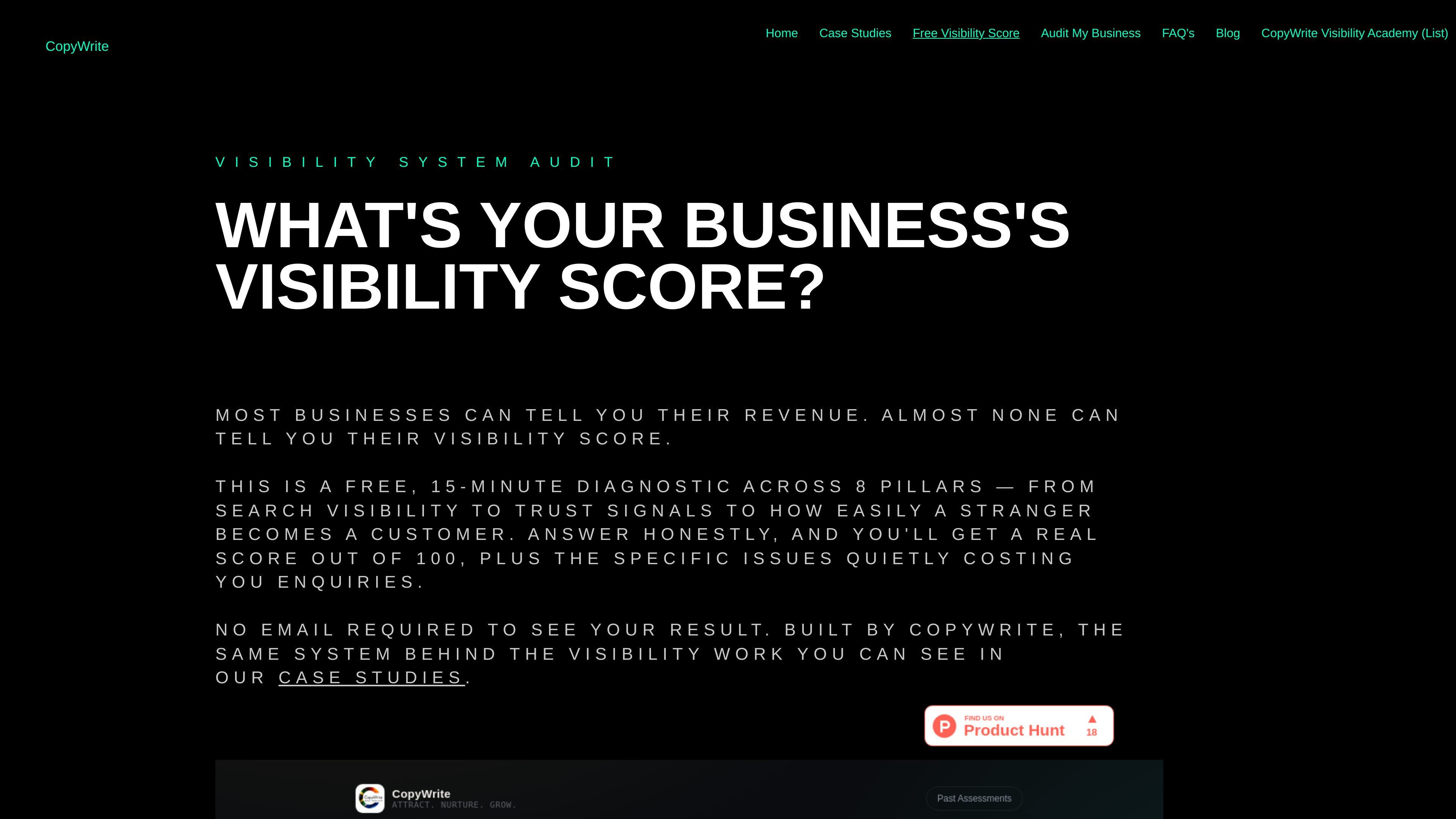
CopyWrite's Free Visibility Score is a no-signup diagnostic for businesses that want a clearer view of how visible they are across the customer journey. The page describes it as a 15-minute audit that reviews eight pillars, from search visibility and trust signals to how easily a stranger becomes a customer.
The goal is to show where a business is being found, trusted, and chosen, and where it may be losing enquiries. Users receive a score out of 100 along with specific issues that may be affecting customer flow, and the result is available without entering an email address.
The wider CopyWrite site frames this as part of a 'Visibility Infrastructure' approach: connected systems that can include Google Business Profile optimization, local SEO, website performance, content marketing, reputation management, Google Merchant Center, and WhatsApp enquiry systems. The audit appears to be the starting point for identifying which of those areas needs work first.
Case studies on the site show CopyWrite using that approach to improve audience growth, enquiry growth, and visibility foundations for different businesses. The score therefore functions as an entry point into a broader visibility review rather than a standalone marketing tool.
A short diagnostic that asks about eight pillars of visibility, from search visibility to trust signals and the path from attention to enquiry.
The result is presented as a score out of 100, giving a simple way to compare how complete a business's visibility system appears to be.
The page promises a real, personalised result based on the answers provided, rather than a generic checklist or automated summary.
The audit is designed to surface issues that may be quietly costing enquiries, so the output is oriented toward action rather than vanity metrics.
The score can be viewed without giving an email address, which lowers friction for people who want an initial check before requesting a deeper audit.
The broader site shows that CopyWrite can recommend different visibility systems after an audit, including visibility, sales, and growth-focused engagements.
A business that knows it gets some traffic or attention but is unsure where enquiries are being lost can use the score to identify weak points across search, trust, and conversion.
A local business can use the audit to check whether Google presence, local discovery, and website credibility are working together well enough to support inbound enquiries.
A company preparing for a more detailed visibility project can use the score as a low-friction first step before requesting a full system audit or scoped engagement.
A business with active social or content output can use the score to see whether attention is connecting to reporting, follow-up, and contact paths.
Teams that want a shared baseline before making changes can use the score as a quick internal diagnostic with a single numeric result and supporting issues to discuss.
CopyWrite positions the score as a 15-minute diagnostic of how a business is being found, trusted, and chosen. The result is a score out of 100 with specific issues that may be costing enquiries.
The page says no email is required to see the result. It is presented as a free audit with no signup.
The audit reviews eight pillars, including search visibility, trust signals, and the path from attention to customer. It is meant to identify what should be fixed first rather than provide a generic marketing summary.
The visibility audit looks at where customers discover, judge, and contact a business, including search visibility, customer flow, and systems gaps. The FAQs also describe CopyWrite's broader Visibility Infrastructure approach, which can include Google Business Profile optimization, local SEO, website performance, content marketing, reputation management, Google Merchant Center, and WhatsApp enquiry systems.
The source does not list fixed pricing for the score or the audit. The pricing page returns a 404, while the audit page says the right system depends on the business gap and is scoped after the audit.

PromptScout tracks how ChatGPT, Gemini, Google AI Overviews, and Perplexity mention your brand or competitors, then pairs those results with source analysis and website audits. It helps teams decide what to fix in content, positioning, or site readiness next.

ClayHog ist eine KI-Sichtbarkeitsplattform für die Suche, die zeigt, wie Marken in ChatGPT, Gemini, Perplexity, Claude und Google AI Overviews erscheinen.

beehiiv is a newsletter platform for creators, publishers, and brands that want to build, grow, and monetize email newsletters and websites from one place. It offers a free Launch plan, plus paid tiers for more advanced growth, monetization, and support features.

Skayle is a content and AI search visibility platform that researches topics before writing, publishes structured content to a CMS, and tracks whether brands are cited in AI search. It is aimed at teams that want one system for publishing, schema-rich content, and visibility monitoring.

SaveMRR is a Stripe retention tool for SaaS teams that scans billing data for churn and MRR leaks, then automates recovery through dunning, cancel-save offers, win-back emails, and onboarding nudges. It is built for founders and bootstrapped teams using Stripe.

Hype is a web tool for finding trending YouTube topics by category, time range, and scoring mode. It helps creators spot emerging ideas, inspect source videos, and decide what to cover next.