Ejentum icon

Ejentum

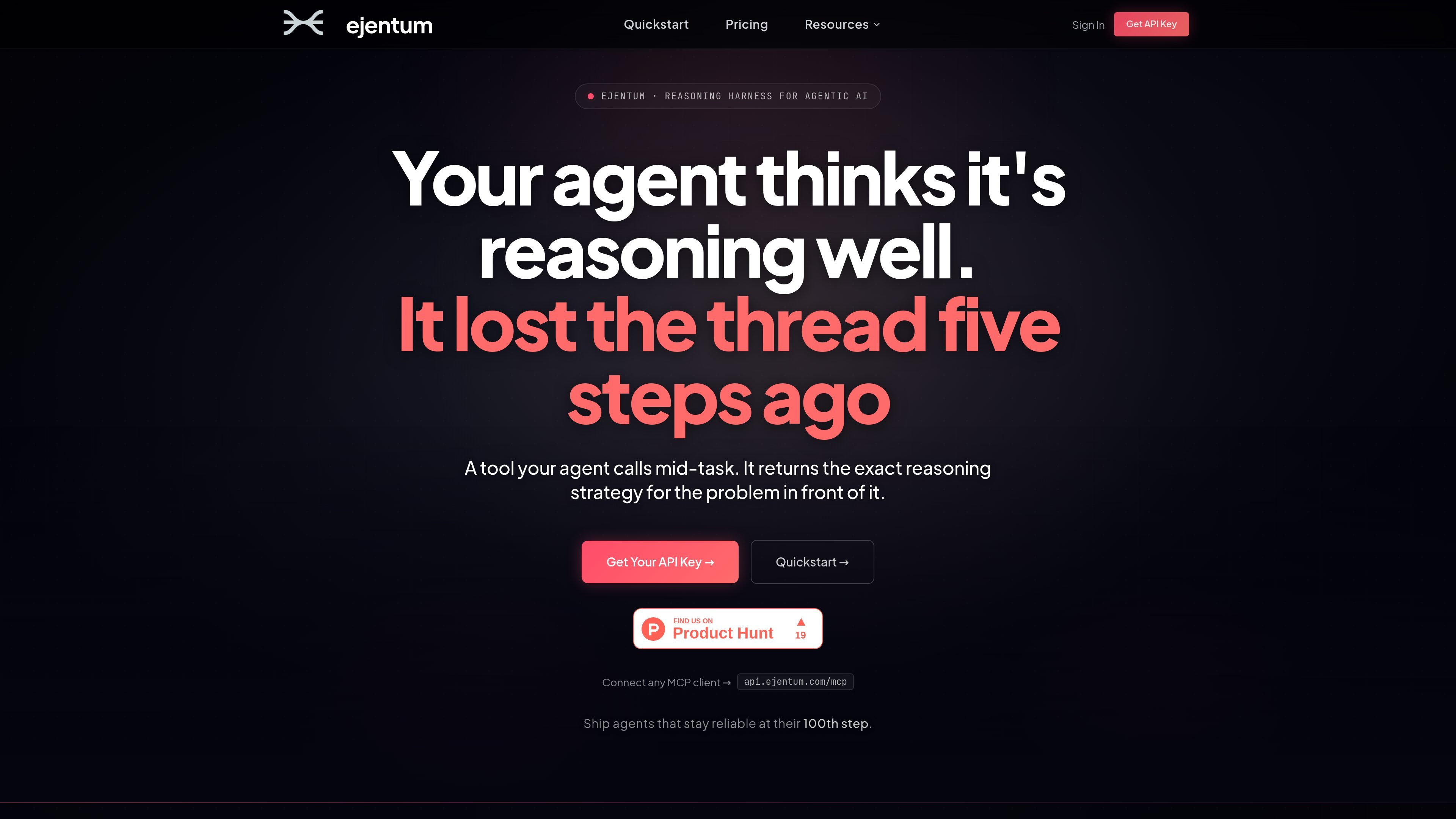
Ejentum is a reasoning harness for agentic AI that injects task-specific cognitive operations into agents at inference time. It helps teams building multi-step agents use MCP or REST to control reasoning, code, anti-deception, and memory workflows.

Ejentum

Overview

Ejentum is a reasoning harness for agentic AI: a runtime layer that your agent calls before generating output, so it can receive the discipline for the task it is about to do. The site describes it as a way to inject engineered cognitive abilities at inference time, with 679 abilities organized across four harnesses: reasoning, code, anti-deception, and memory.

The product is aimed at multi-step agent workflows where reasoning errors compound across a chain, rather than simple one-hop tasks. Ejentum’s core workflow is to retrieve a matching cognitive operation, inject it into the agent’s context, and use it to block a failure mode, follow an approach, and run a checkpoint before the agent answers or acts.

Core capabilities

Inference-time reasoning harness

Ejentum retrieves a pre-rendered cognitive operation at inference time and injects it into the agent’s context before task execution. The goal is to change how the model reasons on that specific task, not to retrain it.

Four task-specific harnesses

The platform exposes four harnesses: reasoning, code, anti-deception, and memory. Each harness is aimed at a different class of task, from causal analysis and planning to debugging, user-facing output, and long-context drift.

Structured cognitive output

Each returned operation includes a failure guard, a step-by-step approach, a reasoning structure, a target pattern, shortcuts to suppress, and a falsification check. The quickstart describes this as the discipline for the task, not just a prompt wrapper.

Dynamic and adaptive modes

Dynamic mode returns the best-fit operation as-is, while adaptive mode rewrites the procedure for the task shape and keeps the safety locks fixed. This gives users a way to choose between lower-cost reuse and more tailored reasoning.

MCP, REST, and framework-friendly access

The product is accessible through MCP or REST, and the site also references native packages or a single skill file for common agent frameworks and IDEs. That makes the harness usable across several integration styles.

Practical use cases

  • Multi-step analytical reasoning

    Use the reasoning harness when an agent needs to analyze causality, choose between alternatives, or plan across multiple steps. The runtime returns an approach and checkpoint before the agent commits to an answer.

  • Code review and debugging

    Use the code harness for review, debugging, and multi-file refactors, where the agent needs verification loops and correctness checks instead of a generic code answer.

  • Guarding user-facing responses

    Use the anti-deception harness for user-facing assistants, evaluation pipelines, or other high-stakes outputs where the model may flatter, fabricate, or validate a bad premise.

  • Long-context memory and drift tracking

    Use the memory harness in long conversations or observational workflows where context drift, people, or signal tracking matter across turns.

  • Integration into existing agent stacks

    Use MCP if the agent already speaks that protocol, or REST if you are writing the integration yourself. The site positions the harness as something that can sit inside existing agent tooling rather than replacing it.

Pros and Cons

Pros

  • Covers several agent needs with one runtime layer: reasoning, code, anti-deception, and memory.
  • Supports both MCP clients and a REST API, making it easier to fit into different agent setups.
  • Returns structured outputs that include a failure guard, an approach, shortcuts to suppress, and a falsification check.
  • Offers a free trial with no credit card required, which lets teams test behavior before paying.

Cons

  • The product scope is intentionally narrow; the founder notes it is not a fit for single-step classifiers, simple RAG lookups, or other tasks that already converge in one hop.
  • Adaptive mode uses more compute per call, so it has a separate monthly pool and is not included in the free trial.

FAQ

What does Ejentum return in practice?

Ejentum provides a runtime reasoning harness that your agent calls before generating output. The harness returns a cognitive operation with a failure mode to block, an approach to follow, a checkpoint, and shortcuts to suppress.

How do you integrate it?

The quickstart shows two ways to use it: MCP for clients that already speak MCP, and a REST API for agents you write yourself. For MCP, point a client such as Claude Code, Cursor, or Windsurf at `api.ejentum.com/mcp`; for REST, send JSON to `api.ejentum.com/harness/` with bearer authentication.

Which harness should I use?

The source supports four harnesses: reasoning, code, anti-deception, and memory. The quickstart says reasoning is for analytical tasks, code for review and debugging, anti-deception for user-facing or high-stakes outputs, and memory for long conversations and context drift.

What is the difference between dynamic and adaptive modes?

Dynamic returns the best-fit operation as-is. Adaptive retrieves the same operation and rewrites the approach for the specific task shape, while keeping the safety pieces fixed. The pricing page and quickstart both note that adaptive uses more compute and has its own pool.

Is there a trial and how does billing work?

The pricing page states that the free trial lasts one month, includes 1,000 dynamic calls, does not require a credit card, and excludes adaptive modes. Paid plans add adaptive calls and use 30-day rolling pools.

Quick Facts

Category
Developer tool / AI agent infrastructure
Product type
Reasoning harness for agentic AI
Primary users
Teams building multi-step AI agents
Integration surface
MCP and REST API
Domain
ejentum.com
Plan structure
Free trial plus Go and Super paid plans

Ejentum Alternativen