
Source-linked research
Each idea includes the original threads, reviews, posts, or other public signals that surfaced demand so readers can inspect the evidence instead of relying on a summary alone.

Eureka DB is a startup idea database built from real public frustration, with sourced research, competitor context, build kits, and some working demos. It is aimed at founders who want to evaluate opportunities before committing time or code.
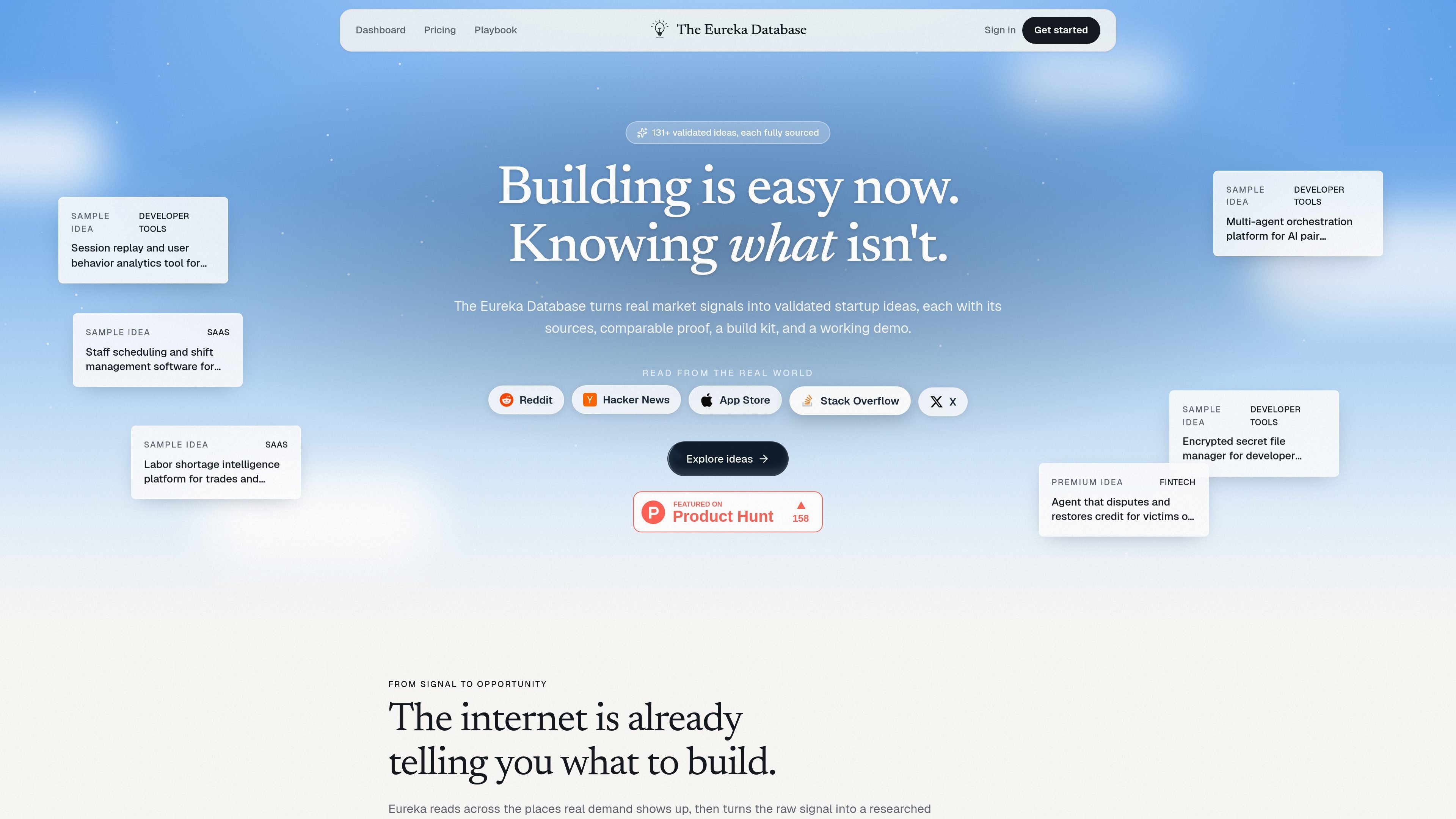
Eureka DB is a curated database of startup ideas drawn from real public frustration across places like Reddit, Hacker News, app reviews, job posts, and other market signals. The site says each idea is researched by a person before it ships, then packaged with sources, comparable evidence, and a plan for how to build it.
The product is designed for founders who want to evaluate opportunities before writing code. Instead of presenting raw mentions or generic idea lists, it organizes each opportunity around the problem signal, the people affected, alternatives already in market, and the next steps needed to turn the idea into an MVP.
Each idea includes the original threads, reviews, posts, or other public signals that surfaced demand so readers can inspect the evidence instead of relying on a summary alone.
Ideas are paired with adjacent market context such as competitor pricing, existing alternatives, and whether comparable businesses already make money.
Many ideas include a build kit with prompts, stack, services, and a build order so a founder can move from research to a first version more quickly.
Some ideas ship with a clickable prototype or demo so the concept can be evaluated before any build work starts.
The database includes a shared workspace per idea with tasks, notes, GitHub activity, team roles, and Claude Code build sessions.
Eureka DB also includes a lifetime investor database with verified contacts, plus co-founder matching and other tools that are added as they ship.
Browse ranked ideas when you want to move from vague curiosity to a concrete opportunity that already has evidence attached. The ideas page encourages you to judge conviction, capability, and intention before saving or building.
Open an idea and review the source threads, competitor landscape, pricing context, and revenue validation before committing time or money. This is useful when you want to pressure-test whether a niche has real demand and an apparent wedge.
Use the build kit, workspace, and Claude Code handoff materials to go from research to an MVP plan with tasks, notes, GitHub activity, and build sessions in one place.
Review the investor database if you are ready to start outreach and want early-stage investors filtered by firm, focus, stage, average check, and geography.
Look for other members who saved the same ideas if you want a co-founder with aligned conviction on the problem and product direction.
Eureka DB is a subscription-style membership with lifetime access to the database and the tools included with it. The pricing page says new ideas and features are added over time, and your access never expires.
The product is built around validated startup ideas that include sources, comparable businesses, and a build kit. Some ideas also include a working demo.
The database is intended for founders who want to evaluate startup opportunities using evidence rather than starting from a blank page. The ideas page says you should still use your own judgment around conviction, capability, and intention.
The site says the ideas are validated from real public frustration and backed by evidence, but it also states that proof is not a guarantee. It is a head start, not a promise that an idea will make money.
Yes. The pricing page says two ideas are open to read in full with no account needed, and the home page says several ideas are open with demos.

Goldfish is an AI memory app for macOS that helps you reply, write, summarize, and continue using the context already on your Mac. It stores memory locally and writes in your tone.

Lasso is an ecommerce product data platform for enriching catalog records, processing supplier files, generating product content, and monitoring competitors. It combines a web app with a REST API, SDK, and MCP server for teams and developers.

Hype is a web tool for finding trending YouTube topics by category, time range, and scoring mode. It helps creators spot emerging ideas, inspect source videos, and decide what to cover next.

ArtDeck is a visual reference board app for iPhone, iPad, and Mac that lets artists collect mixed reference material on one canvas and study it with ToolBox lenses. It works offline, supports optional iCloud sync, and is sold as a one-time purchase with no account required.

Struere is an AI-native platform for turning spreadsheet data into structured operational software with dashboards, alerts, and automations. It is aimed at teams that want to replace manual spreadsheet workflows without building custom tools from scratch.

garden-md is an open-source Node.js CLI that turns meeting transcripts into a local company wiki. It links entities across transcripts, keeps the original text intact, and renders the result as a browsable wiki.