
Agentic workflow execution
M3.1 Flash is built for multi-step planning, chained tool calls, and end-to-end execution across enterprise SaaS workflows, including sales, marketing, operations, customer service, finance, and HR scenarios.

MiniMax M3.1 Flash is a language model for multi-step agents, coding, computer use, enterprise workflow automation, and cybersecurity. Developers can access it through the MiniMax API, M Plan, and MiniMax Code, with token-based pricing for input, output, and cached input.
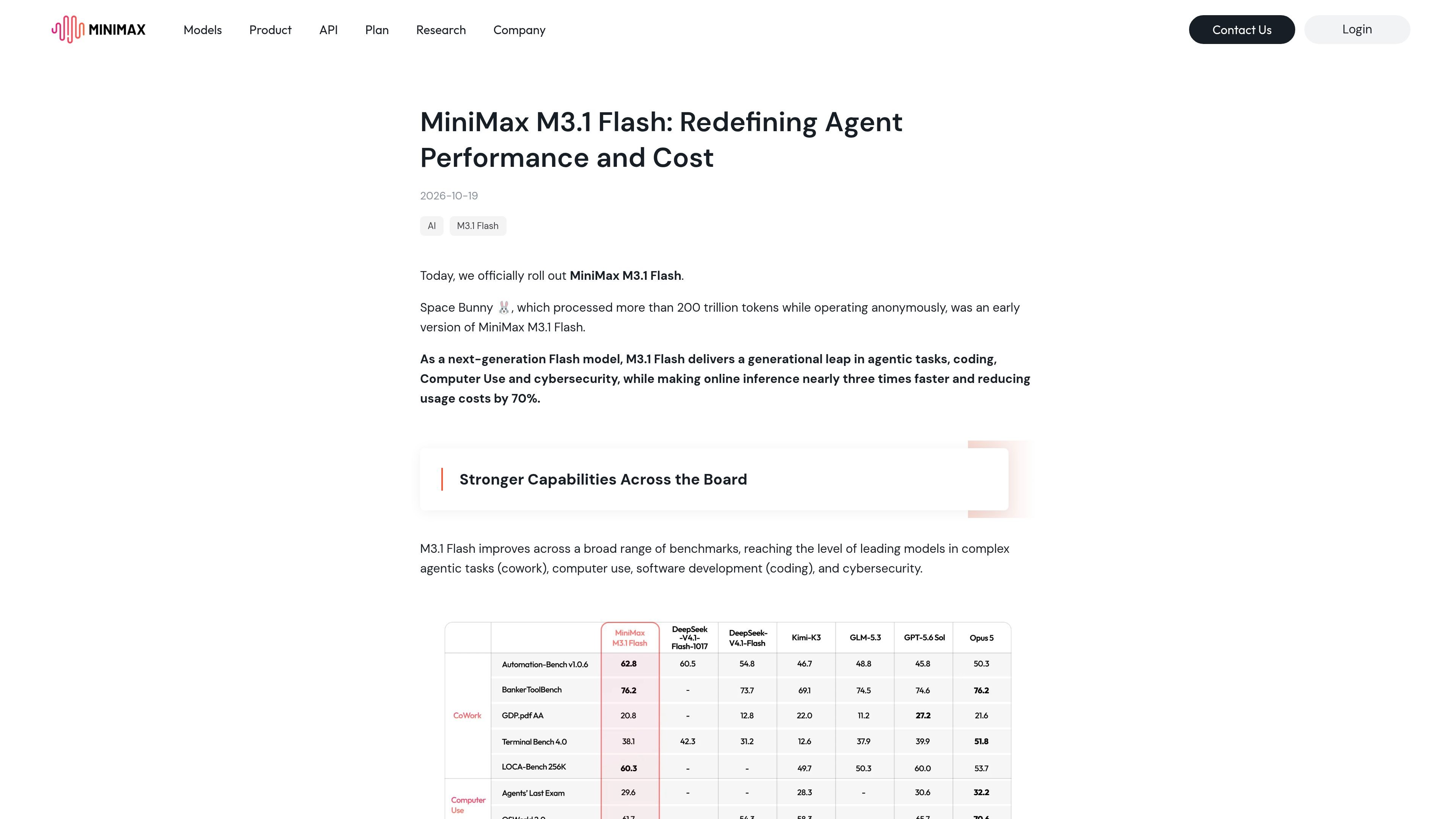
MiniMax M3.1 Flash is a language model focused on agentic tasks, coding, computer use, and cybersecurity. It is designed to move beyond generating responses by planning across multiple steps, invoking tools, operating in software environments, and completing workflows that require sustained execution.
The model is intended for developers and teams building AI agents, coding assistants, automation systems, and security workflows. It is available through the MiniMax API, M Plan, and MiniMax Code, with published pricing based on input, output, and cached-input token usage. MiniMax reports a 70% lower overall usage cost for agentic tasks than its predecessor, while the pricing page lists the current per-token rates.
M3.1 Flash is built for multi-step planning, chained tool calls, and end-to-end execution across enterprise SaaS workflows, including sales, marketing, operations, customer service, finance, and HR scenarios.
The model supports complex software tasks that involve understanding code, implementing features, fixing issues, and validating changes through testing. MiniMax reports a 73.7% score on DeepSWE v1.1.
It is evaluated on cross-application computer operation and professional work tasks, with reported scores of 61.7 on OSWorld V2 and 29.6 on Agents’ Last Exam.
M3.1 Flash is positioned for vulnerability discovery and validation, code auditing, vulnerability patching, penetration testing, malware analysis, and reverse engineering. MiniMax reports an 82% CyberGym score.
The model is optimized for inference efficiency through increased sparsity. The source reports everyday output speeds above 200 tokens per second and median speeds above 170 tokens per second.
The listed rates are $0.15 per 1 million input tokens, $0.60 per 1 million output tokens, and $0.015 per 1 million cached input tokens, making token usage straightforward to estimate.
Automate multi-step work across SaaS applications, such as coordinating records and documents across sales, marketing, operations, customer service, finance, or HR workflows. The model is intended to maintain task consistency while making chained tool calls.
Use the model as a coding assistant for feature development, bug fixing, repository understanding, and test-based validation. Its reported DeepSWE result relates to software tasks requiring independent execution over multiple steps.
Build agents that interact with desktop or web applications across multiple interfaces rather than stopping at text instructions. This fits workflows where the agent must operate software and produce a completed result.
Support security teams with code review and vulnerability-oriented workflows, including discovery, patching, penetration testing, malware analysis, and reverse engineering.
Run high-volume agent workloads where response throughput and token cost materially affect operating expense. The published pricing and speed figures are relevant when estimating repeated or long-running tasks.
MiniMax M3.1 Flash is available through the MiniMax API, M Plan, and MiniMax Code. The source states that model weights will be released later, so downloadable weights are not currently documented as available.
It is designed for agentic workflows that require planning, tool use, multi-step execution, coding, computer interaction, or cybersecurity-related analysis. The source does not provide a complete compatibility list for external tools or integrations.
The published API rates are $0.15 per 1 million input tokens, $0.60 per 1 million output tokens, and $0.015 per 1 million cached input tokens. The pricing page identifies these as the listed MiniMax-M3.1-Flash rates; actual billing is based on token consumption.
MiniMax reports everyday output speeds of more than 200 tokens per second in some usage and median speeds above 170 tokens per second. The source does not guarantee a fixed response speed for every request or workload.