
Repository integrations
Connect GitHub, GitLab, Bitbucket, or Gitea so Octopus can monitor repositories and review new pull requests automatically.

Octopus is an AI code review tool that reviews pull requests with repository context, posts severity-rated findings, and supports GitHub, GitLab, Bitbucket, and self-hosted workflows.
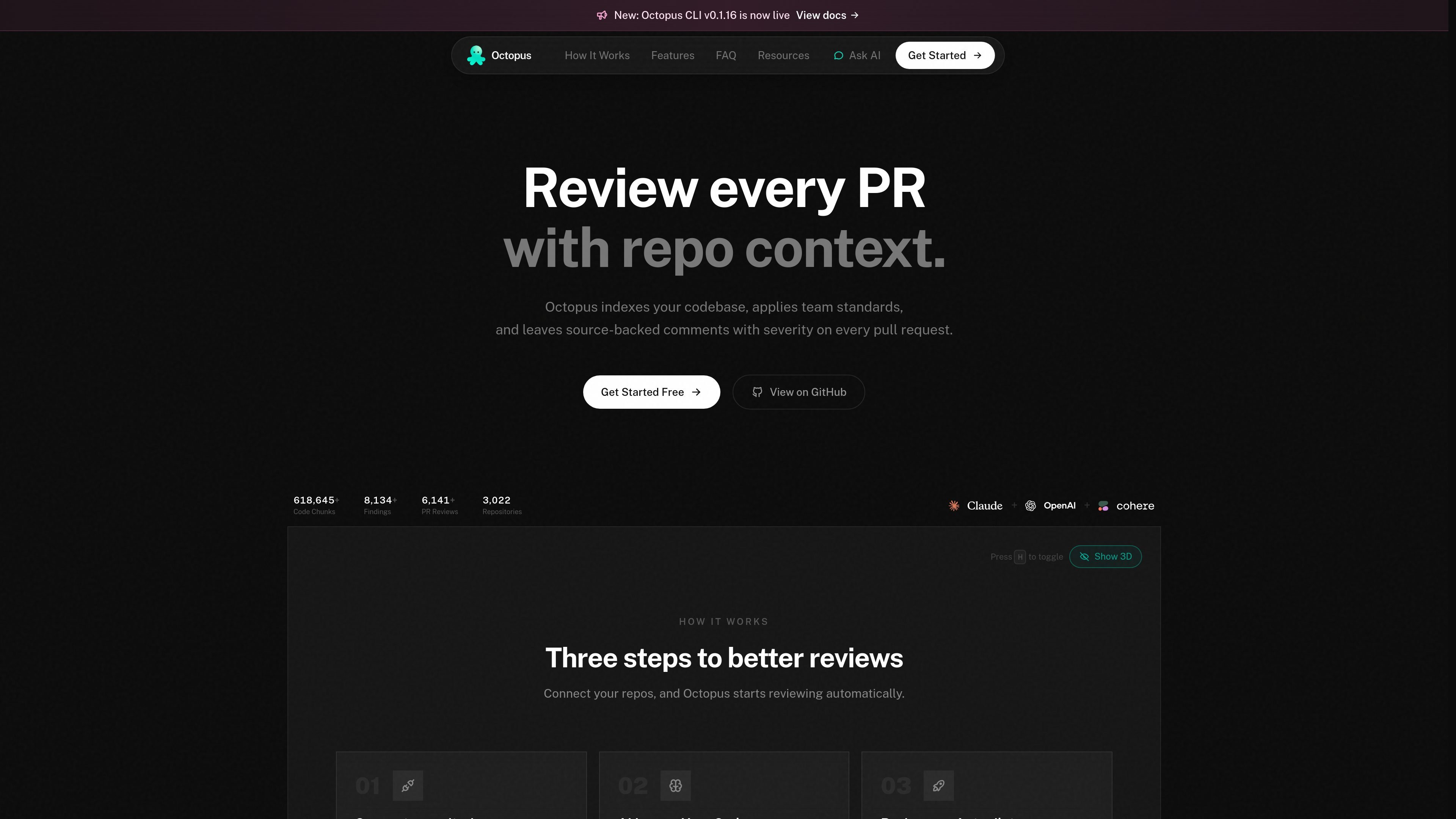
Octopus is an AI code review tool that reviews pull requests with repository context. It connects to source control providers, indexes your codebase, and posts source-backed findings directly on pull requests so teams can catch bugs before merge.
The product is designed for both hosted and self-hosted use. It supports automatic PR review, CLI-based workflows, and a knowledge base for organization-specific rules and documents, giving teams a way to apply the same review guidance across repositories.
Connect GitHub, GitLab, Bitbucket, or Gitea so Octopus can monitor repositories and review new pull requests automatically.
Index the codebase so reviews use repo-specific context instead of only the pull request diff.
Retrieve relevant files and snippets with vector search and use that context during review and chat.
Leave inline review comments with severity labels such as Critical, Major, Minor, Suggestion, and Tip.
Use the CLI to review PRs, inspect repository status, chat with the codebase, manage knowledge documents, and trigger dependency analysis.
Add knowledge-base documents and team standards so reviews can follow shared guidance across repositories.
Automatically review each incoming pull request with codebase context and severity-marked findings before the change is merged.
Run Octopus from the terminal to review a pull request, inspect repository status, or ask questions about the codebase without leaving the shell.
Give teams a shared set of review rules and knowledge documents so feedback stays aligned across repositories and reviewers.
Use the open-source or self-hosted deployment path when code needs to stay on your own infrastructure.
Apply the open-source program to public, OSI-licensed repositories that want unlimited PR reviews with no monthly quota.
Octopus is an AI-powered code review tool that connects to GitHub and Bitbucket, indexes your codebase for context, and automatically reviews pull requests by posting inline findings with severity levels.
When a pull request is opened, Octopus fetches the diff, retrieves relevant context from the indexed codebase using vector search, and sends it to an LLM for analysis. The findings are posted directly on the PR as inline comments with severities such as Critical, Major, Minor, Suggestion, and Tip.
Octopus is language-agnostic and can review any text-based code file, including TypeScript, Python, Go, Rust, Java, C#, Ruby, PHP, Swift, Kotlin, and more.
No. Octopus is meant to augment human reviewers by surfacing bugs, security issues, and style inconsistencies so people can focus on architecture, design decisions, and business logic.
Yes. Octopus can be self-hosted on your own infrastructure, and source code is processed in memory rather than stored permanently. Only vector embeddings are persisted for search.

Skills Janitor is a GitHub-hosted set of slash commands for auditing, tracking, and managing Claude Code and OpenAI Codex skills. It helps users find duplicates, broken links, and unused skills, then clean them up with self-contained commands.

ByteAsk is a terminal-first AI coding agent for C and C++ that edits repositories and verifies changes with the real compiler, debugger, sanitizers, and tests before showing a diff. It offers a free tier plus paid plans, with editor connectors and zero-retention handling described in the source.

ClawTick is an AI agent automation platform for scheduling jobs from the CLI, dashboard, or REST API. It is aimed at developers and teams running LangChain, CrewAI, webhook, or custom agent workflows that need monitoring, alerts, and logs.

Falconer is an AI-powered company brain that keeps internal documentation accurate, searchable, and up to date by syncing with tools like GitHub, Slack, and Linear. It helps engineering and cross-functional teams centralize knowledge and answer questions from a shared source of truth.

Ghost ist ein terminalbasierter KI-Assistent für Chats, Code-Generierung und Aufgaben direkt in der Kommandozeile. Mit kostenlosen Modellen, Linux, macOS und Windows. Open Source.
OpenFlags is an open-source, self-hosted feature flag platform for modern JavaScript teams. It supports local evaluation, targeted rollouts, and controlled launches while keeping flag data in your own infrastructure.