
AI inventory and discovery
Create a current inventory of AI activity across the company, including tools, agents, workflows, prompts, MCP servers, data sources, and ownership.

Proxon is an AI workforce management platform that helps organizations discover AI activity, assign ownership, attribute spend, and measure outcomes. It is aimed at companies that need a shared view of AI usage, risk, and value across teams.
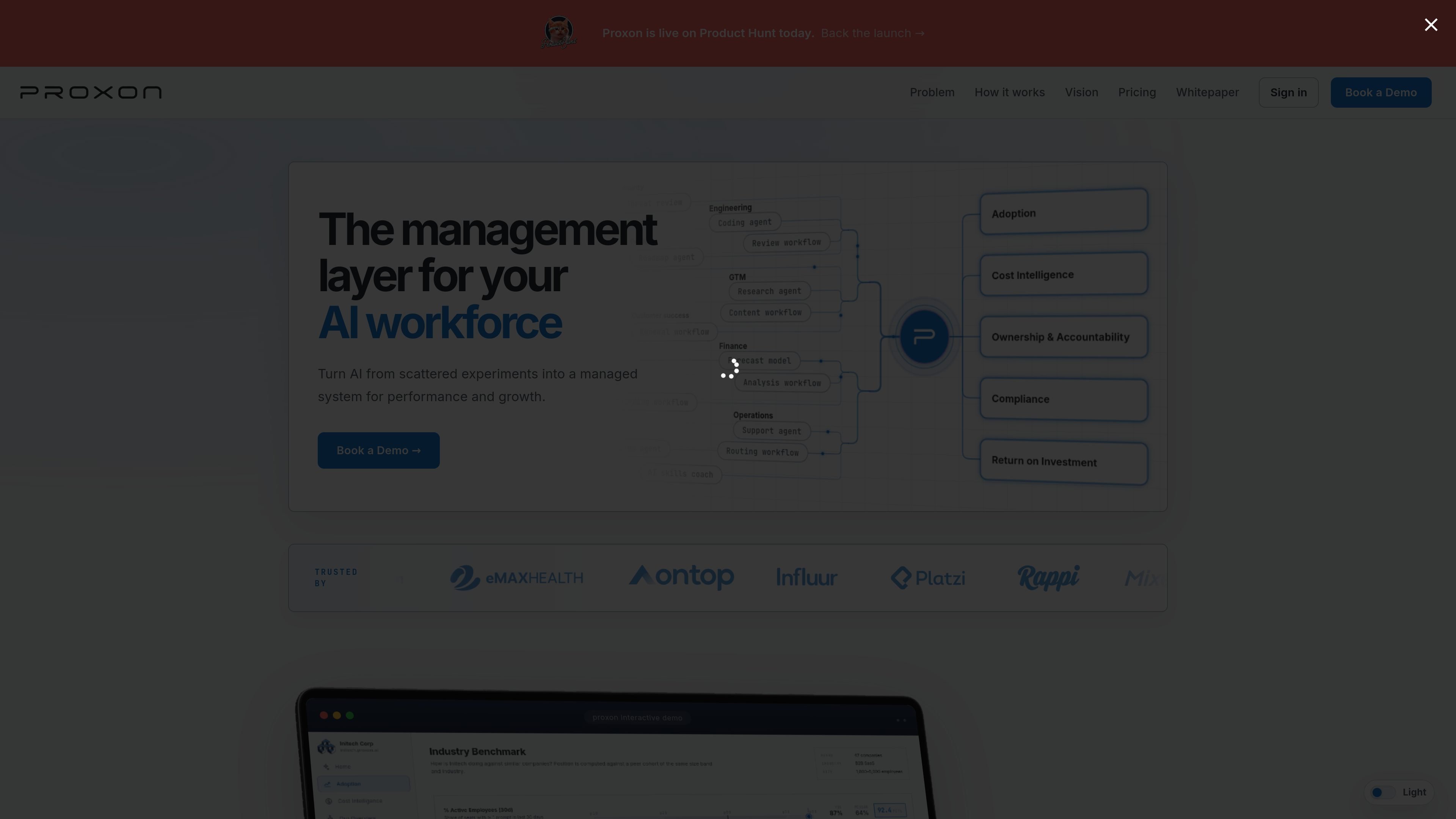
Proxon is a management layer for an AI workforce. It is designed to help companies turn scattered AI usage into a shared operating record for discovery, ownership, spend, policy, and growth.
The product focuses on five connected jobs: discovering AI systems already in use, governing them with ownership and review, attributing spend to the work behind it, measuring adoption and outcomes, and propagating effective workflows to more teams. The site positions it for organizations where AI is already spreading across functions and leadership needs a clearer view of what exists and how it performs.
Create a current inventory of AI activity across the company, including tools, agents, workflows, prompts, MCP servers, data sources, and ownership.
Assign each AI workflow a team, owner, budget, review cadence, policy surface, and business context so responsibility stays attached to the work.
Attribute AI spend to vendors, models, teams, workflows, and owners instead of leaving costs at the invoice or token level.
Connect AI activity to business outcomes and review whether adoption, performance, or results are improving over time.
Detect patterns that are working and help propagate them to similar teams or workflows across the organization.
Provide configurable collection through integrations plus proxy, browser, and desktop signals, with support for policy context and shadow AI visibility.
Leadership can build an inventory of AI tools, agents, workflows, and data sources so the company has one shared view of what is already running.
Finance and operations teams can connect spend to teams, workflows, owners, and business processes to understand what AI budget is actually buying.
Security and legal teams can review ownership, policy, collection scope, retention, and control boundaries before rollout or expansion.
Enablement and functional leaders can spot high-performing workflows, measure adoption, and help stronger patterns spread to similar teams.
Managers can review alerts about overrun spend, shadow connectors, low ownership coverage, or partial rollout and decide what to tune, contain, or expand.
Proxon is a management layer for an AI workforce. It maps the AI systems running across a company, assigns ownership and policy, ties spend to teams and outcomes, and helps effective workflows spread.
It uses integrations together with configurable proxy, browser, and desktop collection. Those signals are normalized into an inventory of approved and shadow AI activity, including systems, users, teams, workflows, costs, and policy context.
No. Proxon is designed to work across the tools and models your teams already use. It provides a company-wide management layer while technical observability tools can continue tracing individual model calls.
The site says deployment scope can be configured and may include AI tools, agents, prompts, workflows, costs, policies, and outcomes. It also states that Proxon uses TLS in transit, encryption at rest where supported, tenant isolation, role-based access, and least-privilege controls.
Proxon is built for AI-forward organizations with 10 to 5,000 employees. The pricing page includes Free, Startup, Scaling, and Enterprise plans, with Enterprise covering custom integrations, SSO/SAML, advanced controls, and dedicated support.

Struere is an AI-native platform for turning spreadsheet data into structured operational software with dashboards, alerts, and automations. It is aimed at teams that want to replace manual spreadsheet workflows without building custom tools from scratch.

Dcyde is a decision log for product teams that captures what was decided, the reasoning behind it, and the source in one shared place. It supports pinning decisions from Slack, Figma, or inside Dcyde and keeps the record searchable over time.

runevr is a connected workspace for creative teams that combines boards, media review, chat, recordings, drive, calls, and AI agents in one room-based environment. It is designed to reduce tool switching and keep project context together.

PromptScout tracks how ChatGPT, Gemini, Google AI Overviews, and Perplexity mention your brand or competitors, then pairs those results with source analysis and website audits. It helps teams decide what to fix in content, positioning, or site readiness next.

Goldfish is an AI memory app for macOS that helps you reply, write, summarize, and continue using the context already on your Mac. It stores memory locally and writes in your tone.

Lasso is an ecommerce product data platform for enriching catalog records, processing supplier files, generating product content, and monitoring competitors. It combines a web app with a REST API, SDK, and MCP server for teams and developers.