
Fully anonymous visitor counting
Trailsense detects anonymous WiFi signals from nearby devices and converts them into aggregated visitor counts instead of identifying individual visitors.

Trailsense is a privacy-friendly visitor counting system for trails and remote outdoor areas. It helps municipalities, tourism teams, and land managers measure usage without cameras or personal data collection.
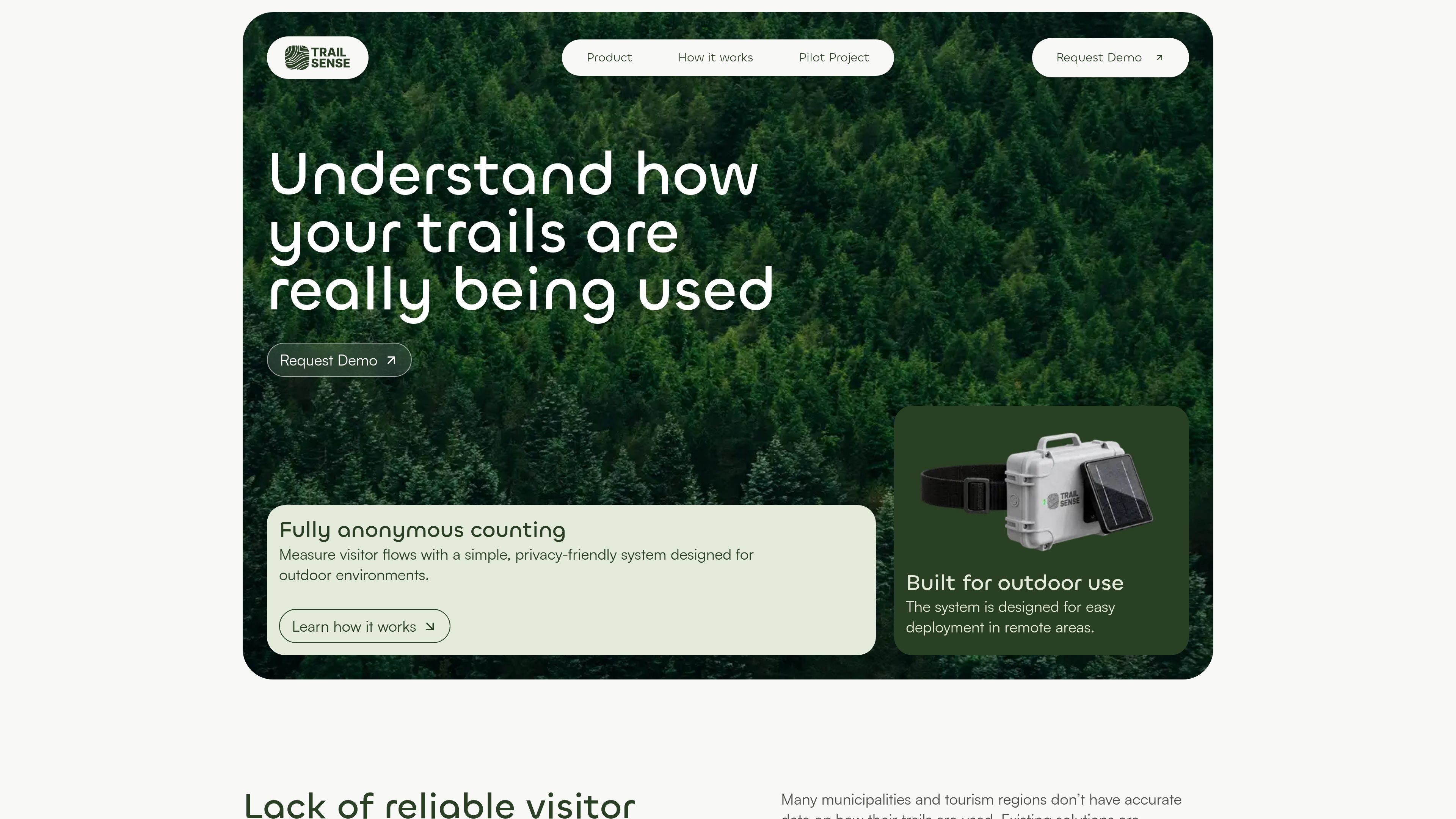
Trailsense is a privacy-friendly visitor counting system for trails and remote outdoor areas. It is built to measure how trails are used without cameras, images, or personal data collection.
According to the site, the system uses small sensor nodes to detect anonymous WiFi signals, process them on device, and transmit aggregated counts to a dashboard. That makes it suitable for municipalities, tourism regions, and other teams that need clearer trail usage data without deploying camera-based monitoring.
Trailsense detects anonymous WiFi signals from nearby devices and converts them into aggregated visitor counts instead of identifying individual visitors.
The system processes data directly on the sensor node and sends only aggregated counts onward, which keeps the workflow lightweight and privacy-focused.
Small sensor nodes are designed for off-grid use, making them suitable for trails and remote outdoor locations without existing infrastructure.
The dashboard presents daily and hourly trends so teams can review how a trail is used over time.
The site describes the setup as scalable, allowing one location to be expanded to multiple trails as needs grow.
Municipalities and local authorities can use Trailsense to replace guesswork with usage data when planning trail investments, maintenance, or access management.
Tourism teams can look at daily and hourly trends to identify busy periods, peak arrivals, and sections that may need visitor guidance.
Operators concerned about crowding can use aggregated counts to spot heavily used areas and react earlier to pressure on popular routes.
Teams responsible for natural areas can monitor usage patterns to understand where visitor pressure may be affecting sensitive environments.
Because the system is built for remote areas and off-grid deployment, it fits trails where power or network access is limited.
Trailsense is set up with small outdoor sensor nodes that detect anonymous WiFi signals, process the data on device, and send only aggregated counts to a dashboard.
The homepage says the system is designed for easy deployment in remote areas and for locations without existing power or network infrastructure.
The site states that Trailsense does not use cameras or visual recording and does not collect personal data. It detects wireless signals that devices send out anyway and converts them into aggregated visitor counts.
The rendered homepage shows a call to request a demo or get in touch for a tailored setup. A pricing page was not available from the provided source.

PromptScout tracks how ChatGPT, Gemini, Google AI Overviews, and Perplexity mention your brand or competitors, then pairs those results with source analysis and website audits. It helps teams decide what to fix in content, positioning, or site readiness next.

SaveMRR is a Stripe retention tool for SaaS teams that scans billing data for churn and MRR leaks, then automates recovery through dunning, cancel-save offers, win-back emails, and onboarding nudges. It is built for founders and bootstrapped teams using Stripe.

Hype is a web tool for finding trending YouTube topics by category, time range, and scoring mode. It helps creators spot emerging ideas, inspect source videos, and decide what to cover next.

Sleek Analytics is a privacy-friendly web analytics tool with real-time visitor tracking, Core Web Vitals, and revenue attribution. It helps site owners understand traffic and conversions without cookie banners or a heavy setup.

Struere is an AI-native platform for turning spreadsheet data into structured operational software with dashboards, alerts, and automations. It is aimed at teams that want to replace manual spreadsheet workflows without building custom tools from scratch.

ClayHog ist eine KI-Sichtbarkeitsplattform für die Suche, die zeigt, wie Marken in ChatGPT, Gemini, Perplexity, Claude und Google AI Overviews erscheinen.