
Server-side pre-filters
Every query written by an AI agent or a person is filtered on the server before it reaches the database.

Upsolve is an AI analytics platform with server-side row-level security for data agents. It helps teams deploy governed, multi-tenant analytics by applying user- and organization-based filters before queries reach the database.
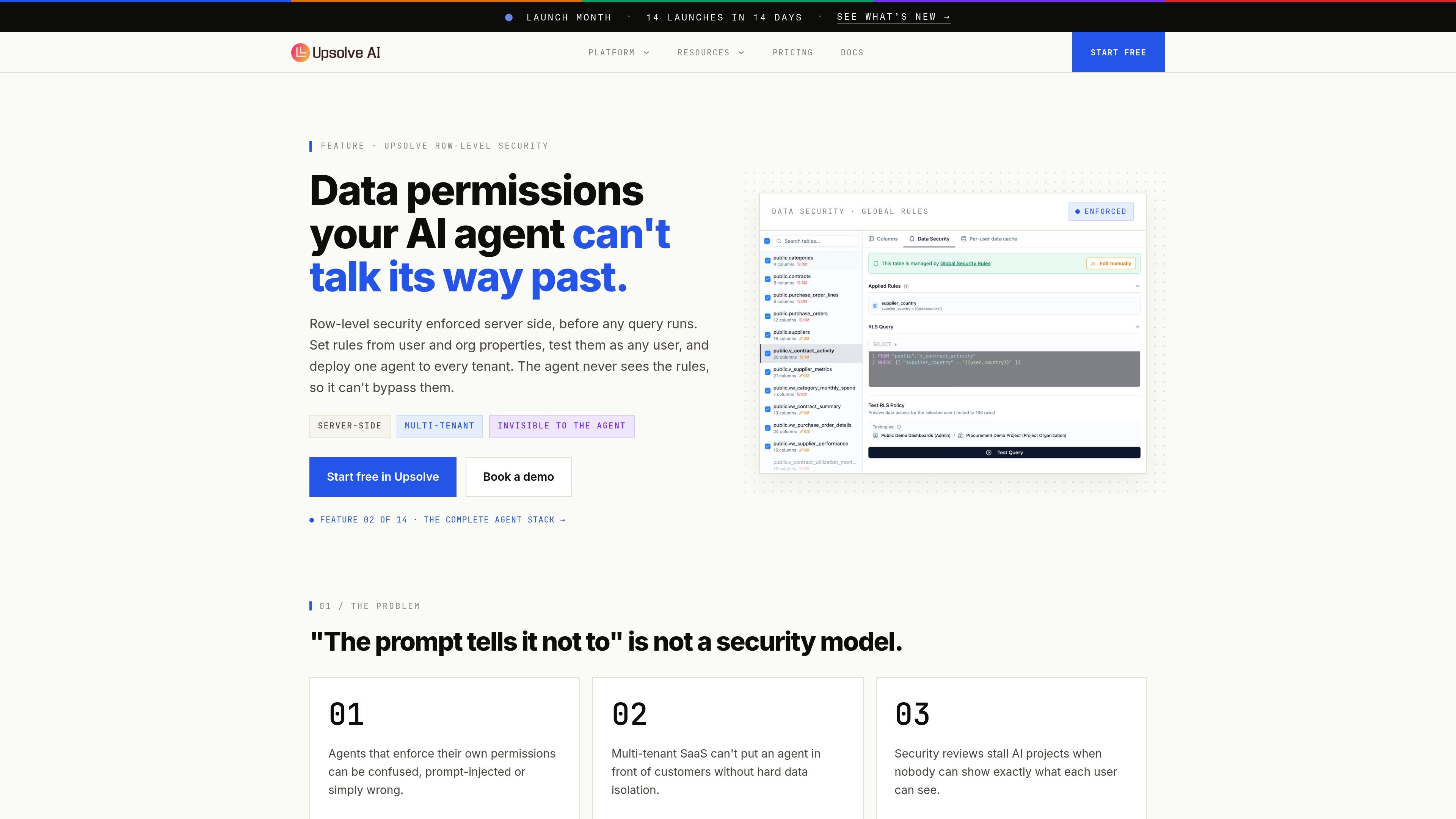
Upsolve is an AI analytics platform that provides server-side row-level security for data agents. It applies access rules before a query runs, so an agent can answer questions from governed warehouse data without receiving the rules themselves or relying on a prompt to enforce tenant boundaries.
Teams define organization and user properties, such as tenant, country, or role, and use them in global or custom SQL rules. Upsolve can test queries as different users and show the resulting WHERE clause. The feature is intended for multi-tenant deployments where one agent must serve multiple customers while each viewer sees only permitted rows.
Every query written by an AI agent or a person is filtered on the server before it reaches the database.
Rules remain outside the agent's context, separating deterministic access control from prompt-driven behavior.
Register organizations and users with properties such as tenant, country, or role, then apply those properties across relevant tables.
Use reusable global rules for matching fields and custom SQL rules when access logic requires a more complex relationship.
Preview any query as any user and inspect the exact WHERE clause Upsolve will apply before execution.
Choose whether a missing user property skips a rule or blocks the data, and use the same agent across multiple tenants.
Deploy one analytics agent for multiple customer organizations while using tenant properties to ensure each customer receives only its own rows.
Give account managers or internal teams shared canvases whose live views re-run under each viewer's permissions instead of exposing the creator's full result set.
Let users ask natural-language questions over governed warehouse data while keeping access enforcement independent of the agent's prompt and reasoning.
Validate security behavior during implementation or review by impersonating different users and checking the exact SQL predicate applied to a query.
No. Upsolve applies row-level-security rules server side as pre-filters on every query before it runs, and the agent does not receive the rules in its context.
Register organizations and users with properties such as country, tenant, or role, then write global rules or custom SQL rules. You can preview a query as any user and inspect the WHERE clause applied before execution.
Yes. Live views on shared canvases are re-run under the viewer's own permissions, so the displayed data follows that user's access rules.
Upsolve supports global rules such as matching a table's country column to the user's country property. For relationships that require a join or other more complex logic, you can write a custom SQL rule for the table.
The feature is listed on the Team and Enterprise plans. The Team plan also includes embedding, multi-tenant support, and an AI data-modeling and semantic-layer workflow; Enterprise adds deployment and identity options such as on-premises, self-hosted, VPC, and SAML SSO.

PromptScout tracks how ChatGPT, Gemini, Google AI Overviews, and Perplexity mention your brand or competitors, then pairs those results with source analysis and website audits. It helps teams decide what to fix in content, positioning, or site readiness next.

SaveMRR is a Stripe retention tool for SaaS teams that scans billing data for churn and MRR leaks, then automates recovery through dunning, cancel-save offers, win-back emails, and onboarding nudges. It is built for founders and bootstrapped teams using Stripe.

Hype is a web tool for finding trending YouTube topics by category, time range, and scoring mode. It helps creators spot emerging ideas, inspect source videos, and decide what to cover next.

Sleek Analytics is a privacy-friendly web analytics tool with real-time visitor tracking, Core Web Vitals, and revenue attribution. It helps site owners understand traffic and conversions without cookie banners or a heavy setup.

Struere is an AI-native platform for turning spreadsheet data into structured operational software with dashboards, alerts, and automations. It is aimed at teams that want to replace manual spreadsheet workflows without building custom tools from scratch.

ClayHog ist eine KI-Sichtbarkeitsplattform für die Suche, die zeigt, wie Marken in ChatGPT, Gemini, Perplexity, Claude und Google AI Overviews erscheinen.