
Per-channel coworkers with memory
Each Slack channel gets its own Claude session with persistent memory, its own tools, and its own state. The session can resume after restarts, which makes it suitable for ongoing work instead of one-off chat.

Yasmine is an AI coworker that works inside Slack, using your own Claude subscription and a separate environment for each workspace. It helps teams connect tools, delegate channel-based tasks, and approve actions before anything sensitive is sent or changed.
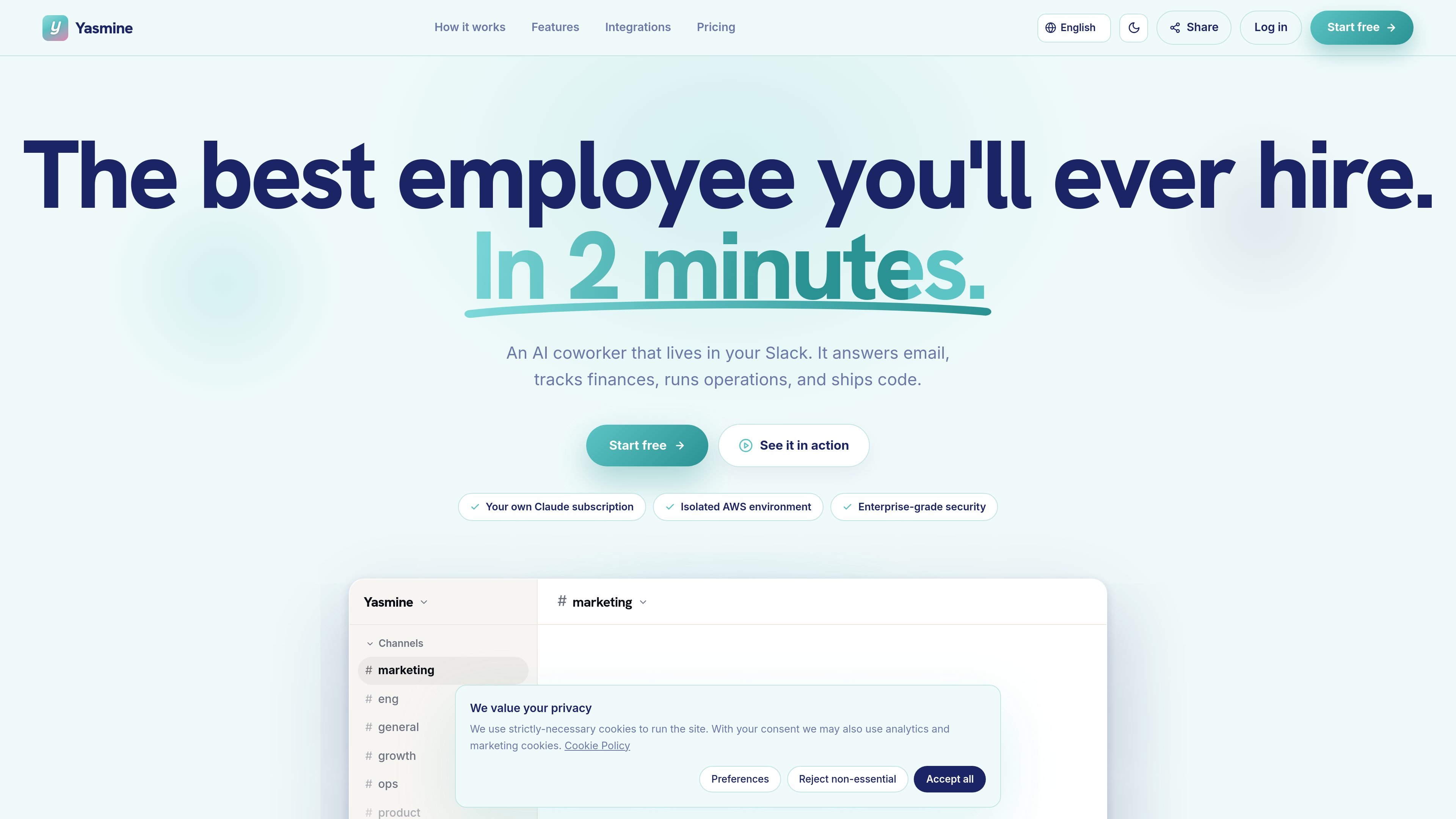
Yasmine is an AI coworker that lives inside Slack and is built for teams that want to delegate real work from a channel thread. The product runs on your own Claude subscription and is isolated per workspace, so each team operates in its own dedicated environment rather than a shared multi-tenant box.
The workflow is simple: add Yasmine to Slack, connect the tools your team already uses, and mention it like a teammate. The site shows it being used for tasks such as staging a promotion across channels, drafting ads, building campaigns, queuing email sequences, publishing landing pages, and cloning a development repository.
The product is positioned around controlled action rather than passive chat. Reads can run automatically, while writes, sends, money movement, and code pushes wait for approval in Slack. That makes it more of an execution layer for channel-based work than a general-purpose chatbot.
Yasmine offers a free trial and monthly plans for different levels of channel usage, integration access, and compute. Starter is aimed at lighter use, Pro at broader team adoption, and Dev at teams that want an isolated environment capable of cloning and running code.
Each Slack channel gets its own Claude session with persistent memory, its own tools, and its own state. The session can resume after restarts, which makes it suitable for ongoing work instead of one-off chat.
Every customer runs in a dedicated microVM with its own Claude subscription, secret store, and volume. The site says nothing crosses tenants and that workspaces are isolated from one another.
Yasmine can connect to MCP tools over stdio or HTTP, including email, calendar, docs, GitHub, databases, analytics, and ticketing systems. The product also supports a large directory of more than 1,200 integrations.
Reads can happen automatically, while sends and writes pause for explicit human approval in the Slack thread. The site also mentions pattern-based policies per channel for controlling actions.
You can invite the bot to a Slack channel and it appears in the dashboard ready for setup without searching for channel IDs. This reduces the work needed to start using it in a new channel.
The product includes usage and cost controls such as per-user and per-channel usage tracking, terse output mode, and scale-to-zero behavior for idle workspaces. These controls are intended to keep activity and cost bounded.
Marketing teams can ask Yasmine to stage a launch or promotion across channels, draft ad sets, queue a nurture sequence, and publish related assets from one Slack thread.
Operations or finance teams can use it for recurring reporting, digests, and routine updates, especially when scheduled tasks are enabled on the plan they choose.
Developers can ask it to clone a repository and set up a development environment, with the Dev plan intended for code-centric work that can run inside the workspace VM.
Customer-facing teams can connect tools like Gmail, HubSpot, Salesforce, and Intercom to draft replies, update records, and manage follow-up work from Slack.
Teams that rely on documentation and files can have Yasmine search, update, and write docs, and work with Drive, Notion, Sheets, and similar tools from inside a channel.
You install Yasmine from the Slack app directory, then connect your Claude subscription and the tools your team already uses. The install page describes a three-step flow: add it to Slack, connect tools such as Gmail, Calendar, Notion, databases, and GitHub, and then mention it in a channel like a teammate.
Yasmine is designed to work inside Slack channels. The home page says each channel is its own Claude session with persistent memory, and the pricing page notes that the Trial plan includes one Slack channel, Starter includes two channels, and Pro includes unlimited Slack channels.
Yasmine can read and write across connected tools from within its isolated workspace. The home page and install page mention email, docs, data, tickets, code, and tools such as Gmail, Notion, Google Drive, Google Calendar, GitHub, HubSpot, Salesforce, Stripe, Asana, Linear, and more through the broader directory.
The pricing page says approval is required before money moves, code is pushed, or customer emails are sent. The features page adds that reads can run automatically, but sends and writes pause for a human approval in the Slack thread.
Yasmine is built for teams that want an AI coworker inside Slack while keeping data and credentials isolated per workspace. The site highlights that it runs on your own Claude subscription and uses a dedicated environment for each workspace.

Biji ist eine vielseitige Plattform, die entwickelt wurde, um die Produktivität durch innovative Werkzeuge und Funktionen zu steigern.

Claude Overlay is a Windows desktop overlay for Claude Code that reads your screen so you can ask questions, inspect content, and request edits without leaving the current app. It runs on your existing Claude subscription through the Claude CLI, so no separate API key is required.

Macuse is a macOS app that lets AI assistants control native Mac apps through MCP and use Computer Use for any app. It works with clients like Claude Desktop, Cursor, and Raycast, and keeps automation on-device.

Dcyde is a decision log for product teams that captures what was decided, the reasoning behind it, and the source in one shared place. It supports pinning decisions from Slack, Figma, or inside Dcyde and keeps the record searchable over time.

Goldfish is an AI memory app for macOS that helps you reply, write, summarize, and continue using the context already on your Mac. It stores memory locally and writes in your tone.

Lasso is an ecommerce product data platform for enriching catalog records, processing supplier files, generating product content, and monitoring competitors. It combines a web app with a REST API, SDK, and MCP server for teams and developers.