
Structured JSON responses
Endpoints return clean JSON structured for LLM consumption, with pre-processed fields that reduce parsing overhead.

ZooData is an agent-native commerce intelligence API that returns structured product, competitor, market, and historical data for AI workflows. It is built for agent tools that need clean JSON, realtime signals, and usage-based API access.
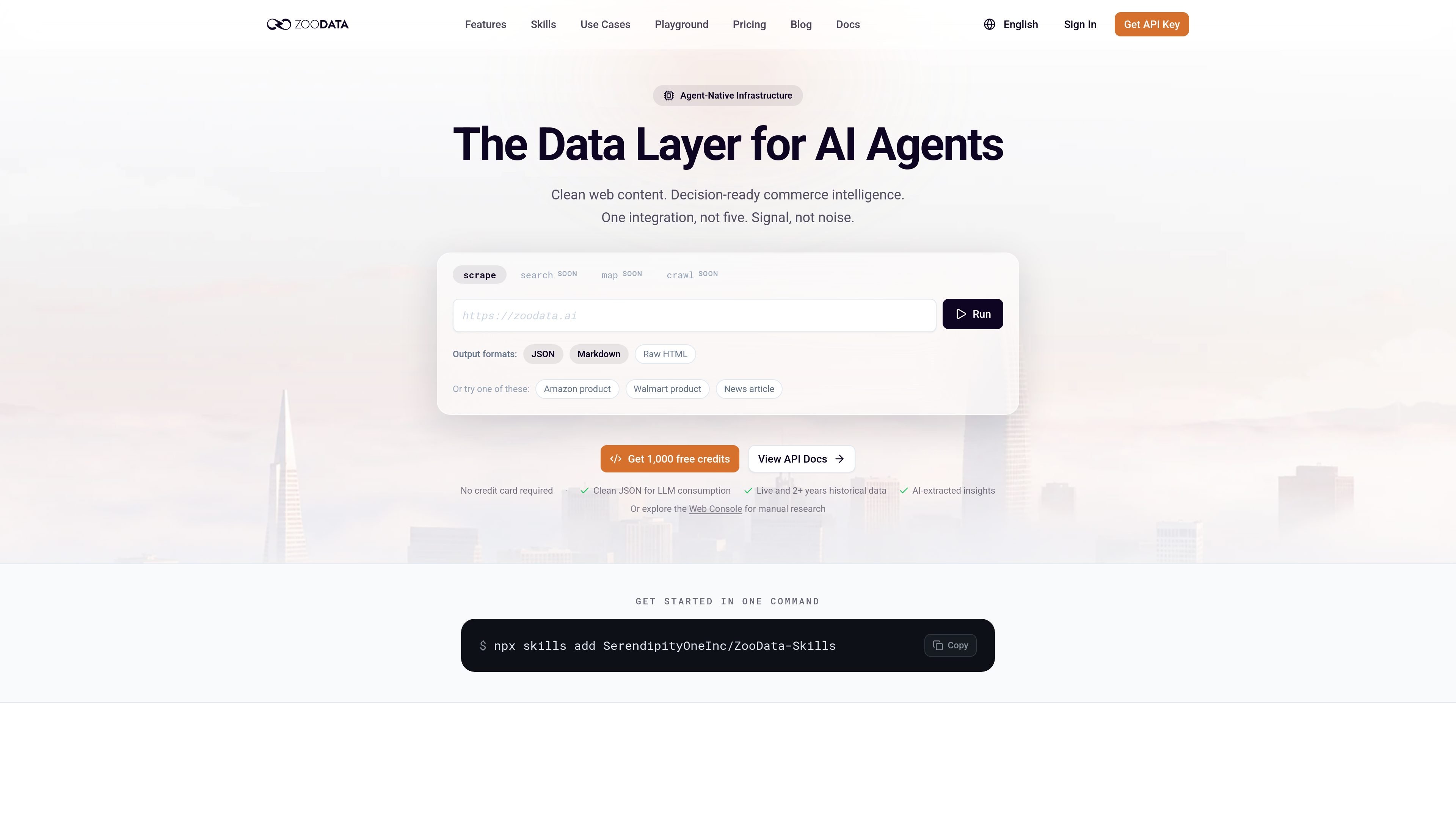
ZooData is an agent-native commerce intelligence API for teams building AI workflows around product research, competitor monitoring, market analysis, and related e-commerce tasks. The product is positioned as a data layer for agents rather than a human dashboard or a generic scraping service.
Its core output is structured, decision-ready data: clean JSON responses, pre-processed insights, and endpoints for live, historical, and category-level commerce signals. The site emphasizes that one integration can replace multiple separate data sources for agents that need continuous access to product and market information.
The platform is designed for workflows that need both breadth and freshness, including product search across large catalogues, competitor lookup by brand or ASIN, realtime pricing and inventory checks, and historical trend analysis. ZooData also provides a web console, OpenAPI documentation, and framework integrations so teams can use it directly or inside existing agent stacks.
Pricing is presented as credit-based and usage-driven, with prepaid API credit packages and a separate web plan. The pricing page also notes a free Basic web tier for exploration and a Pro plan for power users.
Endpoints return clean JSON structured for LLM consumption, with pre-processed fields that reduce parsing overhead.
The API includes product search, competitor lookup, market analysis, realtime product data, and historical trend data.
The site states that the platform tracks 500M+ products across Amazon and TikTok Shop, with 40+ filters for product search.
Historical endpoints provide more than two years of BSR, price, sales, and rating history for trend analysis.
Inputs and outputs are built for agent tool-calling, including OpenAPI 3.0 support and import paths for LangChain, CrewAI, AutoGen, and Claude MCP.
The platform includes image-to-attributes product tagging and pre-built skills for workflows such as market validation, product selection, competitor analysis, pricing strategy, and daily operations.
Use ZooData to scan large product sets for opportunities using filters, preset modes, and market signals. The source describes workflows that let an agent review far more products per day than a human researcher could manually.
Monitor competitors for price changes, new listings, and review shifts using competitor lookup plus realtime product queries. The source emphasizes continuous monitoring and second-level alerts for market changes.
Combine market analysis, realtime product data, and competitor prices to support pricing decisions. The product is positioned as the data layer feeding a pricing agent rather than a standalone pricing app.
Track category trends, BSR movement, and emerging signals on a schedule to identify changes as they happen. The source frames this as continuous market radar rather than static reporting.
Build end-to-end listing pipelines that move from opportunity discovery to validation and listing generation. The site describes a workflow that can connect discovery, real-time checks, and publishing in one agent flow.
ZooData is used by AI agents that need structured commerce data for research, competitor tracking, market analysis, or listing workflows. The API returns clean JSON and supports agent-oriented endpoints such as product search, competitor lookup, market analysis, realtime product data, and historical data.
The source shows a straightforward setup flow: get an API key, make a POST request to an endpoint, and receive structured JSON. The site also mentions an OpenAPI 3.0 spec and import paths for frameworks such as LangChain, CrewAI, AutoGen, and Claude MCP.
ZooData supports both automated agent workflows and a web console for manual research. The site also points to pre-built skills and OpenAPI-based integration for AI frameworks, so it can fit either direct API use or a broader agent stack.
The API is focused on commerce intelligence rather than generic web scraping. Documented outputs include product search, competitor intelligence, market analysis, realtime product data, historical trends, and product tags.
The pricing page shows both prepaid credit packages and a web plan with a free Basic tier and a paid Pro tier. It also states that credits can be bought when needed and that there are no subscriptions or seat limits for API plans.

Mindcase is a web data API and console for extracting structured data from websites and major online platforms. It helps users retrieve clean rows of data through prompt or API access, with prepaid per-record billing.

ByteAsk is a terminal-first AI coding agent for C and C++ that edits repositories and verifies changes with the real compiler, debugger, sanitizers, and tests before showing a diff. It offers a free tier plus paid plans, with editor connectors and zero-retention handling described in the source.

CreateOS Sandbox is an isolated compute environment for running code and agent workloads inside Firecracker micro-VMs. It is designed for workflows that need machine-level isolation, private networking between sandboxes, and programmatic control through SDK, CLI, or MCP.

hob is an independent workspace for coding agents that keeps agent sessions, terminals, history, and follow-up work organized around the tools and providers you already use. It is aimed at developers who want local control over routing, history, and workspace structure rather than a bundled model stack.

Ably Chat is a chat API platform for building custom realtime chat applications. It supports room-based messaging, typing indicators, presence, reactions, and message updates, with usage-based pricing options for different deployment stages.

Manta AI is an autonomous web app testing tool for teams that want to map application behavior, catch regressions, and generate tests without writing scripts or maintaining selectors. It works from a URL and supports plain-English test flows, run results with screenshots, and scheduled or deployment-triggered checks.