
Traveler-authored stories
The site centers on stories written by real travelers, which suggests a content-led approach rather than generic destination copy.

Been There is a travel-focused website that shares real stories from travelers to help people “know before you go.” It is aimed at travelers looking for firsthand context before planning or booking a trip.
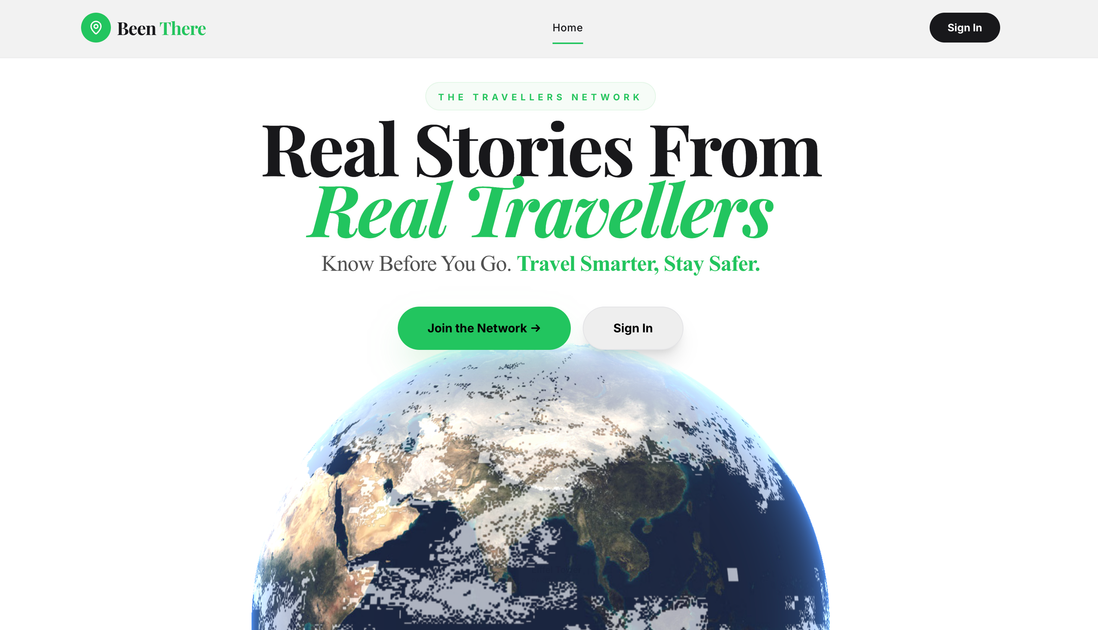
Been There is a travel-focused website built around real stories from travelers. Its stated purpose is to help people “know before you go” by surfacing firsthand travel experience in a global network of explorers.
The available pages present Been There as a public web product rather than a tool with documented software features, pricing tiers, or onboarding steps. Based on the source content, its main job is to help prospective travelers find practical, experience-based context before they make trip decisions.
The site centers on stories written by real travelers, which suggests a content-led approach rather than generic destination copy.
Its message, “Know Before You Go,” points to practical trip preparation and context before a journey.
The brand describes itself as a global network, indicating a community-oriented format for sharing travel experience.
The product spans the browsing and pricing pages with the same core positioning, which suggests a web-based service with a public information flow.
A traveler can browse it before a trip to learn from other people’s first-hand experiences and gather context that may not appear in standard destination descriptions.
Someone planning an unfamiliar destination can use the site to look for practical, experience-based insight before finalizing an itinerary or booking decisions.
A user who prefers community perspective over promotional travel content can use Been There as a source of traveler narratives and guidance.
A traveler who wants a broader sense of what to expect can use the platform to collect real-world context from a global network of explorers.
It appears to be a travel-focused platform centered on sharing real stories from travelers, so people can learn from others’ experiences before they go.
The site positions itself around helping travelers know before they go, making it most relevant for people who want practical trip context from other travelers.
The collected source does not show sign-up steps, pricing details, or a published trial on the pages provided.
The home and pricing pages both present the same core message, so the pricing page appears to be part of the site rather than a separate product with different positioning.

SCAPTION provides real-time captions and AI translation for conferences, ceremonies, corporate events, and hybrid productions. Attendees access captions and participation tools on their phones by QR code, while organisers can send caption graphics to NDI, HDMI, or browser-based screens.

HiredQuick is a startup-focused job-application platform for software engineers. It researches companies, guides candidates in building a relevant proof-of-concept project, and supports founder outreach and application tracking.

Arazio is a Mac utility for converting and processing files directly from Finder, with 283 tested conversions and 14 file tools. It processes files locally and writes new files beside the originals rather than uploading or modifying them.

MARVIS is a music-rights intelligence workspace for artists, managers, publishers, distributors, and rights teams. It monitors publishing, royalty, copyright, DSP, sync, neighboring-rights, and AI-music policy changes while helping organize catalog ownership, splits, registrations, and collection tasks.

MonoDuty routes operational incidents to on-call responders through schedules, escalation policies, and email, SMS, or voice alerts. It accepts transformed alerts over a universal HTTPS Webhook and supports HTTP/HTTPS monitors, heartbeats, and team-channel updates.

Cue is a hand-curated UI component library with references to high-quality web and product interactions. It gives designers, developers, agencies, and solo builders AI prompts they can use in Bolt, v0, Cursor, Framer AI, ChatGPT, or Claude.