

Context-aware explanations
Termy explains the meaning of unfamiliar words or phrases directly on your screen so you can keep reading, watching, or playing without switching to a separate dictionary tab.
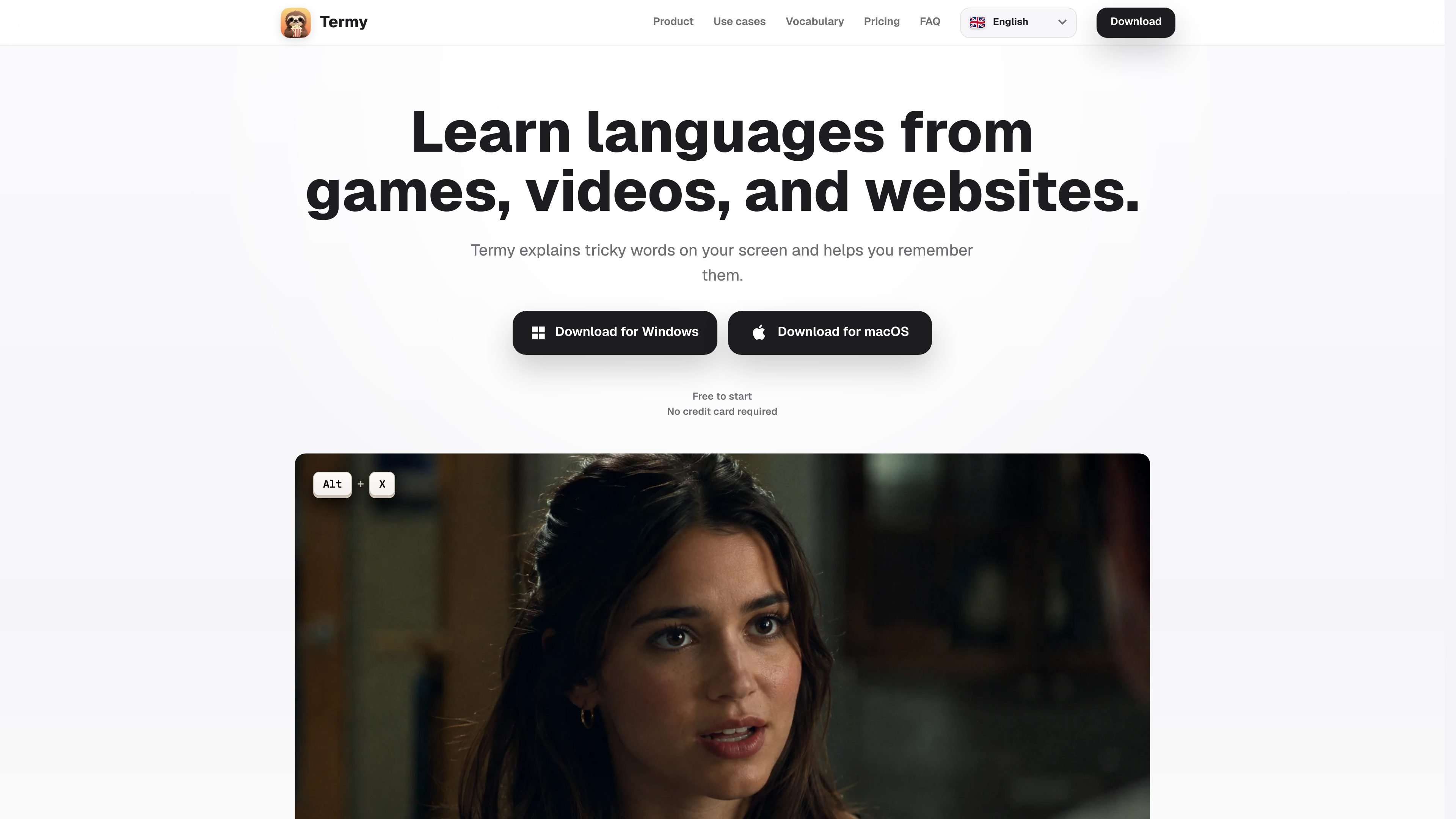
Termy is a language-learning app for Windows and macOS that helps you learn from the text you already encounter in games, videos, websites, books, and other desktop apps. When you trigger it on screen text, it gives a short explanation in context and saves the item for later practice.
The product is positioned as an alternative to switching into a dictionary or translation tab for every unfamiliar word. Instead of replacing the activity, it aims to let you continue it, then review saved words and phrases later through adaptive exercises and spaced practice.
Termy explains the meaning of unfamiliar words or phrases directly on your screen so you can keep reading, watching, or playing without switching to a separate dictionary tab.
The product is built around saved items from real content. It keeps the original sentence and screenshot context connected to the explanation and translation for later review.
Termy turns saved words and phrases into adaptive practice, including context questions, fill-in-the-blank prompts, typing, listening, screenshot recall, and spaced reviews timed to memory.
The site says Termy recognizes names, slang, complete expressions, and idioms, so explanations can reflect the whole phrase rather than isolated words.
Exporting saved cards to Anki is supported, letting users move their vocabulary into another review system if they want.
Termy works on Windows and macOS and is described as usable anywhere desktop text appears, including games, videos with subtitles, websites, books, and other apps.
Use Termy while playing games in the target language to understand dialogue, menus, quests, and UI text without leaving the game. The site also says it works with gamepads.
Use it on YouTube videos, movies, and TV subtitles to capture unfamiliar words or expressions as they appear in context, then review them later.
Use Termy in the browser to understand articles, forums, docs, and posts without keeping a dictionary tab open.
Use it in books, terminal output, AI chats, ebooks, or other desktop text when you almost understand the content but a few words block you.
Use saved items for review after the session, where Termy offers adaptive exercises and optional Anki export for continued practice.
Termy is designed for desktop text that appears on your screen, including games, websites, videos with subtitles, books, and other apps. The source does not indicate a browser extension or a web-only workflow.
No. The site says Termy is not a screen translator. It shows short, context-aware explanations where needed and then saves words and phrases for later review and practice.
Termy keeps the original sentence, screenshot context, explanation, and translation connected. It then uses adaptive timing and exercises such as context questions, fill-in-the-blank prompts, typing, listening, and screenshot recall; the site also says saved cards can be exported to Anki.
The site states that screenshots are not stored on Termy’s servers. When you save vocabulary, the useful screenshot context stays locally on your computer so you can revisit it later.
Yes. The site says Termy supports Windows and macOS.

LangPanda is a browser extension for learning languages from streaming video and other supported sites. It combines instant subtitle lookup, flashcard creation, vocabulary tracking, and spaced-repetition review for 36 languages.

Talkpal is an AI-powered language learning web and mobile app for practicing speaking, listening, writing, and pronunciation. It offers guided courses, roleplays, and call-style conversation practice across 130+ languages.

Microsoft Translator is a Bing translation web app for translating short text between English and more than 100 languages. It also supports image capture translation and basic output actions like listen and copy.

Toku Reader - 読 is an iPhone app for reading Japanese and Chinese with tap-to-define lookups, reading support, and study tools. It works across texts, websites, videos, and podcasts, with offline core features and a free plan that includes 50 word lookups per day.

Lingofable is a story-based language learning app that helps learners practice reading at an appropriate level and review new vocabulary in context. It currently supports Spanish, with Android listed as coming soon.

Yokoso is a Japanese-learning app for people moving to or living in Japan. It focuses on practical daily language, adapts to what you already know, and supports offline learning with real-world content.