

AgentBase
AgentBase is a PR review workspace that combines diff, thread context, author intent, and an AI Q&A panel—plus Slack pings to orient reviewers.
What is AgentBase?
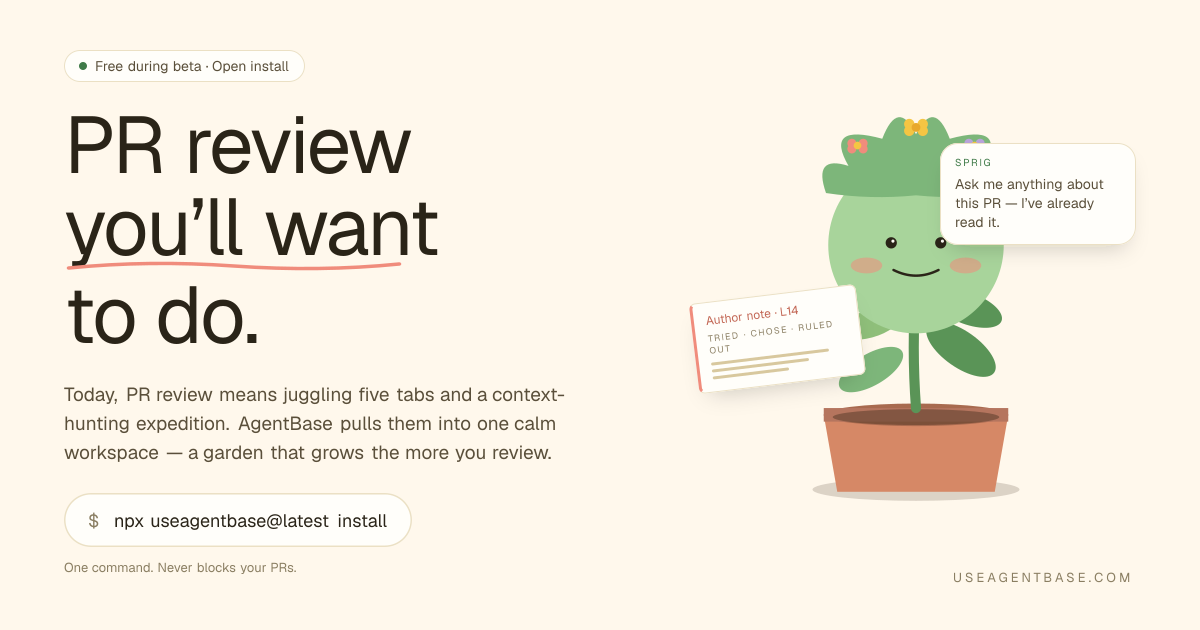
AgentBase is a PR review workspace that consolidates multiple tools into a single page for reviewing pull requests. It pairs the GitHub diff with PR intent and context, including an author note and a Q&A-style panel (“Ask me anything”) to help reviewers understand what changed and why.
The core purpose is to reduce tab-juggling during PR review by pulling together the materials reviewers typically need—diff, thread context, ticket/intent, and code navigation—into one workflow, while adding a way to answer follow-up questions directly in the same panel.
Key Features
- One-page PR review surface (instead of multiple tabs): Consolidates diff, discussion/thread context, blame/history view, ticket/why context, and an AI Q&A panel in a single workspace.
- Slack-based reviewer pings with structured intent: Sends a Slack message that includes the PR intent, scope, relevant code logic that changed, and an estimated read time so reviewers can quickly orient before opening the PR.
- PR “author note” tied to the diff: Displays an author note (including referenced ticket linkage) next to the relevant diff lines, capturing the reasoning for the change.
- Context loading for deep-dive questions: When a reviewer asks questions (e.g., where a function is called or what the blast radius is), AgentBase loads the PR and relevant codebase review patterns so answers appear without switching branches.
- Transcript handling with redaction: Scrubs secrets before saving transcripts (e.g., API keys/tokens/passwords/private keys are replaced with
[REDACTED]) and does not store other information beyond what is described. - Privacy-focused scope of what’s captured: Only captures the conversation made with the AI for that PR along with basic PR metadata (repo, branch, commit) when the reviewer opens a PR.
How to Use AgentBase
- Install and open it during beta: The site shows installation via
npx useagentbase@latest install. - Start reviewing a PR: When you open a pull request, AgentBase presents a consolidated review page with the diff, author intent, and supporting context.
- Ask follow-up questions in the panel: Use the “Ask me anything” interface (labeled as Sprig on the page) to request details such as “where a function is called” or “what else this change affects,” with citations tied to what’s available in the PR and codebase.
- Use the Slack ping as the entry point: AgentBase can message the right reviewer in Slack with intent, scope, core logic changed, and read time to help you decide what to focus on.
Use Cases
- Edge/middleware auth refactors: If a PR moves authentication/rate limiting logic from per-route handlers to edge middleware, reviewers can use the panel to verify scope (e.g., files/packages), reasoning pinned to the diff, and whether all call sites were migrated.
- Reviewing for “blast radius” during migrations: When the change replaces a function (e.g.,
fetchSessionwith header-based reads), the reviewer can ask what the impact is across the repository and whether there are orphaned call sites. - Determining what changed and why quickly: For PRs that include both code diffs and intent notes (ticket linkage, author reasoning), reviewers can read the “author note” next to the lines it explains rather than searching across tabs.
- Answering consistency questions during review: If a reviewer wants to know whether a similar refactor pattern was shipped before (e.g., a prior session middleware refactor), they can request that comparison directly in the Q&A panel.
- Team review queue triage: When PRs sit in a queue, Slack pings provide the structured summary needed to begin review efficiently, including an estimated read time.
FAQ
-
What does AgentBase collect when I open a PR? It captures the conversation you had with the AI about that change plus basic PR details (repo, branch, commit). It does not monitor you while you code or read other content on your laptop.
-
Does AgentBase store secrets from my AI conversation? The transcript runs through a scrubber before saving. API keys, tokens, passwords, and private keys are replaced with
[REDACTED]automatically. -
Can I ask questions beyond the diff view? Yes. The interface supports follow-up questions (e.g., where a function is called, what the blast radius is), and the panel cites relevant information loaded from the PR and codebase.
-
How do notifications work? The site describes Slack messages sent to the right reviewer that include PR intent, scope, core logic changed, and estimated read time.
-
How do I install AgentBase? The page shows installing with
npx useagentbase@latest install(noted as available during beta).
Alternatives
- Manual PR review with standard GitHub UI + separate notes: Reviewers can open the diff, check the conversation, and use search/blame directly. This typically requires more context switching than a consolidated single-page workspace.
- AI code assistants used in parallel with PR tabs: Tools that generate explanations or answers can be used alongside GitHub, but they may not automatically centralize diff context, blame, and ticket/intent into one review surface.
- Workflow systems that route PRs by role and send Slack notifications: Some teams use automation to notify reviewers, but without the same “diff + intent + Q&A” consolidation in one place.
- Code review checklists and templates: Teams can reduce missed context via standardized checklists and PR templates; this helps consistency but doesn’t provide PR-specific Q&A tied to the diff and codebase in the same way.
Alternatives

Devin
Devin is an AI coding agent that helps software teams complete code migrations and large refactoring by running subtasks in parallel.

Codex Plugins
Use Codex Plugins to bundle skills, app integrations, and MCP servers into reusable workflows—extending Codex access to tools like Gmail, Drive, and Slack.

ClawTick
ClawTick is a CLI-first AI agent automation platform for scheduling webhook tasks on cron with monitoring, alerts, retries, and execution logs.

Falconer
Falconer is a self-updating knowledge platform for high-speed teams to write, share, and find reliable internal documentation and code context in one place.
OpenFlags
OpenFlags is an open source, self-hosted feature flag system with a control plane and typed SDKs for progressive delivery and safe rollouts.

AakarDev AI
AakarDev AI is a powerful platform that simplifies the development of AI applications with seamless vector database integration, enabling rapid deployment and scalability.