

Rosentic
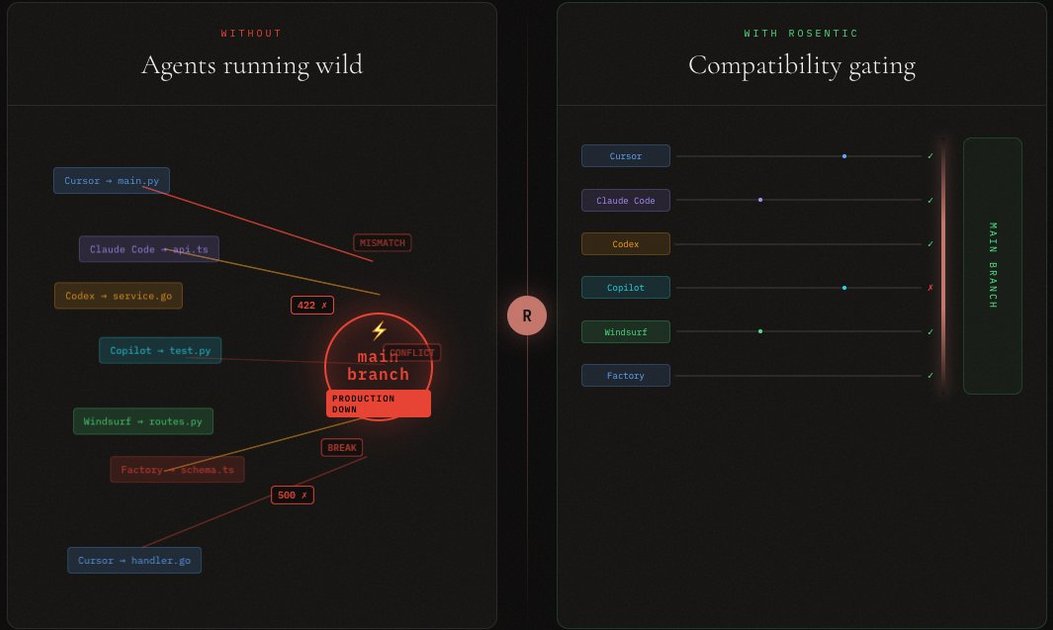
Rosentic checks every PR against active branches in your CI to spot compatibility conflicts like schema drift and API/signature mismatches before merge.
What is Rosentic?
Rosentic is a deterministic CI check that scans a pull request (PR) against active branches to find compatibility conflicts before merge. It focuses on cases that break cross-branch behavior, including schema drift, API breaks, and signature mismatches.
The workflow is centered on automated verification: for a PR event, Rosentic runs in your CI, produces a breakdown of breaking changes, and reports specific locations (file paths and line numbers) associated with conflicts it detects.
Key Features
- Scans PRs against every active branch before merge to catch cross-branch incompatibilities, not just issues within the PR’s own diff.
- Deterministic execution for consistent results across CI runs.
- Runs in your CI/runner (“code never leaves your runner”), keeping analysis within your existing build environment.
- Language coverage across 12 languages, based on the site’s stated scanning scope.
- Provides line-level breakdowns (file paths and line numbers) for conflicts so teams can address the exact call sites and interfaces involved.
- Uses regression fixtures to guard changes to the underlying engine.
How to Use Rosentic
- Add Rosentic’s GitHub Actions workflow to your repository (the site provides a
.github/workflows/rosentic.ymlexample). - Configure the workflow to run on
pull_requestevents targeting branches (the example showsbranches: [main]). - Ensure your workflow checks out the repository with
fetch-depth: 0(as in the example) so Rosentic can inspect what it needs for branch comparisons. - The workflow runs
Rosentic/rosentic-action@v1. After the job completes, review Rosentic’s reported “Breaking” conflicts and line-level locations in the output.
To run it in an agent-based workflow, the site also suggests installing Rosentic on the repo and then having your coding agent follow that instruction.
Use Cases
- Prevent runtime or integration failures before merge: A PR changes a function signature (e.g., adds required arguments), and Rosentic identifies remaining callers on other branches that still invoke the old signature.
- Detect schema drift across branches: When code updates affect schema definitions (e.g., a resolver or contract shape changes), Rosentic reports “Schema drift” and points to affected files/lines.
- Catch API return-type or contract changes: If a function’s return type changes (for example from
Promise<void>to a differentPromise<Result>shape), Rosentic lists callers that may not handle the new result structure. - Guard against mismatched interfaces between backend and frontend code: When a PR updates shared interfaces, Rosentic can flag “signature mismatch” style conflicts where call sites in other branches don’t match.
- Standardize compatibility checks for multiple agent branches: If your team uses multiple branches and automation workflows, Rosentic verifies compatibility across branches so the PR is less likely to conflict with parallel development.
FAQ
Does Rosentic require an API key or signup?
The site states: “No signup” and “No API key.”
Where does Rosentic run?
The site indicates it runs in your CI/runner, and that code “never [leaves] your runner.”
When does Rosentic check conflicts?
The provided example workflow runs on pull_request events (with branches: [main] in the example), and Rosentic checks the PR against active branches before merge.
What kinds of conflicts does Rosentic report?
The page examples mention categories such as schema drift, API break, and signature mismatch, with a breakdown of specific breaking changes and affected locations.
What information do I get back from Rosentic?
The site states that results include file paths and line numbers, and it provides a “full breakdown” and counts of conflicts found on the PR.
Alternatives
- Automated test suites in CI: Instead of proactively comparing a PR against other branches, unit/integration tests validate behavior at runtime. This differs because tests verify specific scenarios rather than enumerating cross-branch interface conflicts.
- Static type checking and linting (language-specific): Type checkers and linters can catch signature and type mismatches within what the compiler can analyze, but may not identify compatibility issues that arise from changes relative to other active branches.
- Conventional Git-based merge conflict detection: Git can surface textual conflicts during merge, but it does not inherently verify semantic compatibility like schema drift or API contract mismatches across branches.
- Change-impact analysis tools for CI: Tools in the category of dependency/impact analysis focus on how changes affect downstream consumers; compared to Rosentic, they may rely more on dependency graphs or coverage rather than explicit cross-branch verification.
Alternatives

ClawTick
ClawTick is a CLI-first AI agent automation platform for scheduling webhook tasks on cron with monitoring, alerts, retries, and execution logs.

Falconer
Falconer is a self-updating knowledge platform for high-speed teams to write, share, and find reliable internal documentation and code context in one place.
OpenFlags
OpenFlags is an open source, self-hosted feature flag system with a control plane and typed SDKs for progressive delivery and safe rollouts.

skills-janitor
Audit, track usage, and compare your Claude Code skills with skills-janitor—nine focused slash commands and zero dependencies.

MakerLoft
MakerLoft is an AI app builder for non-developers that connects to your GitHub repo to generate working apps with auth, payments, files, jobs.

Rectify
Rectify is an all-in-one operations platform for SaaS, combining monitoring, analytics, support, roadmaps, changelogs, and agent management—via conversation.