
Single-call research pipeline
A single `/research` call handles source selection, reading, synthesis, and citation formatting, so you do not have to build and maintain a separate research pipeline.

Tabstack Web Research is an API that returns synthesized answers with inline citations from the live web in a single call. It helps teams add sourced research features without building their own research pipeline.
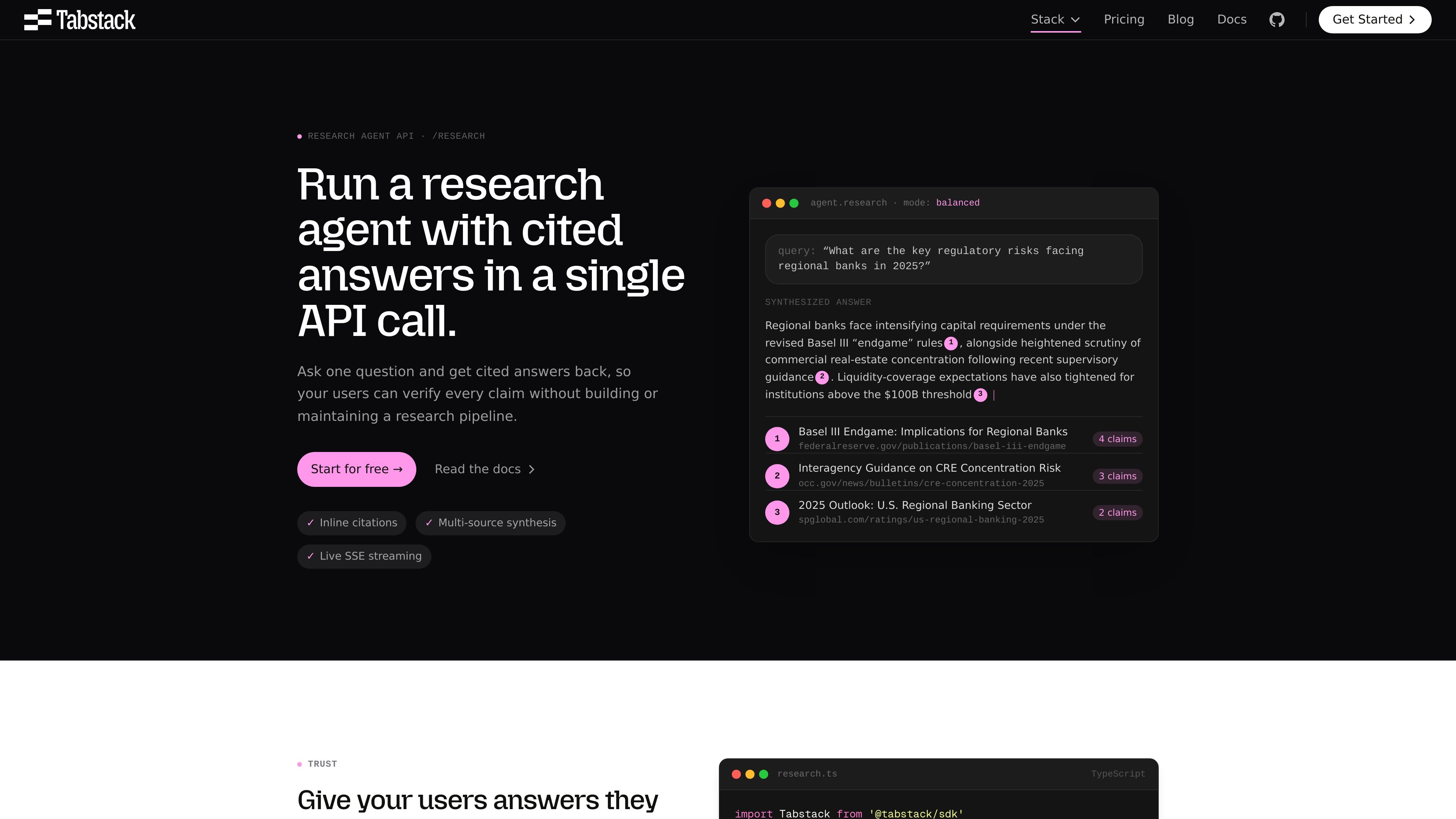
Tabstack Web Research is an API for asking a question and receiving a synthesized answer with citations in a single call. It is designed to run the full research workflow for you: finding sources on the live web, reading them, combining the results, and returning cited claims that users can verify.
The product is aimed at teams that want research features inside their product without building source selection, prompting, citation handling, or streaming infrastructure themselves. The page examples show a streamed response with cited source pages, and the pricing page presents the service as part of a broader platform that also includes extraction and browser automation APIs.
A single `/research` call handles source selection, reading, synthesis, and citation formatting, so you do not have to build and maintain a separate research pipeline.
Answers are generated from pages fetched at request time rather than a pre-indexed corpus, which helps with current topics and niche sources.
Every answer includes inline citations and source URLs, allowing users to inspect where individual claims came from.
Streaming over SSE lets users watch the research run in real time instead of waiting for a single final response.
The endpoint supports modes such as fast and balanced so teams can choose speed or deeper synthesis depending on the task.
Add a research feature to a product so users can ask a question and get a cited answer back without leaving your app.
Support legal, financial, or competitive workflows where users need to check the source behind each claim before acting on it.
Pull together live information from multiple pages when the topic changes quickly or the sources are newly published.
Replace an internal research pipeline with a single call that handles sourcing, synthesis, and citation formatting end to end.
It runs a research agent in a single API call. You send a question, and Tabstack returns a synthesized answer with inline citations and source URLs so readers can verify each claim.
The source pages show research mode options such as fast and balanced. The product copy also emphasizes live-web retrieval, multi-source synthesis, and SSE streaming.
The pages describe a TypeScript SDK and API endpoints for research, extraction, and automation, with examples for streaming and event handling. The pricing page also lists TypeScript SDK, Python SDK, MCP, and CLI as access surfaces.
Tabstack positions /research for teams that need cited answers, including legal tech, financial services, sales intelligence, and competitive intelligence.
The pages say queries and retrieved pages are used to complete the call and then purged, and that answers include source URLs and inline citations by design.

Hype is a web tool for finding trending YouTube topics by category, time range, and scoring mode. It helps creators spot emerging ideas, inspect source videos, and decide what to cover next.

Ably Chat is a chat API platform for building custom realtime chat applications. It supports room-based messaging, typing indicators, presence, reactions, and message updates, with usage-based pricing options for different deployment stages.

Ghost é um assistente de IA para terminal, para conversar, gerar código e executar tarefas no prompt. Traz modelos gratuitos, funciona no Linux, macOS e Windows e é open source.

Paperpal 是一款面向学术写作的 AI 工具,提供文献阅读、语言润色、引用、查重、AI 检测和投稿前检查。它适合需要在英文论文和学术材料上进行写作、修改与合规自检的学生、研究人员和教师。

AakarDev AI helps teams manage AI provider access, project-level setups, logs, and analytics from one dashboard. It supports BYOK workflows and lists providers including OpenAI, Google Gemini, Anthropic, Groq, Mistral AI, and Perplexity AI.

VForms lets you place questionnaires directly inside YouTube videos so viewers answer in context instead of switching to a separate form. It is aimed at collecting feedback and insights through timestamped, embeddable video forms.