
Guided project intake
A guided conversation captures the product idea, users, integrations, technical context, hosting preferences, budget, and relevant security or performance requirements before planning begins.

Zalcro is a pre-build planning tool for people building software with AI coding tools. It turns a plain-language idea into architecture documentation, diagrams, phased plans, Prompt Packs for vibe-coding tools, or dependency-ordered tickets for coding agents.
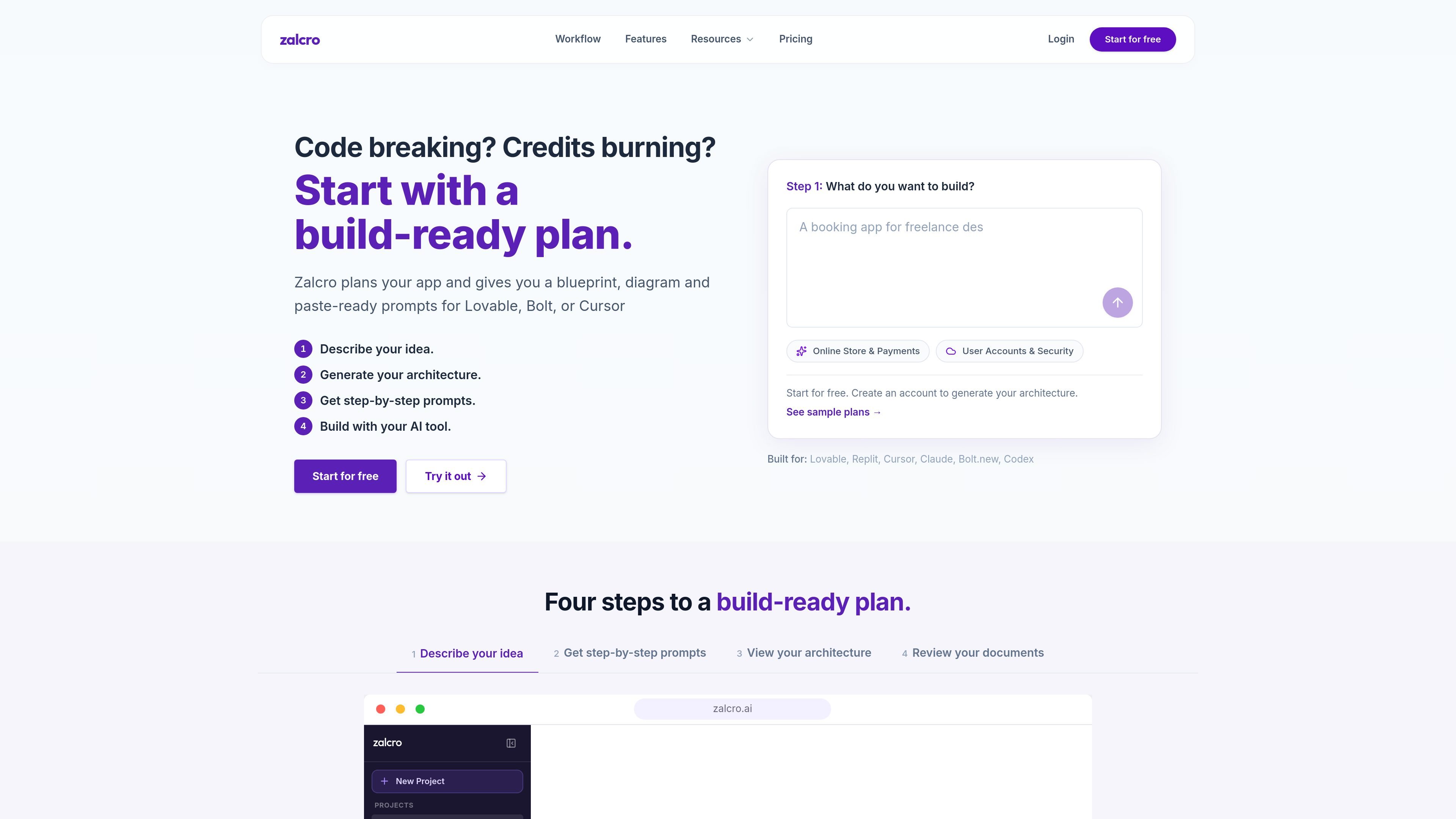
Zalcro is a pre-build planning and spec-driven development tool for people creating software with AI coding tools. Users describe an app in plain language and answer guided questions about its users, integrations, technical requirements, hosting preferences, and constraints. Zalcro then maps the system before implementation starts, rather than writing application code itself.
The resulting plan includes an Architecture Design Document, a system diagram, and a phased implementation plan. Depending on the chosen workflow, users receive a sequential Prompt Pack for Lovable, Bolt, or Replit, or a dependency-ordered ticket backlog for Cursor, Claude Code, or Codex. The aim is to give an AI builder a stable reference for how components fit together and what should be built first.
A guided conversation captures the product idea, users, integrations, technical context, hosting preferences, budget, and relevant security or performance requirements before planning begins.
The Architecture Design Document records system components, data models, architectural decisions, and tradeoffs as a reference for the build.
A visual system map shows how the main parts of the application connect. Diagrams can be delivered in Mermaid and, on the Builder plan, exported as Draw.io XML.
The implementation plan organizes work into dependency-aware phases, including what each phase builds, why it exists, and what completion should mean.
For Lovable, Bolt, and Replit, Zalcro generates prompts for each build phase so users can pass context to their AI builder in sequence.
For Cursor, Claude Code, and Codex, Zalcro creates an ordered ticket backlog with acceptance criteria and architectural directives for agent execution.
Before sending prompts to Lovable, Bolt, or Replit, a builder can clarify the app architecture and then paste phase-specific prompts in sequence instead of starting with isolated feature requests.
A developer using Cursor, Claude Code, or Codex can turn a product concept into dependency-ordered tickets with acceptance criteria and architectural guidance for an agent to execute.
A team or individual restarting an unstable AI-generated project can document the intended components, data model, and tradeoffs as a reference for future changes and debugging.
A founder or product planner can review the architecture document, diagram, and phased plan before implementation and share those artifacts with developers or stakeholders.
A builder can export planning materials in formats such as Markdown, PDF, Mermaid, DOCX, or Draw.io XML, depending on the plan, for documentation and handoff.
Zalcro is a pre-build planning tool for AI app development. It turns a plain-language product idea and guided answers into architecture documentation, a system diagram, a phased implementation plan, and workflow-specific prompts or tickets.
Zalcro supports vibe-coding workflows for Lovable, Bolt, and Replit, and agentic workflows for Cursor, Claude Code, and Codex. Its outputs can also be exported or used with tools such as Linear, Jira, ClickUp, and Google Drive where the selected plan supports those capabilities.
You describe the product, users, interactions, integrations, team and technical context, hosting preferences, budget, and relevant security or performance requirements. Zalcro asks focused follow-up questions, then generates the planning documents and downstream build outputs.
Vibe-coding users receive a phase-based Prompt Pack intended to be pasted into Lovable, Bolt, or Replit in sequence. Agentic builders receive dependency-ordered tickets with acceptance criteria and architectural directives for use in Cursor, Claude Code, or Codex.
The Starter plan is free and includes one architecture generation per month, a Phase 1 implementation plan, Phase 1 tickets, the first Prompt Pack prompt, and Markdown, PDF, and Mermaid exports. The Builder plan adds unlimited architecture generations, full plans, all tickets and prompts, additional export formats, and Google Drive integration.

Lucid Train is a local-first AI coding harness that turns repository code into architecture diagrams and uses those diagrams as specifications for coding agents. It is available as a desktop app and a lightweight Rust CLI, and it can run with local models or your own API keys.

Cherry Blossom is a browser-based PCB editor that turns plain-English prompts into editable schematics, PCB layouts, and fabrication files. It is built for people who want AI-assisted board drafting with verification checks and open exports.

ByteAsk is a terminal-first AI coding agent for C and C++ that edits repositories and verifies changes with the real compiler, debugger, sanitizers, and tests before showing a diff. It offers a free tier plus paid plans, with editor connectors and zero-retention handling described in the source.

Epherem is a static security scanner for web apps built with AI coding tools such as Lovable, Bolt, v0, Replit, Cursor, and Claude Code. It checks source files and dependencies for common security mistakes, then provides categorized findings and suggested fixes without running the app.

CreateOS Sandbox is an isolated compute environment for running code and agent workloads inside Firecracker micro-VMs. It is designed for workflows that need machine-level isolation, private networking between sandboxes, and programmatic control through SDK, CLI, or MCP.

GitBot is a local browser-based workspace for creating reusable coding bots powered by Claude Code, Codex, or OpenCode. It helps developers run those agents across repository folders with persistent threads and configurable permissions.