UStackUStack
Alkera icon

Alkera

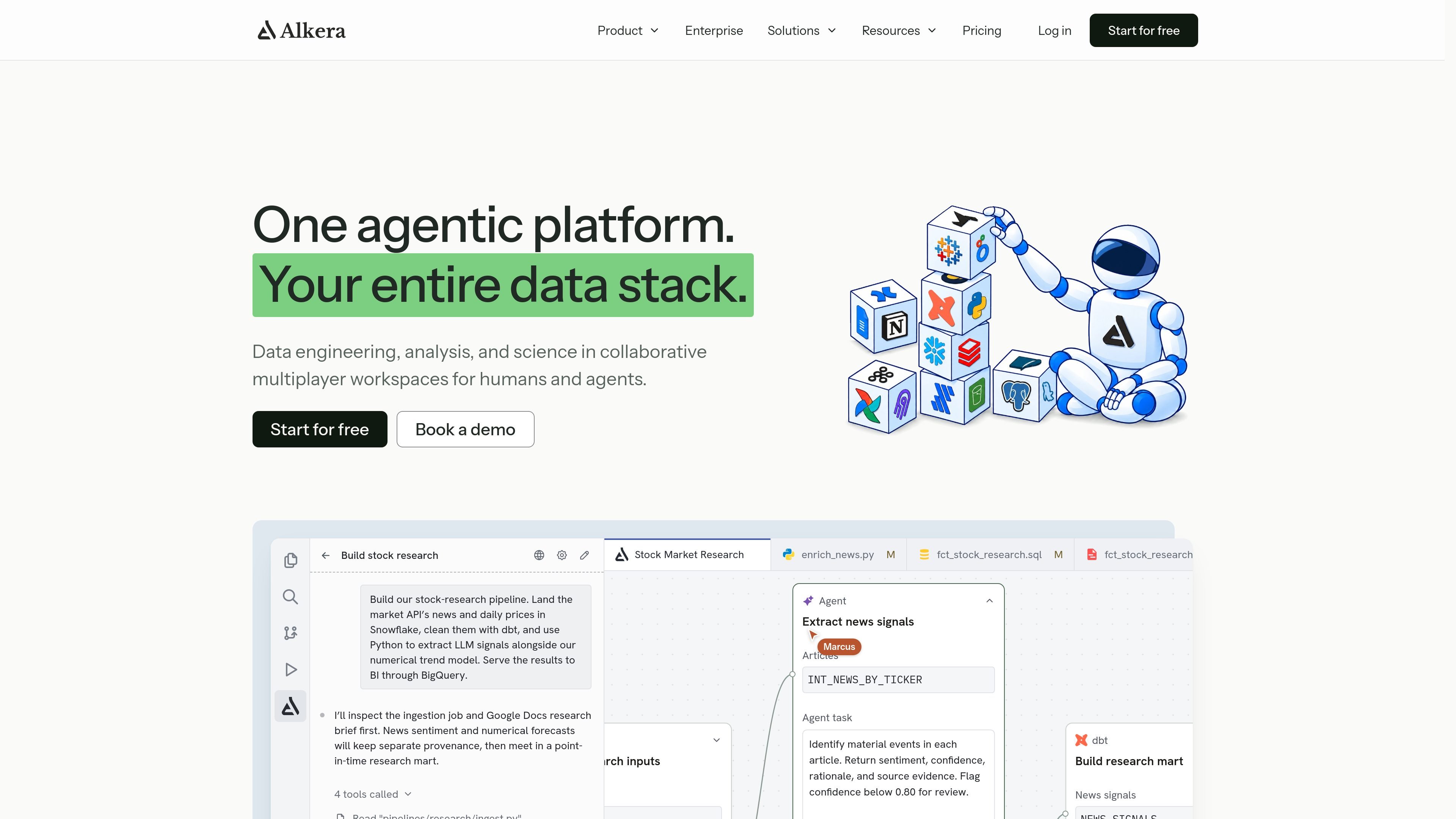
Alkera is an agentic data platform for data engineering, analysis, and science teams. It connects data tools, business knowledge, monitoring, lineage, and collaborative workspaces so agents can help investigate incidents, analyze data, and prepare changes for human review.

Alkera

Alkera at a glance

Alkera is an agentic data platform for data engineering, analysis, and science. It brings people and software agents into shared workspaces connected to the tools already used across a data stack, including databases, warehouses, transformation systems, orchestration tools, BI products, documentation sources, and communication platforms.

The platform is designed to keep data work contextual and reviewable. Its agents can trace data dependencies, use recorded business knowledge, monitor jobs and data quality, investigate incidents, and prepare changes for review. Repairs are tested in sandbox environments rather than applied directly to production, while lineage, pull requests, CI/CD checks, and approval workflows provide points for human oversight.

Core capabilities

Column-level lineage

Trace dependencies from ingestion through warehouses, transformations, and dashboard charts at the column level. Before a change, an agent identifies affected downstream assets and asks for approval when it detects a possible break.

Knowledge base

Store business context beside tables, columns, and dashboards. Entries record their author and trust level, support private or team sharing, and can be synced from sources such as Google Docs, Notion, and Confluence.

Monitoring and data quality

Monitor warehouses and jobs using query and job history, Airflow and dbt runs, and Datadog monitors. Teams can define checks for missing, duplicate, stale, or reference-related data across whole tables or new rows.

Automated maintenance

Agents investigate incidents and prepare repairs using operational context, lineage, documentation, and code history. Changes are tested in isolated environments before production, with pull requests and checks available through GitHub.

Collaborative data workspaces

Work in shared spaces where people and agents can address data engineering, analysis, and science tasks together. Connected tools include databases, warehouses, orchestration systems, transformation tools, BI platforms, knowledge sources, and team communication services.

Practical use cases

  • Assessing the impact of schema changes

    When a team needs to remove or modify a field, Alkera can trace that field from ingestion through transformations to dashboards, identify downstream dependencies, and present the impact before approval.

  • Investigating pipeline incidents

    When a warehouse or scheduled job fails, agents can combine monitoring signals with execution history, lineage, team knowledge, and code history to investigate the incident and prepare a repair for review.

  • Enforcing data quality rules

    Teams can define checks for missing, duplicate, stale, or invalid reference data and apply them to complete tables or newly added rows, helping identify rule violations before bad data moves further through the stack.

  • Collaborative exploratory analysis

    Analysts can use a connected notebook-style workspace to ask questions, create charts, and refine an analysis collaboratively, while agents perform data tasks and respond to follow-up requests such as adding a regional breakdown.

Pros and Cons

Pros

  • Combines data engineering, analysis, and science workflows in one platform for human and agent collaboration.
  • Column-level lineage helps identify downstream tables, models, and dashboard assets before a change is made.
  • Agents can investigate failures and test proposed pipeline repairs in isolated environments before production.
  • Business context can be attached to data assets and searched semantically, with authorship and trust levels recorded.
  • Offers a free plan and native integrations across a broad set of data, documentation, monitoring, development, and BI tools.

Cons

  • The source describes many capabilities and integrations, but does not provide detailed setup requirements, implementation timelines, or limits for individual integrations.
  • Advanced governance and deployment options such as SSO/SAML, audit logs, VPC or on-premises deployments, and data residency controls are presented under Enterprise rather than the standard plans.

FAQ

What tools and data systems does Alkera integrate with?

Alkera connects with data, orchestration, transformation, monitoring, documentation, communication, and BI tools listed on its site, including Snowflake, BigQuery, Databricks, Redshift, PostgreSQL, MySQL, Airflow, dbt, Datadog, GitHub, Slack, Google Docs, Notion, Confluence, Tableau, Looker, Sigma, and Hex. The available connections may depend on the plan and workspace configuration.

How does Alkera handle pipeline incidents?

Alkera agents can investigate warehouse and job failures, review execution logs, lineage, knowledge-base items, and code history, then propose pipeline repairs. Proposed changes are tested in sandbox environments before production, and fixes can be reviewed through pull requests and CI/CD checks.

Can teams collaborate in Alkera?

Yes. Teams can create an organization with shared connections and permissions. Members can work alongside agents, receive incident updates in Slack, and approve or reject requests from the messaging platform.

What pricing plans does Alkera offer?

Alkera offers Free, Plus, Pro, and Enterprise plans. The Free plan is listed as free forever with 10 GB of storage and limited usage; Plus and Pro add more storage and usage, while Enterprise is custom and includes options such as SSO/SAML, SCIM and IAM, audit logs, VPC or on-premises deployments, data residency controls, and available SLAs.

Quick Facts

Category
Agentic data platform
Primary users
Data engineering, analysis, and science teams
Collaboration model
Shared workspaces for humans and agents
Workflow focus
Lineage, monitoring, data quality, maintenance, and analysis
Plans
Free, Plus, Pro, and Enterprise
Free plan
Free forever; 10 GB storage and limited usage

Альтернативы Alkera