
Search by title or person
Search for a film, TV show, or person, then open a graph built around that entry.

Filmlinks is a web app for exploring film and TV credits as a connected graph. Users can search for a title or person, then click through directors, cast, and authors to discover related works.
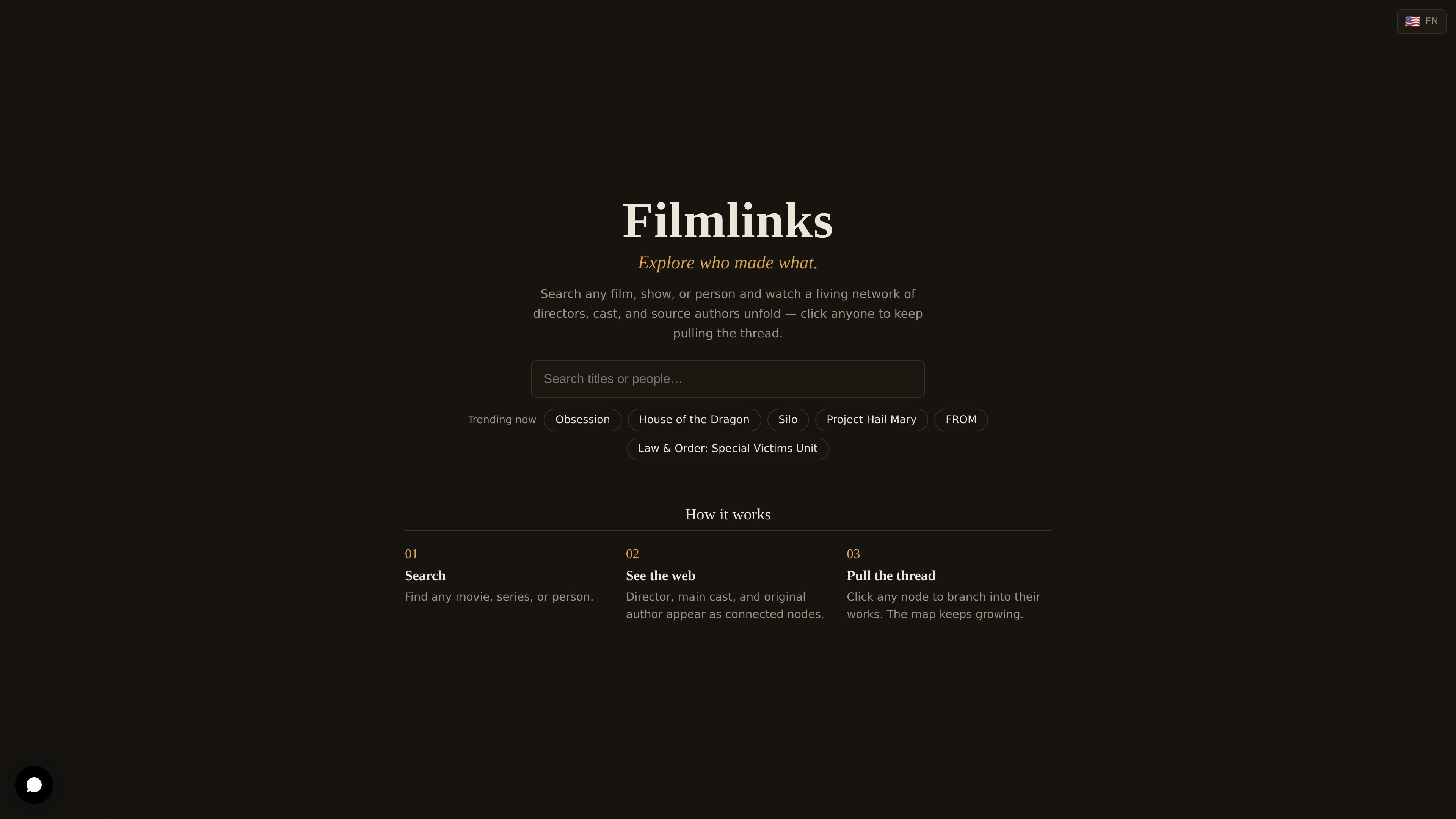
Filmlinks is a web-based discovery tool for film and television credits. It presents titles and people as a connected graph so users can move from one work to another through directors, cast members, and source authors.
The product is designed around a simple workflow: search for a title or person, inspect the resulting network, and click through connected nodes to uncover related works. The pages also show a graph interface with options such as works plus people, works only, and service filtering on supported graph pages.
Search for a film, TV show, or person, then open a graph built around that entry.
See directors, main cast, and original authors shown as connected nodes instead of as a flat list.
Click any node to keep exploring related people and works linked to that entry.
Switch between views that include works plus people or works only, depending on how you want to explore the data.
Filter the graph by service on supported pages to narrow the visible results.
Open node details and expand the graph with click and double-click interactions.
Start with a movie or series and inspect the people connected to it, including directors, cast, and source authors, to understand how the work was assembled.
Look up a filmmaker, actor, or author and follow their linked works to see how their projects connect across film and TV.
Use the graph to move from one known title to related titles through shared people, which is useful when you want to discover similar or adjacent works.
Open a graph page, switch between works plus people and works only, and use service filtering when you want a narrower view of the network.
Filmlinks is a web app for exploring the people behind film and TV titles. You can search for a movie, series, or person and then click connected nodes to move through related works and credits.
The site shows a graph view with works and people connected together. The homepage says you can search any title or person, see directors, cast, and source authors as nodes, and click through to branch into their works.
The public pages shown here do not document an API, export option, or formal integration with other tools.
The site has a pricing page, but the collected text does not show plan names, prices, or limits, so only the existence of a pricing page can be confirmed from the available sources.

garden-md is an open-source Node.js CLI that turns meeting transcripts into a local company wiki. It links entities across transcripts, keeps the original text intact, and renders the result as a browsable wiki.

Scite — AI-платформа для поиска статей, проверки контекста цитирования и ответов на основе научной литературы.

DrDroid is an AI SRE agent that connects to cloud, code, and telemetry sources to build a stack-wide knowledge graph for incident investigation and remediation support. It is aimed at teams that want faster root-cause analysis, shared investigations, and an enterprise path for self-hosted deployments.
NodeDB is a universal database engine that combines relational, vector, graph, document, columnar, and scientific array data in one Rust binary. It claims PostgreSQL client compatibility and shows a GraphRAG-style workflow that fuses vector search with graph expansion in a single query.

HydraDB is a graph-native context and memory layer for AI systems that need persistent, structured retrieval across sessions. It helps developers build agents for support, research, coding, sales, and operations workflows.

BackEngine connects customer-facing systems into an account-based knowledge layer for AI. It helps teams ask questions, receive scheduled briefs, and work from the same context inside tools they already use.