
PRD claim validation
Paste a PRD or other product brief and have each claim checked against real conversations. The product returns supported, contradicted, or unsupported findings with receipts so review discussions can focus on what to build next.

Fragment is a product intelligence layer that turns customer conversations, product context, and company knowledge into structured evidence for product teams and AI agents. It helps users validate PRDs, synthesize feedback, generate specs, and keep customer context current.
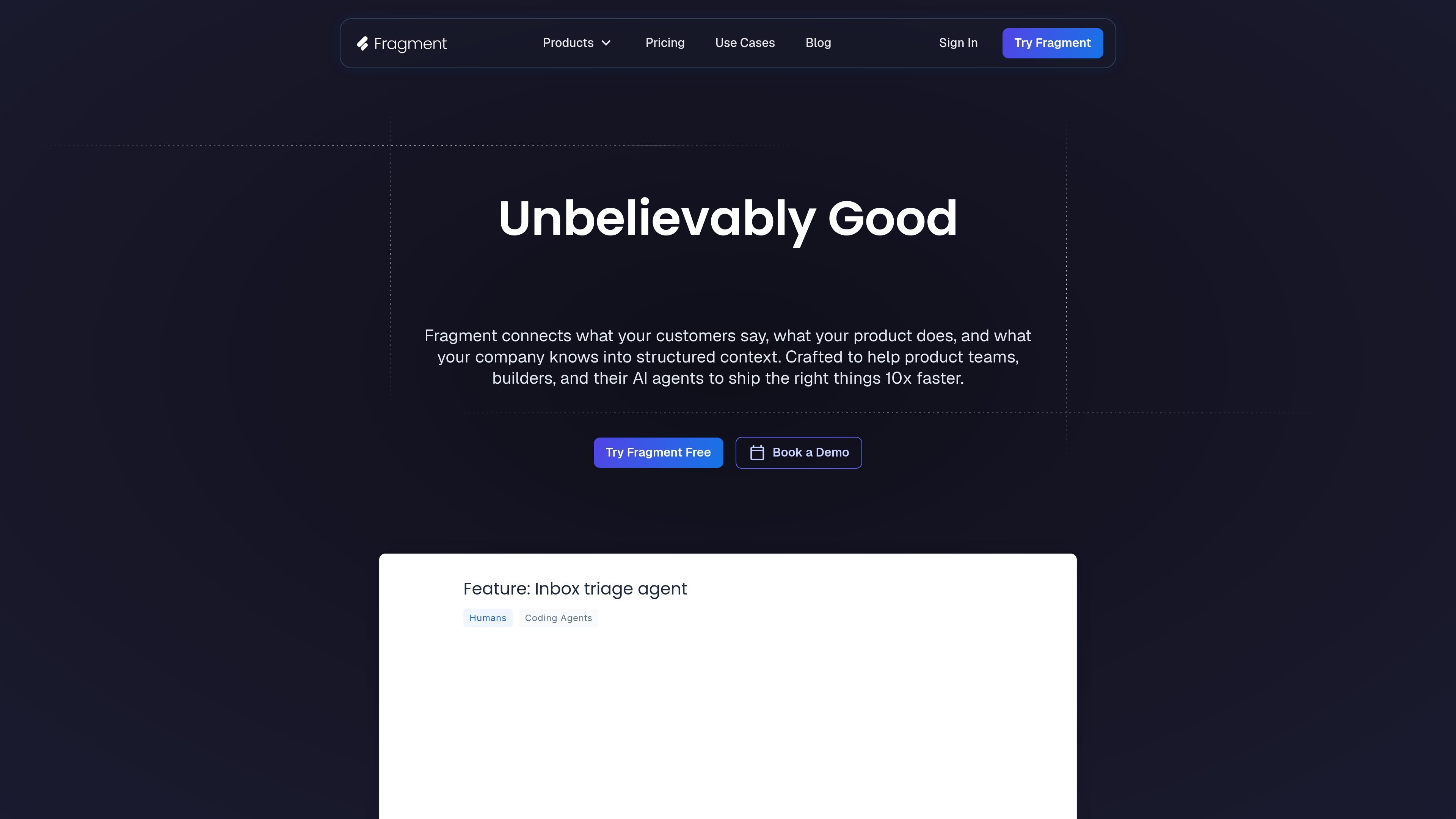
Fragment is a structured context layer for product teams and builders. It connects what customers say, what the product does, and what the company knows into one living source of truth that can be used in planning, research, and execution.
The product is designed to reduce the time spent assembling context from calls, docs, and messages. It can analyze conversations, surface themes, validate PRD claims, generate specs and research artifacts, and provide that context to AI agents through MCP-enabled integrations.
Paste a PRD or other product brief and have each claim checked against real conversations. The product returns supported, contradicted, or unsupported findings with receipts so review discussions can focus on what to build next.
Read across customer conversations to surface patterns, missed pains, and evidence for roadmap decisions. Fragment is positioned to highlight what the PRD left out, not just what it already says.
Turn calls, uploads, and feedback into tagged themes and prioritized signals automatically. The site says Fragment analyzes new material without manual tagging or taxonomy maintenance.
Generate build-ready specs from a rough idea, business goal, or question. Fragment uses customer evidence, product reality, and company context to draft execution-ready direction instead of leaving the team to assemble context manually.
Create research outputs such as VoC reports, customer personas, and Jobs-to-be-Done style summaries from real conversations. The use-case pages emphasize sourced outputs tied to exact customer wording.
Connect AI coding and product agents through MCP so they can retrieve company, product, and customer context while working in tools like Claude Code, Cursor, and Codex.
Use /prd-validation to paste a product requirement document and check each customer claim against the conversation corpus. Fragment grades claims as supported, contradicted, or unsupported and surfaces the evidence behind each result.
Run deep research across conversations for a given role and turn the findings into a sourced Jobs-to-be-Done persona. This is meant to replace persona decks built from one loud customer or a workshop guess.
Trace churn as a sequence across calls, product behavior, and written feedback instead of treating it as a single event. The use-cases page indicates Fragment can connect those time-stamped signals into one timeline.
Start from a business goal or rough product idea and use Fragment to assemble build-ready context. The homepage describes a workflow that turns a hunch into a spec grounded in customer need, product reality, and company knowledge.
Keep discovery running continuously by analyzing new meetings and uploads as they arrive. Fragment is positioned as a hands-free way to keep themes, pain points, and evidence current for the team and its AI agents.
Fragment is a structured context layer for product work. It connects customer conversations, product information, and company knowledge so teams and AI agents can work from one current source of truth.
The site describes Fragment for product teams, builders, researchers, founders, product marketers, and the AI agents they use. It is positioned around turning customer conversations into specs, insights, personas, and evidence-backed decisions.
The site says Fragment can turn a rough idea into a build-ready spec, run continuous discovery from calls, synthesize feedback, keep company context current, generate VoC reports and personas, and answer customer questions grounded in evidence.
Fragment connects to Claude Code, Cursor, and Codex through MCP. The pricing and homepage also mention native support for Gong, Zoom with Fragment's AI notetaker, Google Drive, Fireflies, and Zapier.
Yes. The pricing page says every new account starts with a 14-day reverse trial at Team-tier limits, and the Free plan still includes access to Fragment's core pipeline with usage limits. If you do not upgrade, the workspace reverts to Free limits while existing data stays accessible.

Falconer is an AI-powered company brain that keeps internal documentation accurate, searchable, and up to date by syncing with tools like GitHub, Slack, and Linear. It helps engineering and cross-functional teams centralize knowledge and answer questions from a shared source of truth.

runevr is a connected workspace for creative teams that combines boards, media review, chat, recordings, drive, calls, and AI agents in one room-based environment. It is designed to reduce tool switching and keep project context together.

Goldfish is an AI memory app for macOS that helps you reply, write, summarize, and continue using the context already on your Mac. It stores memory locally and writes in your tone.

Lasso is an ecommerce product data platform for enriching catalog records, processing supplier files, generating product content, and monitoring competitors. It combines a web app with a REST API, SDK, and MCP server for teams and developers.

ArtDeck is a visual reference board app for iPhone, iPad, and Mac that lets artists collect mixed reference material on one canvas and study it with ToolBox lenses. It works offline, supports optional iCloud sync, and is sold as a one-time purchase with no account required.

Biji - это универсальная платформа, разработанная для повышения продуктивности с помощью инновационных инструментов и функций.