
Learning memory APIs
Retain observations, Recall relevant memories, and Reflect on experience through SDKs, MCP, or HTTP. Extraction, entity linking, four-way retrieval, and reranking are handled behind the interfaces.

Hindsight is Vectorize's open-source agent-memory system for developers building coding agents, personal assistants, and custom AI applications. It stores experience, retrieves relevant context across sessions, and reflects on patterns so agents can use accumulated knowledge over time.
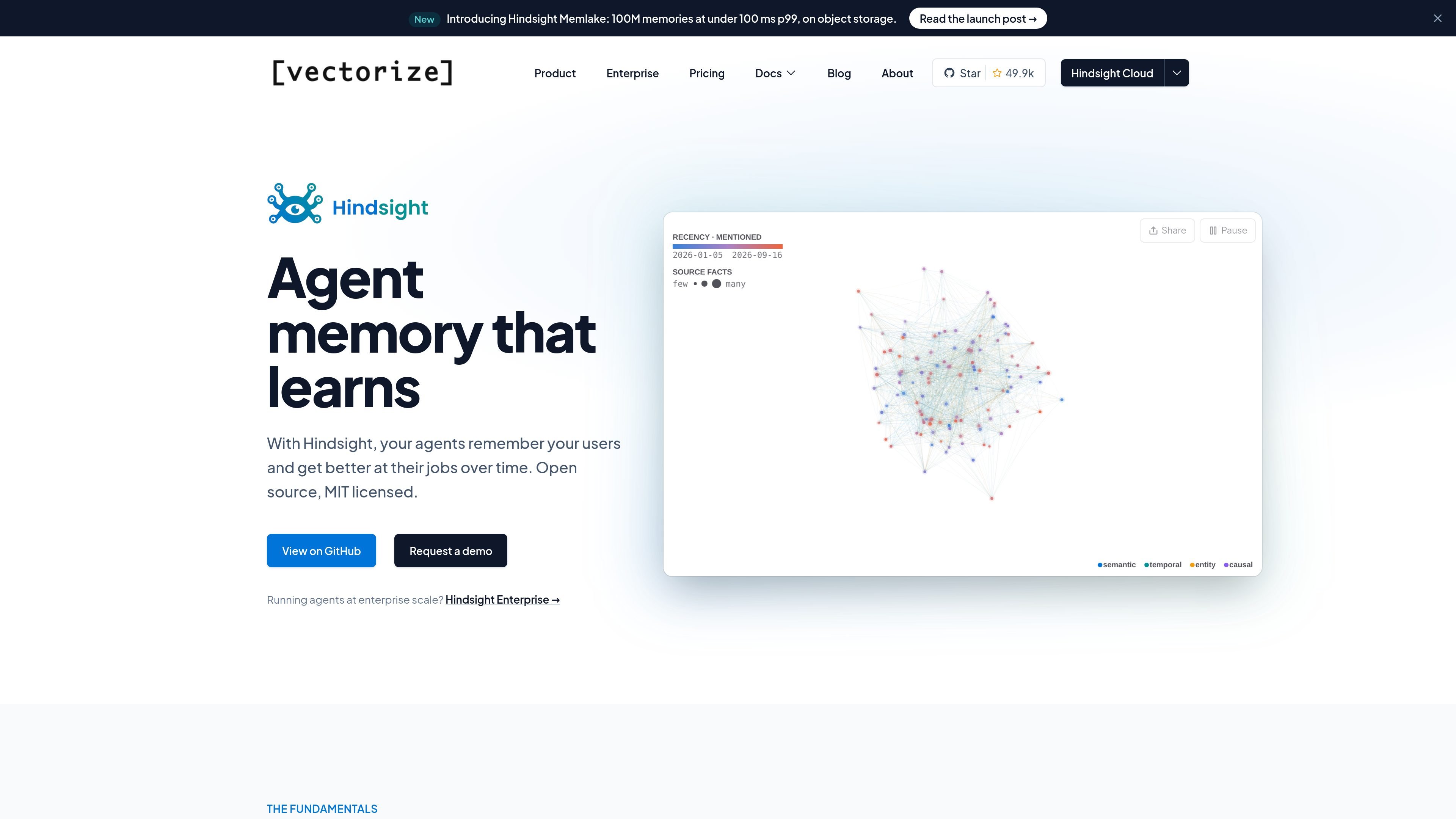
Hindsight is an open-source agent-memory system from Vectorize. It stores observations from agent interactions, retrieves relevant context across sessions, and reflects on accumulated experience to form consolidated knowledge. The goal is to give agents persistent, per-user memory that can improve their responses and decisions over time rather than relying only on retrieval of isolated facts.
Developers can run Hindsight on their own infrastructure with Docker, use the managed Hindsight Cloud service, or choose Enterprise deployment in Vectorize's cloud, a private cloud, a customer-owned public-cloud account, or on premises. Applications connect through Python, TypeScript, or Go SDKs, MCP, or plain HTTP; coding agents, personal agents, and custom applications are supported by the documented integrations.
Retain observations, Recall relevant memories, and Reflect on experience through SDKs, MCP, or HTTP. Extraction, entity linking, four-way retrieval, and reranking are handled behind the interfaces.
Each user can have persistent context containing preferences, history, and decisions, while context remains available across separate sessions.
A reflection layer consolidates individual facts into reusable knowledge and mental models, allowing recurring patterns and mistakes to influence later responses.
Hindsight is designed to work independently of a specific language model, so applications can change LLMs without discarding the memory they have accumulated.
Coding agents can be installed with one command across more than 20 listed harnesses, with per-repository memory built from Git history and prior sessions. Hermes and OpenClaw can also use Hindsight as their memory provider.
The open-source edition runs on Postgres, while Enterprise includes Memlake, a Rust storage engine for object storage designed for very large memory banks and four kinds of search over one copy of each memory.
Install Hindsight across supported coding-agent harnesses so each repository can retain Git history and prior-session context. This gives the agent project-specific memory while work continues across tasks.
Give a personal agent persistent recall before it answers and retention after each turn. The documented Hermes and OpenClaw integrations are designed for this conversational workflow.
Connect an existing agent or application through an SDK, MCP, or HTTP and use Retain, Recall, and Reflect to preserve user preferences, retrieve relevant history, and consolidate recurring patterns.
Run Hindsight in a private cloud, customer-owned cloud account, or on-premises environment when an organization needs single-tenant isolation, private networking, identity controls, auditability, or contracted support.
Use Memlake when continuously accumulating agent memory exceeds the intended operating range of a conventional Postgres-backed deployment. It is designed for large memory banks on object storage and can be deployed across the Enterprise options.
Hindsight is an open-source agent-memory system that can be run on your own infrastructure with Docker. The self-hosted edition is MIT licensed, has no usage limits or telemetry according to the pricing FAQ, and includes the full learning system, SDKs, REST API, and MCP server.
Hindsight Cloud is a managed, pay-as-you-go service. Vectorize operates the infrastructure, scaling, backups, and updates; billing is based on token usage or fixed-workload operations rather than seats, and free credits are available to get started.
The product exposes Retain, Recall, and Reflect operations through Python, TypeScript, and Go SDKs, MCP, or plain HTTP. The system handles extraction, entity linking, retrieval, and reranking behind these interfaces.
Enterprise deployments can run as Hindsight Cloud with enterprise features, in a dedicated private cloud, in a customer-owned AWS, Google Cloud, or Azure account, or on the customer's Kubernetes infrastructure, including air-gapped environments.
Hindsight Enterprise adds controls such as SSO, enforced MFA, Memory Defense, data-privacy workflows, audit logs, webhooks and SIEM integration, private networking, single-tenant deployment options, and contracted support. Enterprise pricing is handled through sales.

Goldfish is an AI memory app for macOS that helps you reply, write, summarize, and continue using the context already on your Mac. It stores memory locally and writes in your tone.

Lasso is an ecommerce product data platform for enriching catalog records, processing supplier files, generating product content, and monitoring competitors. It combines a web app with a REST API, SDK, and MCP server for teams and developers.

CreateOS Sandbox is an isolated compute environment for running code and agent workloads inside Firecracker micro-VMs. It is designed for workflows that need machine-level isolation, private networking between sandboxes, and programmatic control through SDK, CLI, or MCP.

ArtDeck is a visual reference board app for iPhone, iPad, and Mac that lets artists collect mixed reference material on one canvas and study it with ToolBox lenses. It works offline, supports optional iCloud sync, and is sold as a one-time purchase with no account required.

GitBot is a local browser-based workspace for creating reusable coding bots powered by Claude Code, Codex, or OpenCode. It helps developers run those agents across repository folders with persistent threads and configurable permissions.

Codex Plugins bundle reusable skills, app integrations, and MCP servers into workflows you can install in the Codex app or use from Codex CLI. They help extend Codex with connected-service tasks, reusable instructions, and shared team workflows.