
End-to-end workflow execution
Nanonets Agents read messy inputs, apply business rules, and complete work inside systems of record instead of stopping at extraction.

Nanonets is an AI platform for automating enterprise document and data workflows, including accounts payable, claims, order management, and document extraction. It connects to systems such as SAP, Salesforce, and Oracle, and offers a starter plan with $200 in credits.
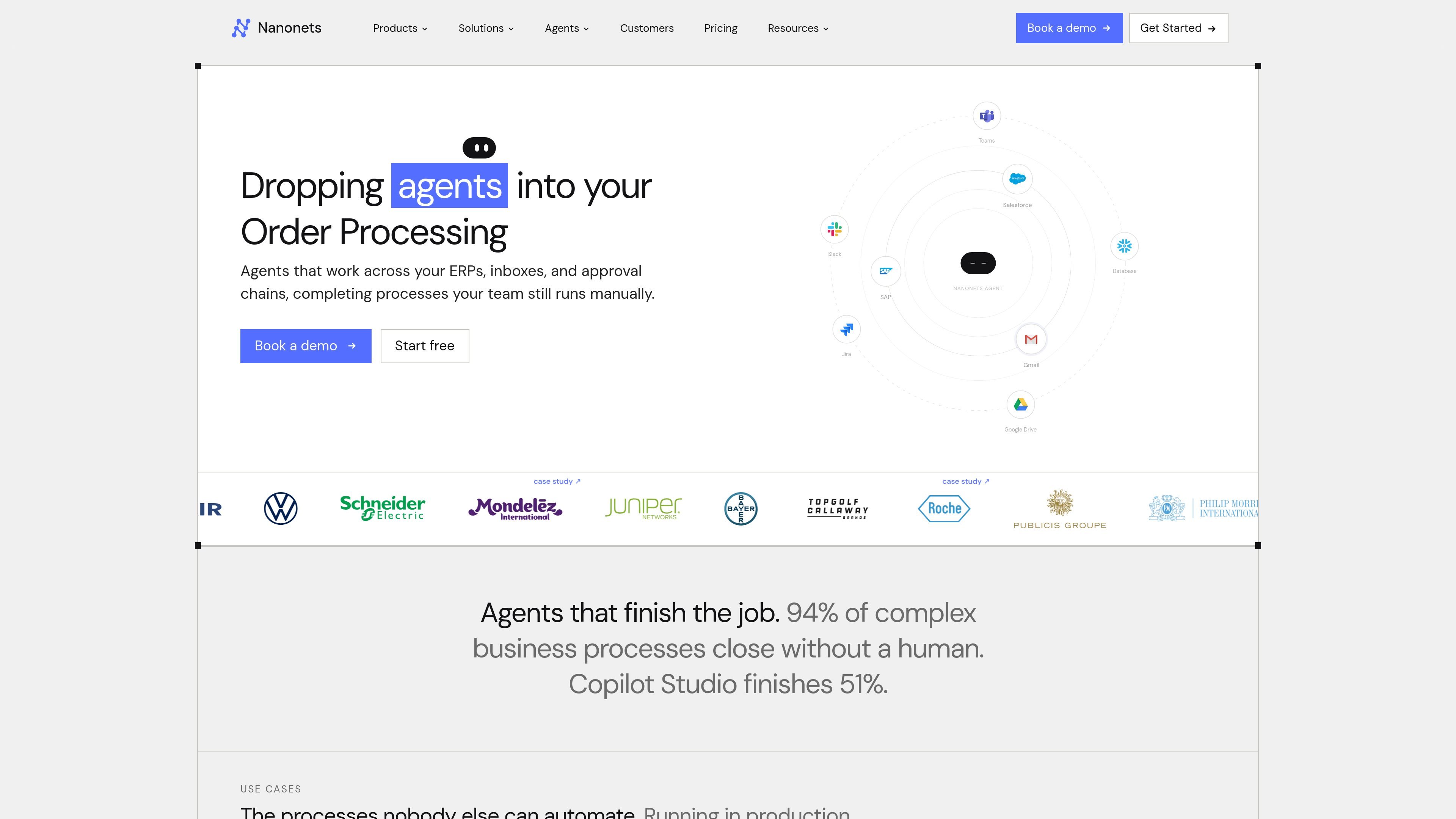
Nanonets is an AI-powered enterprise data processing platform that combines managed agents with document extraction APIs. It is designed to handle manual business workflows such as accounts payable, order management, claims processing, contract analysis, and invoice or rate-card reconciliation.
The platform reads documents and other inputs, validates them against business rules, and posts results into connected systems such as SAP, Salesforce, Oracle, and other business tools. Nanonets also offers an extraction API for teams that need structured output from complex documents for LLM pipelines, RAG systems, and automation workflows.
Nanonets Agents read messy inputs, apply business rules, and complete work inside systems of record instead of stopping at extraction.
The platform integrates with enterprise tools including SAP, Oracle, Salesforce, Google Drive, Slack, Microsoft Teams, Gmail, Jira, Asana, Snowflake, and common finance apps.
The agents can ingest SOPs and runbooks written in natural language, then use them to guide task execution.
When the agent is unsure, it can route cases to Slack, Teams, or email for human review and approval.
Every extracted field can link back to its source, with side-by-side citations, context-aware viewing, and discrepancy detection.
The extraction product returns clean markdown and structured JSON, and is built for parsing, splitting, chunking, and extraction workflows.
Automate invoice intake, 3-way matching, approval routing, and ERP posting for accounts payable teams.
Validate freight invoices or similar charges against rate cards, reconcile discrepancies, and flag exceptions for review.
Process orders across inboxes and approval chains, then route clean data into systems of record.
Handle claims or reimbursement workflows where documents, validation rules, and human review are part of the process.
Extract structured data from complex documents for RAG pipelines, LLM applications, and downstream automation.
Nanonets Agents complete workflows end to end by reading inputs, applying business rules, and posting results into systems of record. The source material contrasts this with chatbots and copilots, which assist a person rather than finish the process.
The source says agents can run across ERP, inbox, storage, and collaboration tools, and lists systems such as SAP, Oracle, Salesforce, Google Drive, Slack, Microsoft Teams, Gmail, Jira, Asana, Snowflake, QuickBooks, Xero, Sage, Stripe, HubSpot, Zendesk, Dropbox, Box, and Notion.
The pricing page says every account starts with $200 in credits, with no platform fees on the Starter plan and no credit card required to start. It also says paid usage is measured by block runs.
For the agent product, the source says you can upload existing runbooks and SOPs, and the agent reads those instructions to start executing. For the extraction API, the quick-start flow is to upload a document and get structured data back.
The source describes configurable approval gates, human review through Slack, Teams, or email, and audit logs for each run. It also says the platform supports private deployment, data residency options, and enterprise controls.

Awish is an AI-powered no-code automation platform that turns natural-language requests into automated workflows across connected apps. It serves individuals and teams that want to automate repetitive tasks, chat-based assistants, and workflow updates without manual configuration.

Codex Plugins bundle reusable skills, app integrations, and MCP servers into workflows you can install in the Codex app or use from Codex CLI. They help extend Codex with connected-service tasks, reusable instructions, and shared team workflows.

Struere is an AI-native platform for turning spreadsheet data into structured operational software with dashboards, alerts, and automations. It is aimed at teams that want to replace manual spreadsheet workflows without building custom tools from scratch.

Make Real is a Next.js app that turns hand-drawn wireframes into working HTML prototypes using the tldraw SDK and AI models. It helps users sketch on a canvas, generate code, and review the result in an embedded preview.

Wysera is an AI business platform that combines PostWyse for content and OpsWyse for CRM and revenue workflows, powered by the shared Wyse AI. It is built for solo operators, teams, and agencies that want approval-first automation across publishing, lead follow-up, and related operations.

OpenFlags is an open-source, self-hosted feature flag platform for modern JavaScript teams. It supports local evaluation, targeted rollouts, and controlled launches while keeping flag data in your own infrastructure.