
Real-time neural rendering
Uses a real-time neural rendering model to infuse pixels with photoreal lighting and materials, shifting DLSS from performance boosting into image-generation-driven visual fidelity.

NVIDIA DLSS 5 is an AI-powered GeForce rendering technology that infuses game pixels with photoreal lighting and materials in real time. It is designed for developers and players using supported RTX workflows and games.
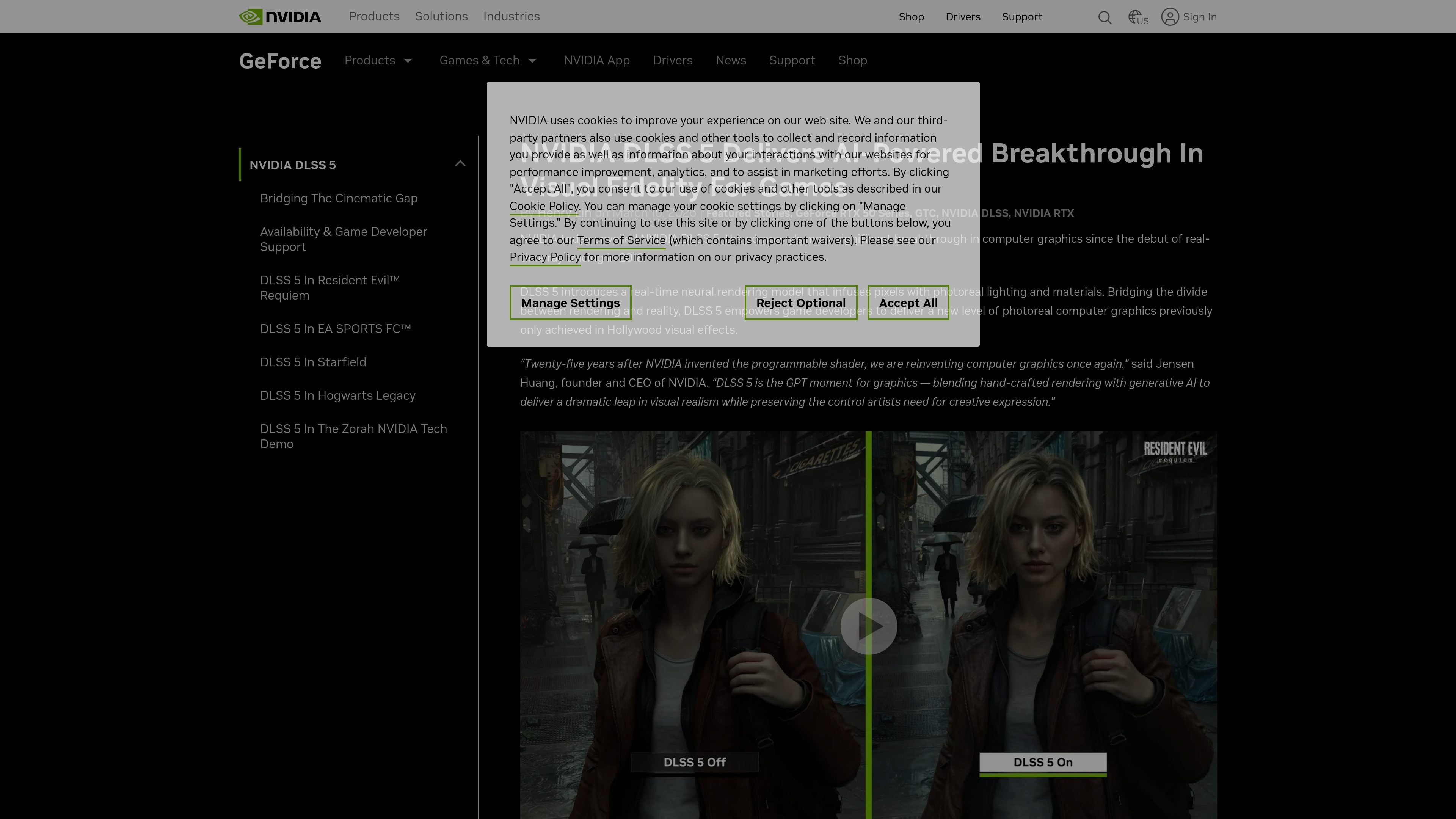
NVIDIA DLSS 5 is an AI-powered GeForce rendering technology introduced as a major step beyond earlier DLSS releases. It uses a real-time neural rendering model to infuse pixels with photoreal lighting and materials, with the goal of narrowing the gap between real-time game graphics and the visual fidelity seen in offline rendering.
According to NVIDIA, DLSS 5 takes a frame’s color and motion vectors as input, keeps the output grounded in the game’s 3D content, and runs in real time at up to 4K resolution. The technology is positioned for game developers building visually rich scenes, while preserving control over look and artistic intent through intensity, color grading, and masking controls.
Uses a real-time neural rendering model to infuse pixels with photoreal lighting and materials, shifting DLSS from performance boosting into image-generation-driven visual fidelity.
Takes each frame’s color and motion vectors as input and anchors the output to the game’s source 3D content, which helps keep results consistent from frame to frame.
Runs in real time at up to 4K resolution, supporting interactive gameplay rather than offline rendering workflows.
Understands scene semantics such as characters, hair, fabric, translucent skin, and lighting conditions like front-lit, back-lit, and overcast scenes.
Provides developer controls for intensity, color grading, and masking so artists can guide where the enhancement appears and how strong it is.
Integrates through the same NVIDIA Streamline framework used by existing DLSS and NVIDIA Reflex technologies.
Teams building visually ambitious games can use DLSS 5 to add photoreal lighting and material detail while keeping the result anchored to the game’s own 3D world.
Studios that want more control over presentation can tune intensity, color grading, and masking to match a specific art direction instead of applying a one-size-fits-all effect.
Games that need smooth play at high resolution can use DLSS 5’s real-time output at up to 4K to maintain interactivity while improving perceived realism.
Developers already using NVIDIA DLSS or NVIDIA Reflex can integrate through the same NVIDIA Streamline framework, which fits into existing supported workflows.
Publishers and studios working on supported titles such as Starfield, Resident Evil Requiem, and Hogwarts Legacy can plan around DLSS 5 as a graphics enhancement for those games.
DLSS 5 is an NVIDIA GeForce AI rendering technology for supported games and RTX hardware. It takes a game’s color and motion vectors as input and uses a real-time neural rendering model to infuse pixels with photoreal lighting and materials.
The source says DLSS integrates with the same NVIDIA Streamline framework used by existing DLSS and NVIDIA Reflex technologies, so it is designed to fit into established game-development workflows rather than require a separate pipeline.
DLSS 5 is described as running in real time at up to 4K resolution for smooth, interactive gameplay. It is trained to understand scene semantics such as characters, hair, fabric, and translucent skin, along with lighting conditions like front-lit, back-lit, or overcast scenes.
The source notes that DLSS 5 gives developers controls for intensity, color grading, and masking so they can decide where and how enhancements are applied while preserving a game’s aesthetic.
The article does not give pricing information. The separate NVIDIA pricing page redirects users to regional sites for local pricing and where to buy information, but it does not provide a DLSS 5 price on the page itself.

GameGrad turns PDF study material into quiz questions that appear inside arcade games, so users can practice active recall while they play. It offers a free tier with one PDF and a Pro plan with more uploads, more questions, and answer explanations.

Gerty is a local AI assistant for Apple silicon Macs that handles chat, writing, documents, voice and selected Mac app tasks without sending data to the cloud. It works offline after model downloads and is designed for users who want private everyday AI without an account or subscription.

DailyPlay.ai is a behavioral growth platform that uses AI site scanning and micro-games to help brands improve engagement and conversion. It supports web, mobile, and other digital touchpoints, with a one-line script setup and a free engagement scan.

Grok 4.7 is an xAI model for software development and knowledge work, including extended coding tasks and professional analysis. It is available through Grok Build, Cursor, the Grok API, and other developer platforms, with token pricing starting at $2 per million input tokens and $6 per million output tokens.

AakarDev AI helps teams manage AI provider access, project-level setups, logs, and analytics from one dashboard. It supports BYOK workflows and lists providers including OpenAI, Google Gemini, Anthropic, Groq, Mistral AI, and Perplexity AI.

BookAI позволяет вам общаться с вашими книгами, просто предоставив название и автора.