
Automatic human segmentation
Uses a neural network to segment people in camera images before pixelating them, with a stated distance-related limitation on detection quality.

A free C++ person-pixelation project that anonymizes people in video using OpenCV and neural network segmentation. It is aimed at developers building privacy-focused live video or browser-based computer-vision applications.
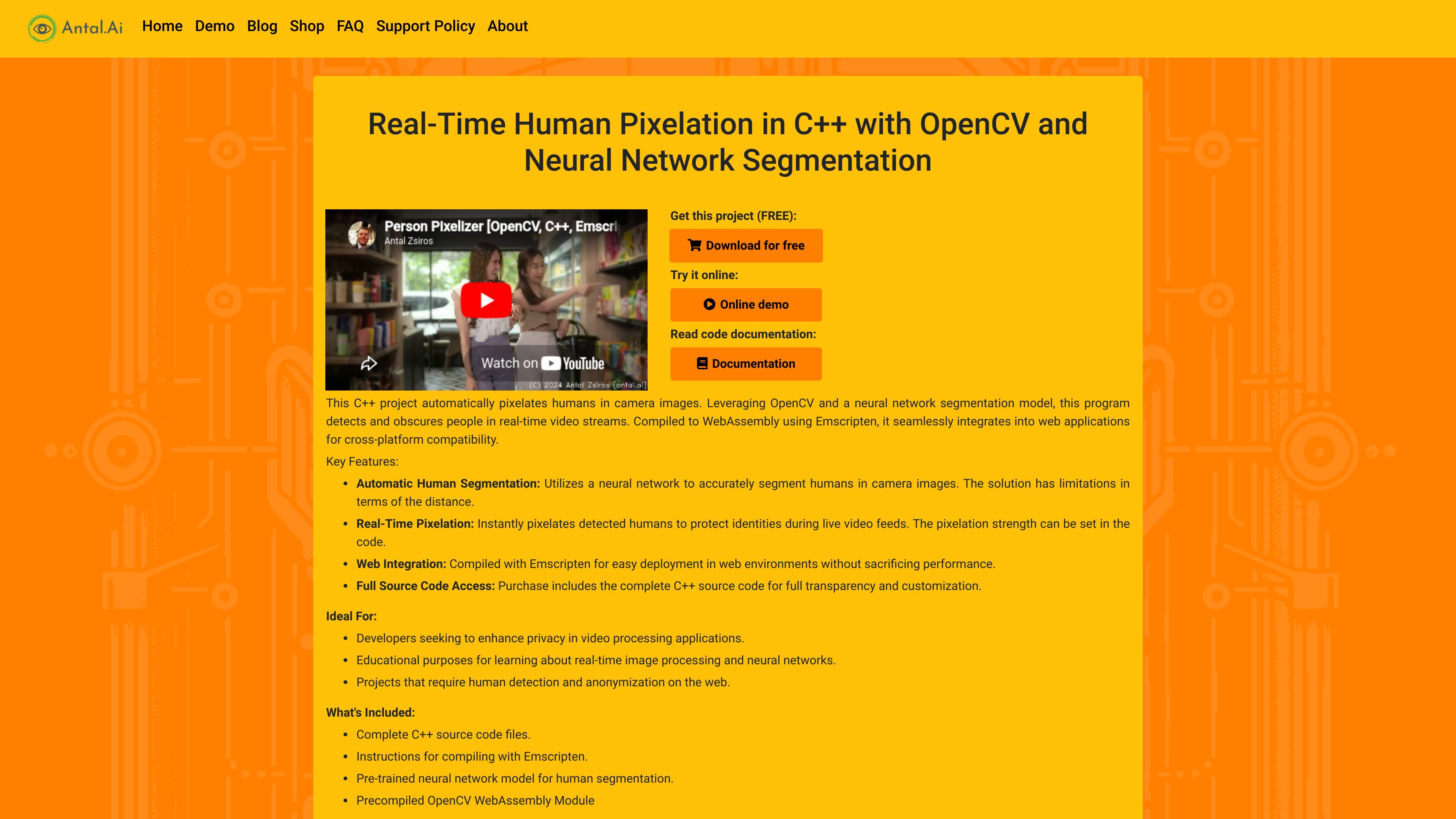
Person Pixelizer is a free real-time privacy anonymization project that pixelates people in video using C++, OpenCV, and neural network segmentation. Its purpose is to detect humans in camera images and obscure them live, helping developers build applications that protect identities during video capture or streaming.
The project is compiled to WebAssembly with Emscripten for browser-friendly deployment. The product page says it includes the complete C++ source code, documentation, build instructions, a pre-trained human-segmentation model, and a precompiled OpenCV WebAssembly module, so buyers can study, customize, and integrate the implementation into their own work.
Uses a neural network to segment people in camera images before pixelating them, with a stated distance-related limitation on detection quality.
Applies pixelation to detected people in live video streams to obscure identities during capture or playback.
The project is compiled to WebAssembly with Emscripten, which supports browser-based deployment and cross-platform use.
Ships with complete C++ source files, build instructions, and documentation so users can inspect and adapt the implementation.
Includes a pre-trained segmentation model and a precompiled OpenCV WebAssembly module required by the demo and build workflow.
Lets developers set the pixelation strength in code rather than through a separate user-facing control panel.
Build a web or app feature that obscures people in live camera feeds to reduce exposure of personal identity.
Prototype or study a practical computer-vision pipeline that combines segmentation, pixelation, and browser deployment.
Integrate the project into a larger commercial product where anonymized video is needed, while keeping the implementation under your control.
Adapt the code for desktop, mobile, server, or browser-based workflows, using the included source and build instructions as a starting point.
Demonstrate a browser-based privacy demo using the provided WebAssembly-oriented implementation and demo workflow.
The product page describes Person Pixelizer as a C++ project that automatically pixelates humans in camera images using OpenCV and neural network segmentation.
The source indicates the project includes complete C++ source code, documentation, build instructions, a pre-trained human-segmentation model, and a precompiled OpenCV WebAssembly module.
Yes. The FAQ says you may integrate the code into your own projects and ship the resulting product commercially, including as binaries or services.
The source says the code is compiled to WebAssembly with Emscripten for web environments, but it also requires C++ knowledge and the Emscripten SDK for compilation.
The product page notes that the solution has limitations related to distance, and the FAQ says support and custom changes are not provided because these are self-serve products.

Snapmark is a VS Code extension that lets you annotate clipboard screenshots before pasting them into AI chats. It supports blur redaction, numbered callouts, and automatic resizing for large images.

Arduino VENTUNO Q is an edge AI computer for AI and robotics applications. It combines AI inference and deterministic control on a single board and is designed to work with Arduino App Lab.

Uni-1 is Luma’s multimodal reasoning model for generating and editing images. It supports text-to-image, reference-guided, and API-based workflows for creators and developers building visual content.

Magic Eraser — это инструмент на основе ИИ, который позволяет пользователям быстро удалять нежелательные объекты, людей, текст и дефекты с фотографий с легкостью.

Faceswapai.Online is a web-based AI face swap tool for photos and videos, including multiple-face workflows. It offers free-to-try access without sign-up and paid credit-based VIP features for larger or longer jobs.

BgSub is a browser-based AI tool for removing or replacing image backgrounds. It supports automatic cutouts, background replacement, and color adjustment for people editing product images, photos, or web visuals.