
Source-to-script generation
Start with a topic, article, document, URL, notes, or audio file and turn it into a structured podcast script without manual reformatting.

PodcastorAI is an AI podcast studio that turns content into podcast scripts, audio episodes, and video podcasts. It helps creators produce publish-ready shows from topics, documents, URLs, notes, or recordings without a traditional studio setup.
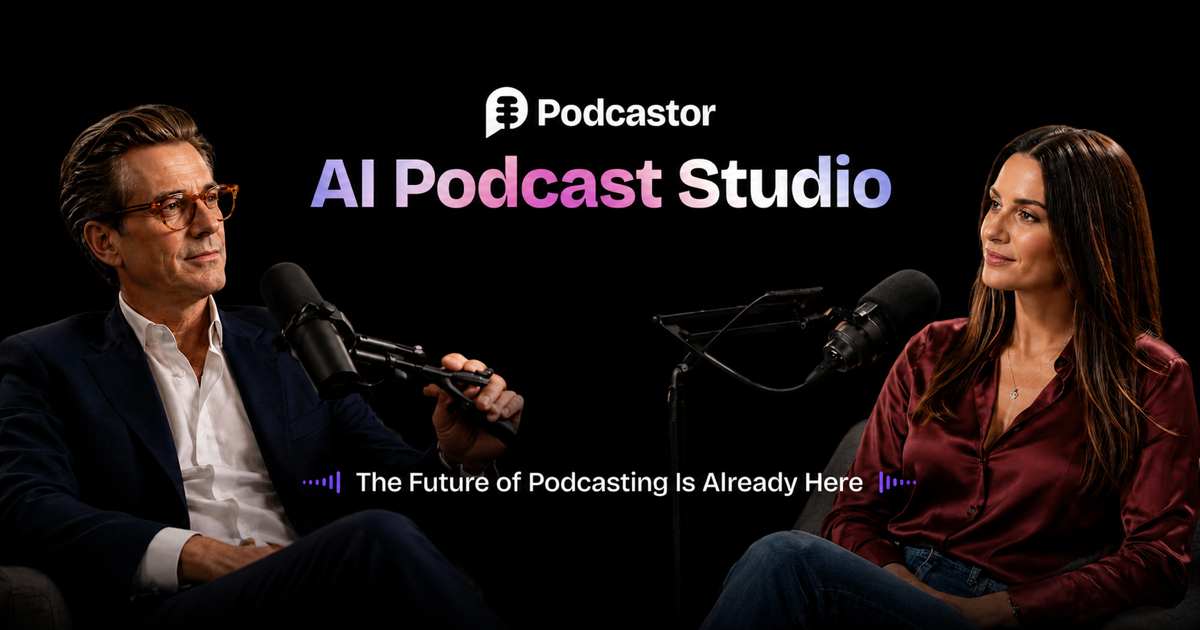
PodcastorAI is an AI podcast studio for creators that turns written content, URLs, notes, documents, and audio recordings into podcast scripts, audio episodes, and video podcasts. The product is built around a single workflow: bring in source material, structure it as a podcast, generate the narration, and render a publishable episode.
The site positions the tool for people who want to produce podcasts without traditional recording setup. It supports both audio-first production and video podcast formats, with options for solo episodes, two-person conversations, talk shows, split-screen layouts, and other visual styles. The pricing page shows a free trial tier and paid plans with increasing credit allowances and longer project storage.
Start with a topic, article, document, URL, notes, or audio file and turn it into a structured podcast script without manual reformatting.
Choose between solo and co-host script structures. The tool can assign sections between two voices and include handoff cues for a conversation-style episode.
Select from AI voices, use voice cloning, or create a custom AI voice before generating the episode audio.
Build video podcasts in layouts such as solo, two-shot, split-screen, talk show, waveform, or same-screen formats.
Export episodes with captions and publish-ready layouts for platforms such as YouTube, Spotify, Apple Podcasts, and TikTok.
The pricing page indicates script generation, transcript editing, audio creation, remove-watermark options on paid plans, and project storage periods that vary by plan.
Turn articles, reports, or long-form notes into a script that can be edited and then produced as an audio episode or video podcast.
Paste a URL or upload a PDF or DOCX file to generate a conversation-ready script without manually rewriting the source material.
Use the co-host workflow to assign lines between two voices and create a discussion-style episode from one source document.
Produce visual podcast versions with layouts such as solo, talk show, split-screen, or two-shot when you want a video format for social or platform publishing.
Start from a topic or outline, generate a first-draft script, then refine it before generating audio with an AI or cloned voice.
PodcastorAI can start from a topic, or from source material such as a URL, PDF, DOCX file, notes, plain text, or an existing audio recording. It turns that input into a structured podcast script and can continue into audio or video production.
The workflow shown on the site is: add source material, generate and edit the script, choose a voice, then publish as audio or video. The product also supports solo and co-host formats, with video layouts such as waveform, split-screen, and same-screen.
The site says you can generate audio with ElevenLabs or MiniMax voices, a cloned version of your own voice, or a custom AI voice. The pricing page also lists free voice design and cloning limits on paid plans.
Yes. The site says finished episodes can be exported with captions and multiple formats, and shared or published to platforms including YouTube, Spotify, Apple Podcasts, and TikTok.
The pricing page offers a free plan and paid subscriptions. The free plan is described as a trial with limited credits, while paid plans add higher credit allowances and additional capabilities.

Fylom is an AI podcast generator that turns a topic or question into a researched narrated episode. It supports typed or spoken prompts, voice selection, and recurring show-style listening.

CAMB.AI Streams dubs live audio in multiple languages in real time for broadcasts on platforms like YouTube, Twitch, and X. It plugs into existing live workflows using common streaming protocols and avoids a post-production step.

Official HeyGen API documentation for building AI avatar videos, translations, lipsync, and interactive video-agent sessions. It supports direct API use plus MCP and CLI-style workflows for developers and AI agents.

Talkpal is an AI-powered language learning web and mobile app for practicing speaking, listening, writing, and pronunciation. It offers guided courses, roleplays, and call-style conversation practice across 130+ languages.

BeFreed is a personalized audio learning app that turns books and other knowledge sources into narrated listening experiences. It helps people learn on demand through interactive audio, voice selection, and built-in learning tools.

Gemini 3.1 Flash TTS is Google’s preview text-to-speech model for generating expressive AI speech with fine-grained control over style and delivery. It is available across the Gemini API, Google AI Studio, Vertex AI, and Google Vids.