
Opportunity discovery and ranking
Settle scans pre-RFP signals, posted RFPs, and buyer movement, then ranks opportunities so teams can focus on the contracts that look most relevant.

Settle is an RFP revenue automation platform that helps teams find and qualify better-fit opportunities, draft responses from approved company knowledge, and review readiness before submission. It is aimed at proposal, sales, and business development teams managing formal buying opportunities.
Settle is an RFP revenue automation platform for teams that want to find better-fit opportunities earlier, qualify them with source-backed context, and respond using approved company knowledge. The site describes it as a revenue channel for teams where one qualified win can justify the platform many times over.
Its core workflow combines opportunity discovery, fit scoring, response drafting, and readiness review. Rather than operating as only a bid board or only a response writer, Settle is positioned to help proposal, sales, and business development teams manage the process from the first signal through submission.
Settle scans pre-RFP signals, posted RFPs, and buyer movement, then ranks opportunities so teams can focus on the contracts that look most relevant.
The product looks at budgets, renewals, board agendas, vendor movement, agency intent, and posted RFPs to surface opportunities earlier than a bid-board-only workflow.
Settle uses company knowledge, approved answers, and prior wins to draft responses from a shared knowledge hub instead of scattered files.
The platform checks whether a response is ready before submission, with a workflow that can carry the opportunity from first signal through final submission.
The site describes workflow consultation, gap analysis, custom signal criteria, and existing data source and app integrations for teams with established RFP processes.
Teams that want to identify likely RFPs before they are widely posted can use Settle to monitor pre-RFP signals such as budgets, renewals, board agendas, vendor movement, and buyer intent.
Proposal teams can route posted RFPs into a single workflow that ranks fit, drafts responses from approved knowledge, and checks readiness before submission.
Organizations with complex questionnaires and reusable content can centralize approved answers, prior wins, and capability statements so responses are faster and more consistent.
Teams with an existing process can use the consultation-led workflow to define custom signal criteria, review gaps, and connect their data sources and apps around a specific motion.
Sales and business development teams can use the platform to surface deadline-sensitive opportunities and reduce the chance that a contract is missed because it was tracked across too many places.
Settle starts with opportunity discovery and qualification, then supports response drafting and readiness review through submission. The site positions it as earlier in the workflow than tools that only help once an RFP is already on your desk.
A bid board shows posted opportunities. Settle is meant to identify what matters earlier, explain why it fits, and help teams turn that opportunity into a stronger submission.
Settle combines source-backed context, fit scoring, company knowledge, response drafting, and readiness checks in one workflow. The site contrasts this with aggregators or scraping setups that mainly collect postings or raw signals.
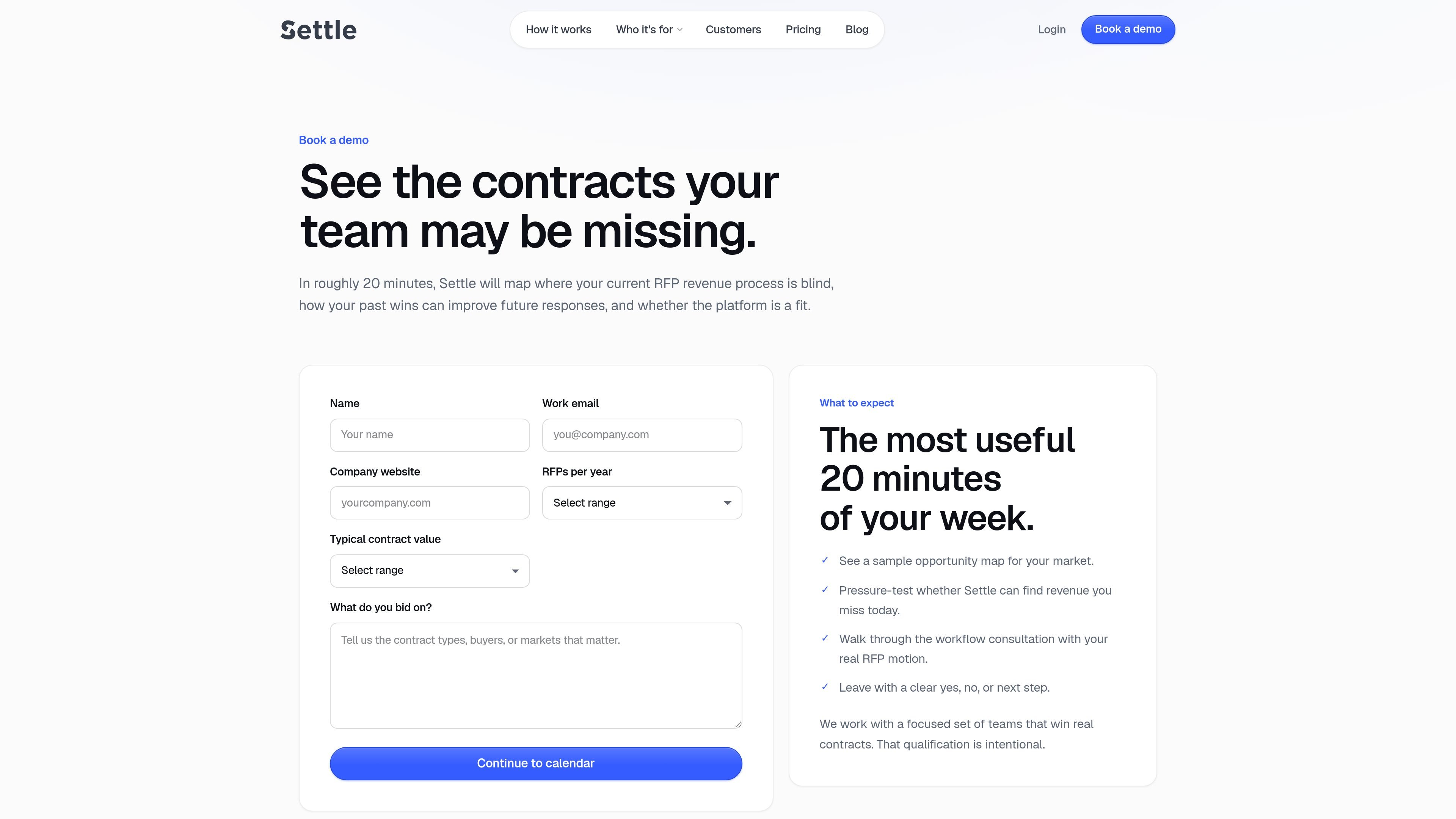
The workflow consultation reviews the markets you bid in, the contracts you should be seeing, and how Settle could be configured around one real opportunity. The book-demo form says the session is roughly 20 minutes.
No. The site says Settle is strongest when there is a real contract motion or clear evidence you can win, such as past performance, buyer context, or approved knowledge to build from.

runevr is a connected workspace for creative teams that combines boards, media review, chat, recordings, drive, calls, and AI agents in one room-based environment. It is designed to reduce tool switching and keep project context together.

Goldfish is an AI memory app for macOS that helps you reply, write, summarize, and continue using the context already on your Mac. It stores memory locally and writes in your tone.

Lasso is an ecommerce product data platform for enriching catalog records, processing supplier files, generating product content, and monitoring competitors. It combines a web app with a REST API, SDK, and MCP server for teams and developers.

ArtDeck is a visual reference board app for iPhone, iPad, and Mac that lets artists collect mixed reference material on one canvas and study it with ToolBox lenses. It works offline, supports optional iCloud sync, and is sold as a one-time purchase with no account required.

Biji - это универсальная платформа, разработанная для повышения продуктивности с помощью инновационных инструментов и функций.

Struere is an AI-native platform for turning spreadsheet data into structured operational software with dashboards, alerts, and automations. It is aimed at teams that want to replace manual spreadsheet workflows without building custom tools from scratch.