
Online video uploads
Upload MP4, MOV, WebM, M4V, and GIF files through the browser, with a stated maximum file size of 200MB.

Video Upscaler is a browser-based AI tool that enhances blurry, noisy, compressed, and low-resolution footage for sharper HD, 2K, or 4K output. It supports creators, editors, marketers, and restoration users working with archived or everyday video.
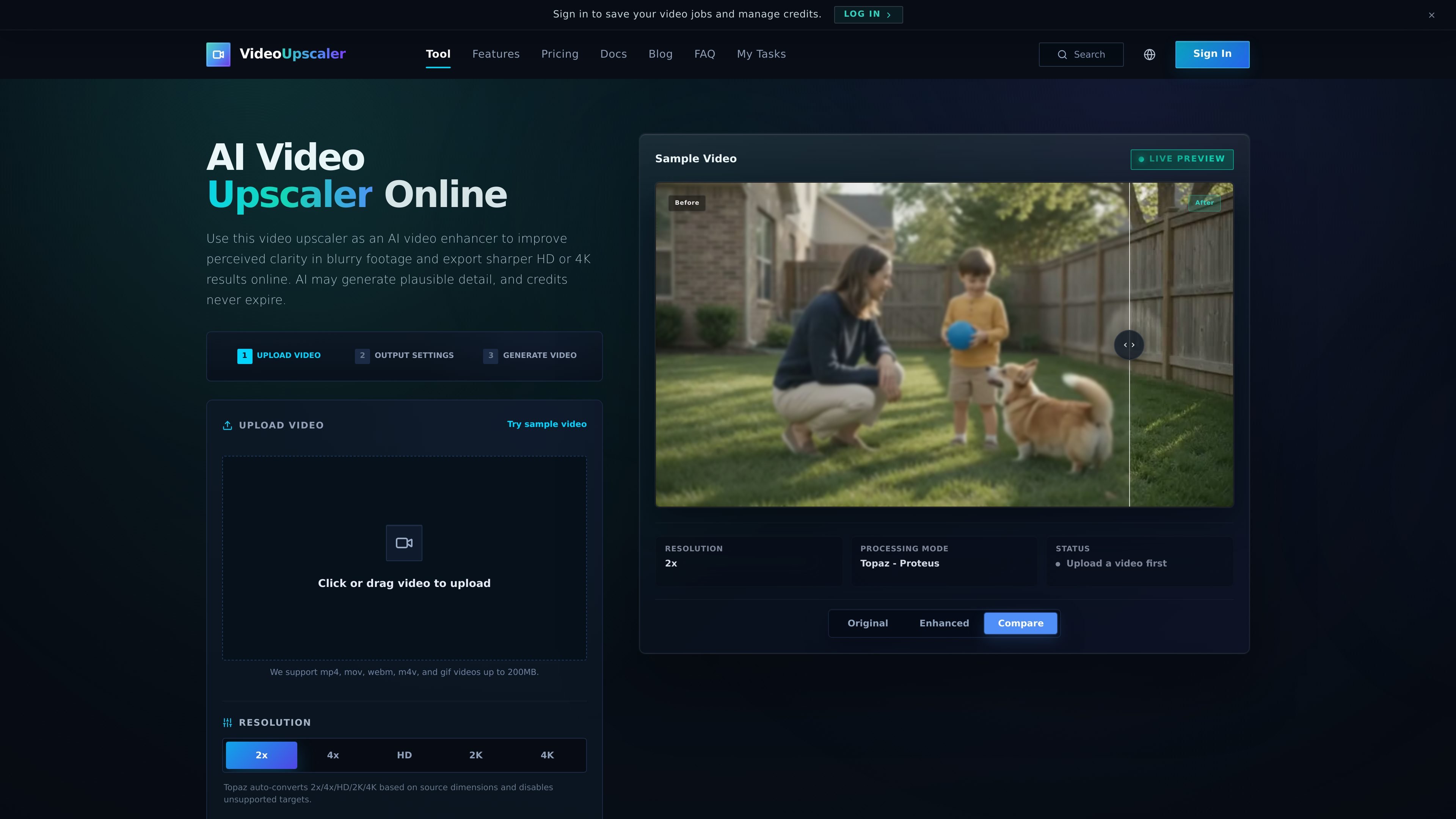
Video Upscaler enhances blurry, noisy, compressed, and low-resolution footage in your browser, with sharper HD, 2K, or 4K output for creators and editors.
The product combines resolution scaling with frame-level enhancement intended to improve edges, texture, readability, and perceived clarity. Users upload a supported video, select a model, processing mode, and output target, then generate and compare the result. Because the system can reconstruct plausible detail, the output should be checked against the source, especially when the original contains little usable information.
Upload MP4, MOV, WebM, M4V, and GIF files through the browser, with a stated maximum file size of 200MB.
Choose 2x, 4x, HD, 2K, or 4K targets where supported. The interface adapts target availability to the source dimensions.
Use the Topaz model with Proteus processing in the documented workflow. The site describes it as a general enhancement mode for improving clarity and detail.
Apply enhancement to blurry, noisy, compressed, archived, or low-resolution footage, with workflows that mention denoising, sharpening, anime enhancement, and face restoration.
Preview a sample, compare before and after results, and review a short test before committing to a larger final export when source quality is poor.
Credits are calculated from settings and file characteristics, and the listed Starter, Standard, and Premium plans retain unused credits rather than expiring them.
Improve family tapes, archived clips, and other older recordings when faces, clothing, signs, or background texture need to be easier to inspect. The source should still be reviewed because reconstructed details can be plausible rather than historically exact.
Prepare vertical clips, reels, and short-form posts for reposting. HD can suit fast publishing, while 4K can provide additional room for cropping before another platform compresses the video.
Polish tutorials, interviews, product shots, gameplay, and b-roll without rebuilding the edit. The enhancement workflow is aimed at making existing creator footage sharper and more readable.
Clean up downloaded, messenger-saved, or heavily compressed clips by combining noise reduction and sharpening, then compare the result to avoid harsh or unnatural edges.
Video Upscaler is a browser-based AI tool that increases video resolution and enhances perceived clarity by analyzing frames, improving edges and texture, reducing visible artifacts, and reconstructing plausible detail. Generated detail may not match information that was absent from the original footage.
Upload an MP4, MOV, WebM, M4V, or GIF file, choose the model, processing mode, and target resolution, then run the enhancement job and export the result. The site supports uploads up to 200MB.
The workflow offers HD, 2K, and 4K targets, along with 2x and 4x scaling options. The interface automatically converts these choices based on the source dimensions and disables unsupported targets.
Low-resolution, blurry, noisy, compressed, archived, and social-media clips are identified as suitable sources. The site recommends using the cleanest source available, matching the output to the final use, and reviewing the enhanced result against the original.
Credits are used according to the selected settings and the uploaded file. Credits in the listed plans do not expire, and the final charge is calculated server-side from the file and settings; pricing estimates are approximate.

Let's Enhance is an online AI image app for enhancing, upscaling, and restoring photos. It helps users clean up images, increase resolution, and process files through free credits, subscriptions, or pay-as-you-go bundles.

EbSynth is VFX software for creative video transformations, retouching, and rotoscopy. It lets users edit keyframes and propagate those changes across a video for tasks like stylized animation, cleanup, and colorization.

SkyReels is an AI video generation platform with a web creative studio and API access. It supports text-to-video, image-to-video, and reference-based workflows for creators and developers.

Gling is a desktop AI video editing tool for YouTube creators. It automatically removes bad takes, silence, filler words, and background noise, and it also supports captions, YouTube metadata tools, and export to common editing formats.

HitPaw is a suite of AI-powered multimedia tools for enhancing, converting, compressing, editing, translating, and changing video, photo, and audio files. It is aimed at creators, photographers, streamers, and teams that need practical media workflows in desktop or online tools.

FocuSee is a screen recording tool that automatically adds zoom tracking, subtitles, and audio cleanup to help users turn raw captures into polished videos. It is geared toward tutorials, demos, presentations, and other screen-based videos that need to be ready after recording.