
Text-to-3D generation from a diffusion prior
Uses a pretrained 2D text-to-image diffusion model, such as Imagen, as a prior for text-to-3D synthesis.

DreamFusion is a 2022 research project for generating 3D objects from text captions using a pretrained 2D diffusion model. It produces NeRF-based outputs that can be viewed, relit, and exported to meshes.
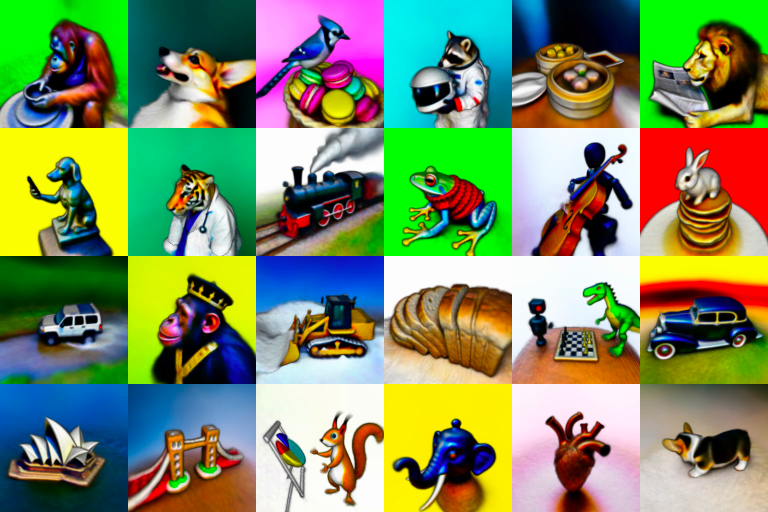
DreamFusion: Text-to-3D using 2D Diffusion is a 2022 research project that describes a text-to-3D generation method built on a pretrained 2D diffusion model. Instead of relying on a large 3D dataset, it uses a probability-density-distillation loss and a DeepDream-like optimization loop to shape a 3D scene from a caption.
The site shows the resulting objects as Neural Radiance Fields that can be inspected from any angle, relit, and exported to meshes. It also describes a gallery of generated assets and examples of composing objects into scenes, which suggests the project is focused on research exploration and visual output rather than a packaged application.
Uses a pretrained 2D text-to-image diffusion model, such as Imagen, as a prior for text-to-3D synthesis.
Optimizes a randomly initialized Neural Radiance Field so its rendered views match the caption-guided objective.
Produces 3D results that can be viewed from arbitrary angles and relit with arbitrary illumination.
Exports generated NeRFs to meshes with marching cubes for downstream use in renderers or modeling tools.
Adds regularizers and optimization strategies on top of Score Distillation Sampling to improve geometry and depth quality.
Generate a 3D object directly from a written prompt when you want a fast way to explore text-guided shape and appearance.
Inspect a generated object from many viewpoints to evaluate shape, depth, normals, and overall coherence.
Export a generated NeRF to a mesh so it can be moved into renderers, modeling software, or a broader 3D pipeline.
Compose generated objects into a scene to test how caption-guided assets might fit together in a larger 3D composition.
DreamFusion takes a text caption and optimizes a 3D scene represented as a Neural Radiance Field, using a pretrained 2D text-to-image diffusion model as the prior.
The site describes DreamFusion as generating relightable 3D objects with high-fidelity appearance, depth, and normals, and notes that the resulting models can be viewed from any angle.
DreamFusion can export its generated NeRF models to meshes using the marching cubes algorithm, which makes them easier to use in 3D renderers or modeling software.
The page says DreamFusion requires no 3D training data and no modifications to the image diffusion model.
The source material does not present DreamFusion as a packaged product or service with pricing or account setup; it is documented as a research project and paper.

AI绘画生成器是一款在线使用的AI自动生成绘画软件,用户只需输入文字描述即可进行智能AI作画。

DeepMotion is a web-based AI motion capture and 3D animation platform with Animate 3D for video-to-animation and SayMotion for text-to-animation. It helps creators and teams generate motion in a browser and export results in common production formats.

Napkin AI 可将文本转为可编辑视觉内容,适用于演示文稿、文档和可分享内容。支持以文本为起点生成,并可协作,导出为 PPT、PNG、SVG 或 PDF。

The Genesis Art turns a meaningful date into a one-of-a-kind digital artwork backed by a registry and certificate system. It is aimed at people marking milestones such as a birth, wedding, or founding day.

Kling AI is an AI creative studio for generating and editing images and videos, with web, mobile, and API access for creators and developers. It supports a broad set of visual workflows, including video generation, image creation, editing, and native 4K output for the V3 series.

Skybox AI by Blockade Labs generates 360° skyboxes and environments for games, XR, film, education, architecture, and other production workflows. The site also shows integrations for tools like Unity, Blender, Godot, SketchUp, Figma, and Roblox.