
Scripted CAD execution
Runs scripts and returns versioned STEP files together with geometric metrics so the agent can verify dimensions and validity after each attempt.

agentcad is an open-source CAD tool for AI agents that lets coding agents design, render, validate, and export real CAD output. It runs locally and supports scripted workflows through a CLI and MCP server.
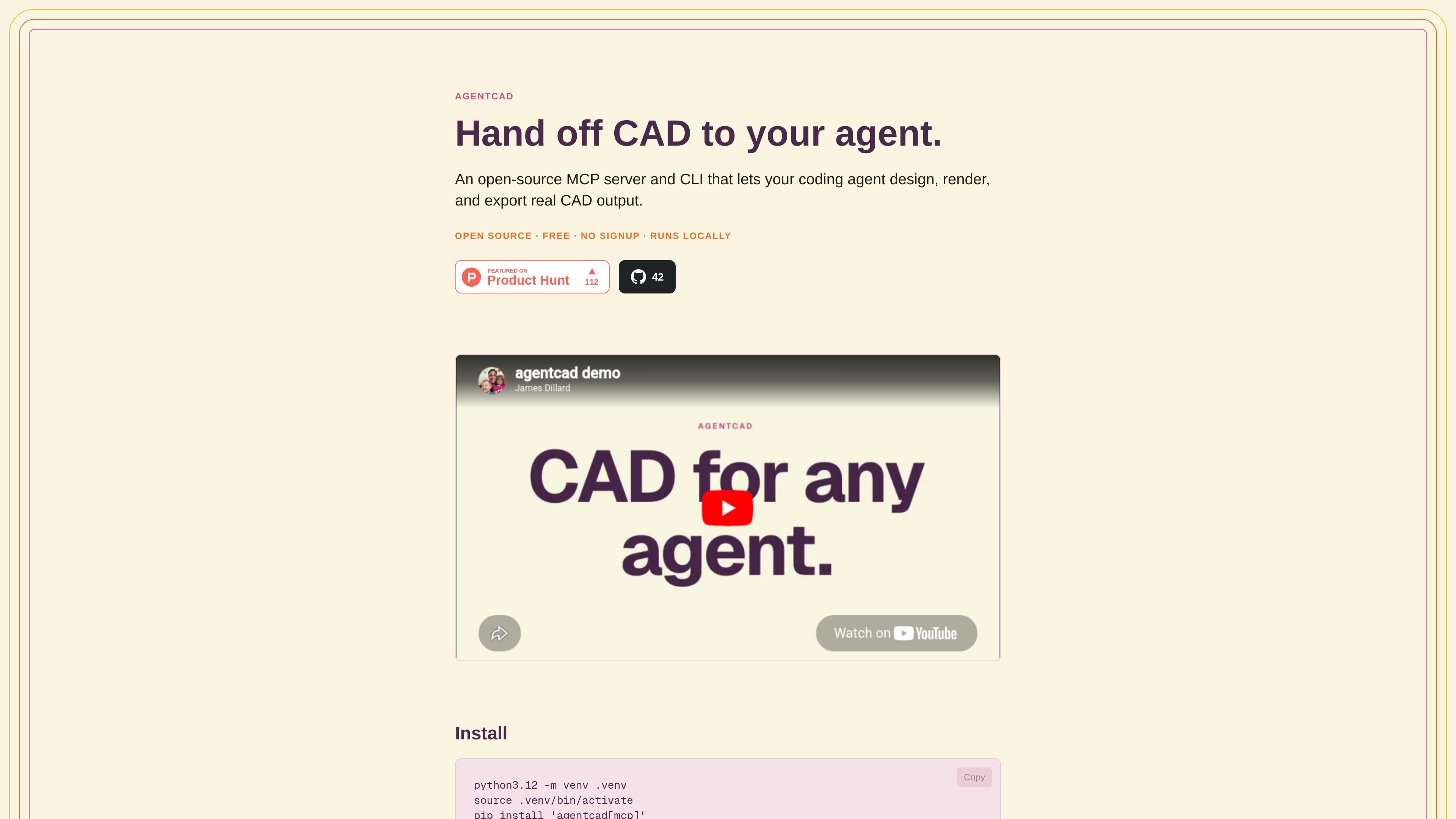
agentcad is an open-source CAD tool for AI agents. It gives coding agents a way to design, render, validate, and export real CAD output instead of stopping at code or approximations.
The site presents it as a local workflow for human-agent collaboration: the agent runs a CAD script, reads back metrics and renders, corrects mistakes, and iterates until the geometry is valid and ready to hand off. The public site highlights STEP, STL, GLB, and OBJ output, plus previews, validation, and version diffs.
Runs scripts and returns versioned STEP files together with geometric metrics so the agent can verify dimensions and validity after each attempt.
Generates PNG previews from different angles so the agent can inspect the model visually before handing it off.
Exports common downstream formats including STL, GLB, and OBJ for printing, viewers, or further processing.
Performs pre-execution checks that can catch errors quickly, helping the agent avoid continuing with invalid geometry.
Provides topology reports and version diffs so changes between iterations are easier to debug and compare.
Supports both CLI use and MCP integration for agent tooling, with install examples for local and cached execution paths.
A coding agent writes a CAD script, runs it locally, checks the returned metrics and renders, and revises the model until the geometry matches the brief.
A developer uses the CLI or MCP server inside a coding environment such as Claude Code, Cursor, or Windsurf to add CAD generation to an agent workflow.
A user needs inspectable 3D output for printing or sharing, so the agent exports STEP, STL, or GLB after validation passes.
A builder wants to compare successive versions of a part or assembly and uses the rendered previews, metrics, and diffs to see what changed.
agentcad runs locally as an open-source CLI and MCP server. The install examples on the site show Python 3.10–3.12 support and a package install path for `agentcad[mcp]`.
agentcad produces CAD outputs such as STEP, STL, GLB, and OBJ, along with PNG renders and validation metrics so an agent can inspect geometry before handoff.
The site positions agentcad for human-agent collaboration on CAD tasks: an agent runs scripts, reads metrics and renders, and then iterates until the geometry is valid or matches the specification.
The source describes pre-execution validation, metrics, renders, and version diffs, but it does not document every possible limitation. It is intended for code-driven CAD workflows rather than a standalone visual CAD editor.
The pricing page at `/pricing` currently returns a 404 on the site snapshot, so the public site does not provide a pricing table or plan details to extract.

DeepMotion is a web-based AI motion capture and 3D animation platform with Animate 3D for video-to-animation and SayMotion for text-to-animation. It helps creators and teams generate motion in a browser and export results in common production formats.

imgcook is a design-to-code tool that converts design drafts into front-end code. It supports plugin-based and developer workflows for Sketch, Photoshop, VS Code, and CLI usage.

ByteAsk is a terminal-first AI coding agent for C and C++ that edits repositories and verifies changes with the real compiler, debugger, sanitizers, and tests before showing a diff. It offers a free tier plus paid plans, with editor connectors and zero-retention handling described in the source.

CreateOS Sandbox is an isolated compute environment for running code and agent workloads inside Firecracker micro-VMs. It is designed for workflows that need machine-level isolation, private networking between sandboxes, and programmatic control through SDK, CLI, or MCP.

hob is an independent workspace for coding agents that keeps agent sessions, terminals, history, and follow-up work organized around the tools and providers you already use. It is aimed at developers who want local control over routing, history, and workspace structure rather than a bundled model stack.

Ably Chat is a chat API platform for building custom realtime chat applications. It supports room-based messaging, typing indicators, presence, reactions, and message updates, with usage-based pricing options for different deployment stages.