Authorizer icon

Authorizer

Authorizer is an open-source, self-hosted identity platform for authentication, authorization, SSO, SCIM, MFA, passkeys, and permission-aware AI workflows. It is designed for teams that want to keep identity data in their own infrastructure.

Authorizer

Self-hosted auth, authorization, and permission-aware AI

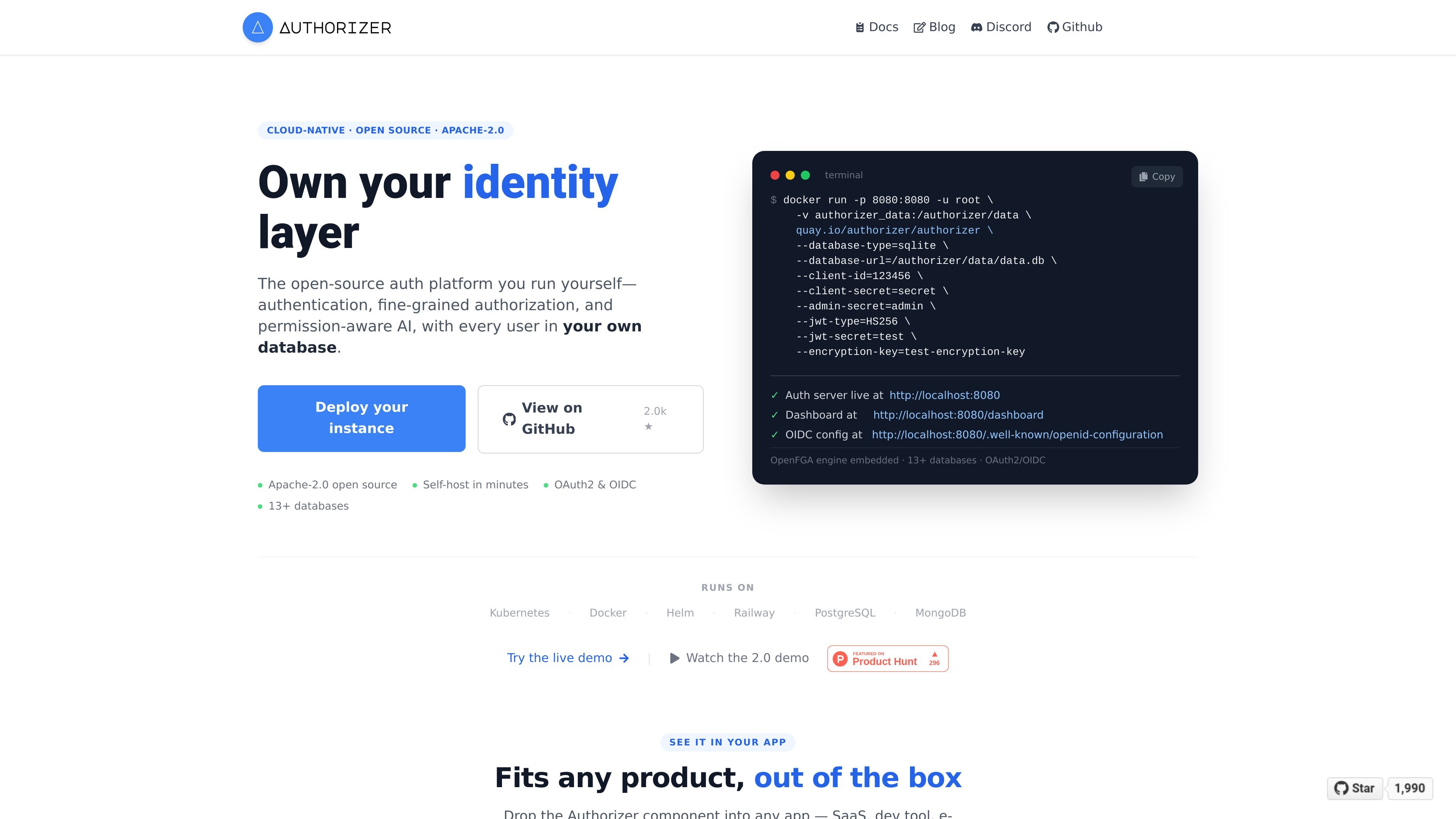
Authorizer is an open-source, self-hosted authentication and authorization platform for teams that want to run identity in their own infrastructure. The homepage positions it as a way to keep user records in your own database while handling login, access control, and related identity workflows in one service.

The product combines OAuth2 and OpenID Connect with SAML SSO, SCIM provisioning, MFA, passkeys, embedded OpenFGA-style fine-grained authorization, and permission-aware AI/RAG access control. It is presented as cloud-native software that can run in Docker, Kubernetes, Helm, and several managed deployment environments.

Core capabilities

Authentication and session handling

Provides authentication and session management with secure HTTP-only cookies, OAuth 2.0 authorization code flow, PKCE, JWT support, and multiple auth recipes such as social login, email and password, and magic link.

Fine-grained authorization

Supports role-based access control and relationship-based fine-grained authorization through an embedded OpenFGA engine, with check_permissions and list_permissions available in-process.

MFA and passwordless login

Includes multi-factor authentication and passkeys, with TOTP, email and SMS one-time codes, WebAuthn passkeys, and admin recovery options.

Enterprise identity management

Offers enterprise identity features including per-organization SAML 2.0 and OIDC SSO, home-realm discovery, organization memberships, and SCIM 2.0 provisioning for users and groups.

APIs, SDKs, and AI tooling

Exposes GraphQL, REST, and gRPC APIs with SDKs for Go, Python, JavaScript, React, Vue, and Svelte, plus a built-in MCP server for AI agents and local tools.

Self-hosting and database support

Can be deployed with Docker, Kubernetes, Helm, and cloud platforms such as Railway, Heroku, and Render, and supports 13+ databases including SQL, NoSQL, and graph databases.

Common use cases

  • Application authentication

    Add login, session handling, and account recovery to a web app while keeping identity data in your own infrastructure.

  • B2B SSO and provisioning

    Support enterprise customers that need SAML or OIDC single sign-on, organization-scoped access, and SCIM-based user and group provisioning.

  • Fine-grained product authorization

    Enforce role-based and relationship-based permissions in products where access depends on both roles and object relationships.

  • Permission-aware AI and RAG

    Build AI assistants or RAG systems that filter retrieval by the user’s access rights before the model reads source data.

  • Self-hosted identity infrastructure

    Run identity services in a cloud-native self-hosted setup using Docker or Kubernetes while exposing APIs and SDKs to multiple application layers.

Pros and Cons

Pros

  • Open-source and Apache-2.0 licensed, with self-hosted deployment so identity data stays under the operator’s control.
  • Combines authentication, authorization, SSO, SCIM, MFA, and passkeys in one platform instead of splitting them across separate services.
  • Includes embedded fine-grained authorization with OpenFGA support, which is relevant for applications needing relationship-based permissions.
  • Provides multiple API styles and SDKs, which can fit different backend stacks and frontend integration patterns.
  • Adds permission-aware AI/RAG and an MCP server for workflows where agent access needs to respect user permissions.

Cons

  • The pricing page was not available, so the site does not confirm any paid offerings, support tiers, or commercial plan structure.
  • Some capability references are broad on the homepage, and the available evidence does not fully show implementation details, limits, or setup requirements for every feature.

FAQ

What does Authorizer do?

The site presents Authorizer as an open-source, self-hosted auth platform that covers authentication, fine-grained authorization, and permission-aware AI. It includes OAuth2 and OIDC, SAML SSO, SCIM, passkeys, MFA, and an embedded OpenFGA engine.

How is Authorizer deployed?

The homepage says Authorizer can be deployed in Docker, Kubernetes, Helm, Railway, Heroku, and Render, with examples showing a Docker-based local setup. The product is positioned as something you run yourself on your own cloud or VPC.

How is Authorizer priced?

The source describes open-source auth and says the product is Apache-2.0 licensed. The pricing page was not available, so no pricing model or paid plan details are confirmed beyond the self-hosted/open-source positioning.

What integration options does Authorizer offer?

The homepage mentions SDKs for Go, JavaScript/TypeScript, React, Python pre-release, and Vue and Svelte in beta, plus GraphQL, REST, and gRPC APIs. It also says there is a built-in universal login page and a React component for embedding login in apps.

What workflows is Authorizer designed to support?

Authorizer is shown with support for social login, email and password, magic link, roles and RBAC, relationship-based fine-grained authorization, multi-factor authentication, passkeys, enterprise SSO, organizations, SCIM provisioning, machine-to-machine auth, and permission-aware AI/RAG workflows.

Quick Facts

Category
Identity and access management
Deployment
Self-hosted; Docker, Kubernetes, Helm, Railway, Heroku, Render
Protocols
OAuth2, OpenID Connect, SAML 2.0, SCIM 2.0, JWT, PKCE
Authorization
RBAC and embedded OpenFGA-style fine-grained authorization
APIs
GraphQL, REST, gRPC
Source domain
authorizer.dev

Authorizer Alternativen

ByteAsk icon

ByteAsk

ByteAsk is a terminal-first AI coding agent for C and C++ that edits repositories and verifies changes with the real compiler, debugger, sanitizers, and tests before showing a diff. It offers a free tier plus paid plans, with editor connectors and zero-retention handling described in the source.

CreateOS Sandbox icon

CreateOS Sandbox

CreateOS Sandbox is an isolated compute environment for running code and agent workloads inside Firecracker micro-VMs. It is designed for workflows that need machine-level isolation, private networking between sandboxes, and programmatic control through SDK, CLI, or MCP.

hob icon

hob

hob is an independent workspace for coding agents that keeps agent sessions, terminals, history, and follow-up work organized around the tools and providers you already use. It is aimed at developers who want local control over routing, history, and workspace structure rather than a bundled model stack.

Ably Chat icon

Ably Chat

Ably Chat is a chat API platform for building custom realtime chat applications. It supports room-based messaging, typing indicators, presence, reactions, and message updates, with usage-based pricing options for different deployment stages.

MacSpoof icon

MacSpoof

MacSpoof ist ein MAC-Adressenwechsler für macOS: WLAN-MAC ändern oder randomisieren, um Verbindungen zu erneuern und die Protokollierung auf öffentlichem WLAN zu reduzieren.

Manta AI icon

Manta AI

Manta AI is an autonomous web app testing tool for teams that want to map application behavior, catch regressions, and generate tests without writing scripts or maintaining selectors. It works from a URL and supports plain-English test flows, run results with screenshots, and scheduled or deployment-triggered checks.