
Page-cited answers
Returns verbatim text from the primary source together with the page citation, so the agent can cite the exact origin of a value or statement.

ByteAsk embedded is an MCP server that gives coding agents page-cited technical answers from primary sources, or an explicit no confident match when evidence is missing. It is built for embedded and firmware lookups and can also search private, org-scoped libraries.
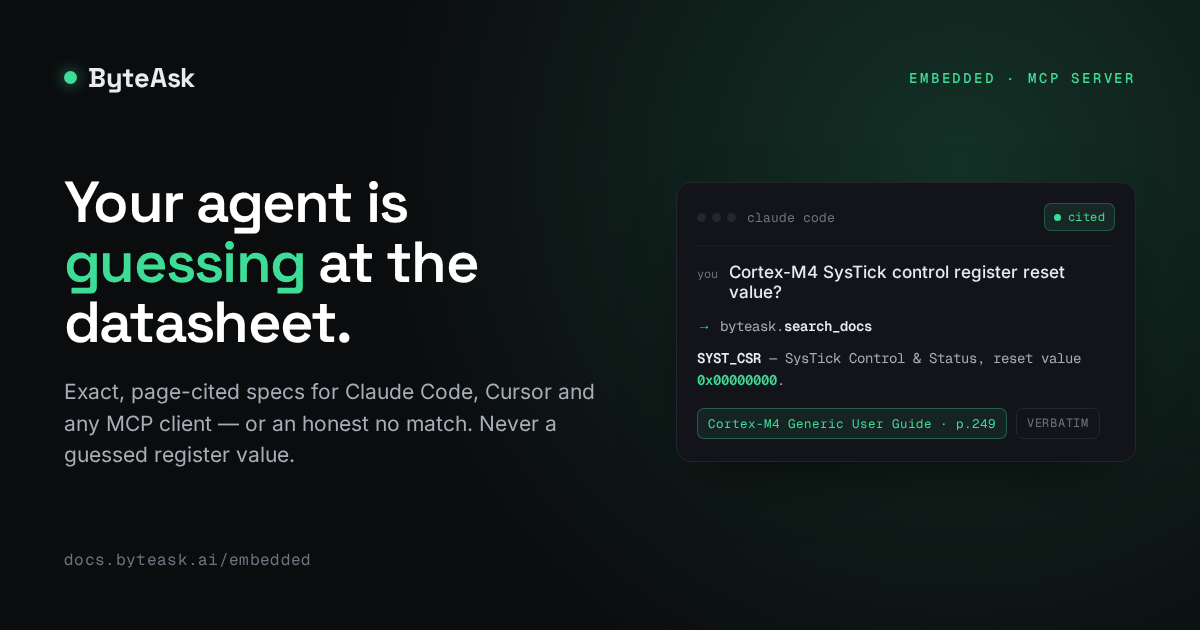
ByteAsk embedded is an MCP server for coding agents that need exact, page-cited technical references instead of guesses. The product is positioned as a reference desk for embedded and firmware work, where the agent can ask a question and receive the verbatim source passage or a clear no confident match result.
The page shows it being used for register values, protocol codes, and datasheet facts, with examples from Cortex-M, Modbus, and SCPI-style technical references. It is designed to work with any MCP client over HTTP, and the site also describes a private, org-scoped library for teams that need to query internal datasheets and design notes alongside public sources.
Returns verbatim text from the primary source together with the page citation, so the agent can cite the exact origin of a value or statement.
If the system cannot find a strong match, it returns an honest no confident match response rather than inventing a value.
Supports embedded and firmware reference material, including registers, datasheets, Modbus, SCPI, MCU parts, and related technical standards shown on the page.
Works with Claude Code, Cursor, VS Code, Kiro, Amazon Q, Codex, Windsurf, Devin, Cline, Copilot CLI, Gemini CLI, and the Claude app via MCP.
Provides a private, org-scoped library for proprietary datasheets and internal design notes, with access limited to the team’s API tokens.
Lets teams add the MCP endpoint in one step with HTTP Streamable transport and no key or token required on the public connection flow.
Use ByteAsk when an agent needs to confirm a register address, reset value, bitfield, or similar low-level firmware detail from a primary source instead of relying on memory.
Use it to retrieve protocol-specific facts such as Modbus function codes or exception codes, or SCPI command references, with citations attached to the answer.
Use the private library flow when engineers need the same query against internal datasheets, custom parts, in-house designs, or NDA-protected components.
Use the MCP endpoint in agents like Claude Code or Cursor so the model can reach for a cited source before web search when technical facts are involved.
ByteAsk connects to an MCP client over HTTP using the published MCP address. The page also shows a Claude custom connector flow for the Claude app and Claude Code, with the instruction to leave OAuth blank and use the Streamable HTTP transport when asked.
The site says the embedded corpus covers embedded and firmware topics, and the examples shown include MCU registers, Modbus protocol references, SCPI command references, and datasheets.
Yes. ByteAsk describes a private, org-scoped library for proprietary datasheets and internal design documents, combined with public components in the same query.
The source explicitly says that if there is no confident match, ByteAsk returns that result instead of guessing. The product is positioned for cases where a cited answer is preferred over an unsourced one.

ByteAsk is a terminal-first AI coding agent for C and C++ that edits repositories and verifies changes with the real compiler, debugger, sanitizers, and tests before showing a diff. It offers a free tier plus paid plans, with editor connectors and zero-retention handling described in the source.

CreateOS Sandbox is an isolated compute environment for running code and agent workloads inside Firecracker micro-VMs. It is designed for workflows that need machine-level isolation, private networking between sandboxes, and programmatic control through SDK, CLI, or MCP.

hob is an independent workspace for coding agents that keeps agent sessions, terminals, history, and follow-up work organized around the tools and providers you already use. It is aimed at developers who want local control over routing, history, and workspace structure rather than a bundled model stack.

Manta AI is an autonomous web app testing tool for teams that want to map application behavior, catch regressions, and generate tests without writing scripts or maintaining selectors. It works from a URL and supports plain-English test flows, run results with screenshots, and scheduled or deployment-triggered checks.

SonOf connects to your repo and PM tool, audits the codebase and surrounding product context, and turns approved work into shipped tickets with senior engineering review. It is aimed at founders and engineering leaders who need backlog help without hiring a full team immediately.

Ghost ist ein terminalbasierter KI-Assistent für Chats, Code-Generierung und Aufgaben direkt in der Kommandozeile. Mit kostenlosen Modellen, Linux, macOS und Windows. Open Source.