
Git-backed workspace
Hexis keeps skills, tool manuals, and knowledge in a git repository you control, so the workspace can be reviewed and changed using normal branch and change-request workflows.

Hexis is an open-source, git-backed workspace for AI agent skills, tools, and knowledge. It helps teams govern what their agents can access, review changes, and connect multiple MCP-capable agents from one controlled repository.
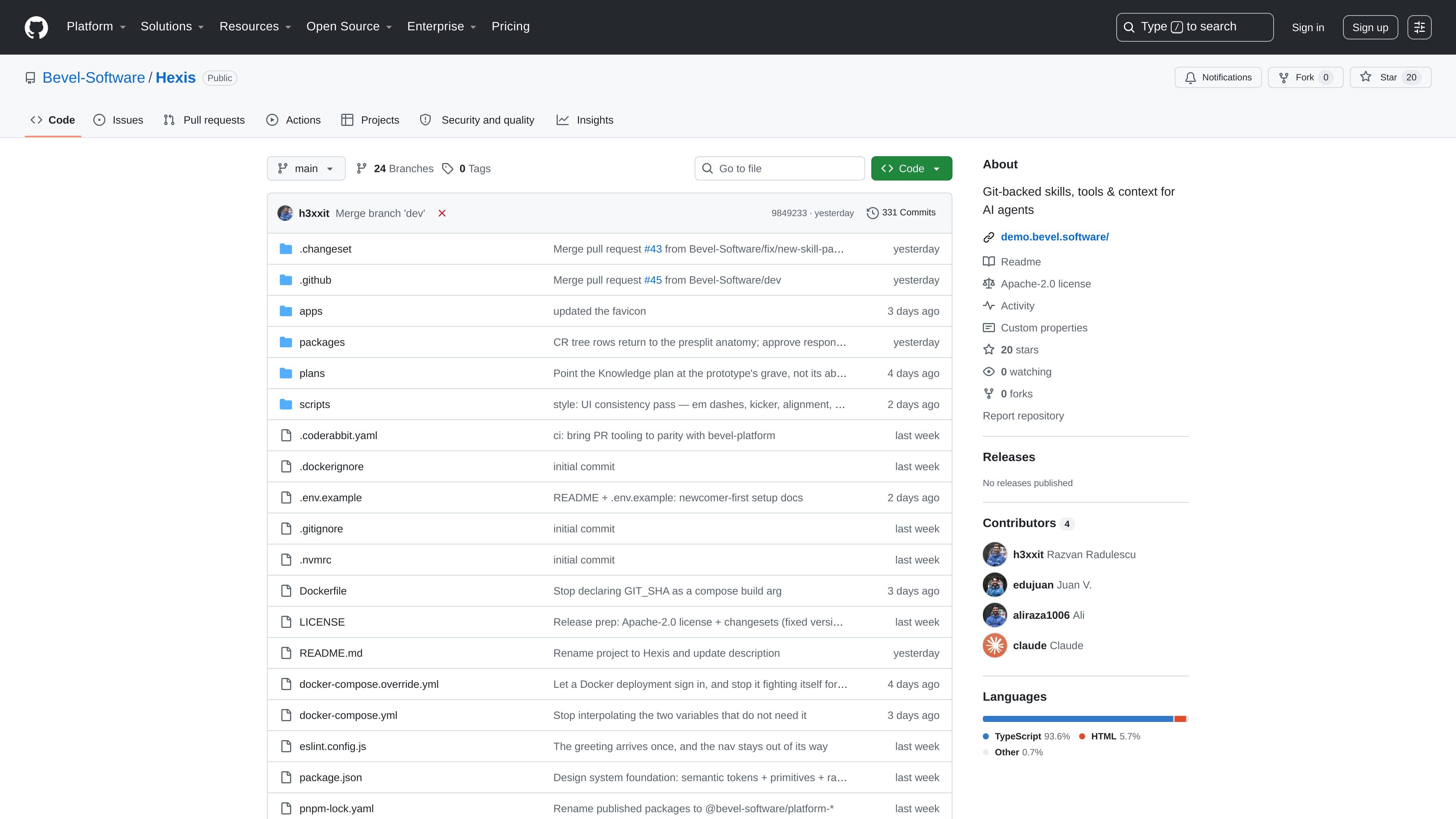
Hexis is an open-source workspace for AI agents that keeps a company's skills, tools, and knowledge in one git-backed place. According to the README, it is the open-source core of the Bevel platform and is meant to be centrally managed, reviewed, and access-controlled while still being usable from any AI agent.
The product is built for teams that want agents to work from the same governed knowledge base. It supports a built-in remote MCP server, role-based access, change requests with owner approval, and deployment to an empty git repository on any host, including GitHub, GitLab, Bitbucket, Azure DevOps, or self-hosted git services.
Hexis keeps skills, tool manuals, and knowledge in a git repository you control, so the workspace can be reviewed and changed using normal branch and change-request workflows.
The product connects to MCP-capable agents through a single connection key and a built-in remote MCP server, so agents can use the workspace without per-tool credentials or separate setup projects.
Changes are reviewed before they land. The README describes change requests, owner approval, and role-based access so agent updates follow the same control model as human edits.
Tool manuals use UTCP and an encrypted secrets vault, giving the workspace a way to store tool instructions alongside protected secrets.
Hexis is independent of one agent vendor and is meant to work with Claude Code, ChatGPT, Cursor, or other MCP-capable agents, which helps teams switch or mix agents by task.
The repository is seeded from a starter template on first run, and the setup flow can initialize an empty repo and write a roles file for the first admin.
A team keeps its agent-facing playbooks, tool instructions, and knowledge in one reviewed repository instead of scattering them across separate systems.
An organization gives employees a single connection key so their chosen agent can access only the skills and tools allowed by their role.
When a skill or tool manual needs to change, contributors submit a change request and owners review it before the update lands on protected branches.
A company tests the public demo to see the workflow end to end before deploying its own instance or asking for a managed deployment.
A team chooses one agent for some jobs and another for different tasks while keeping the underlying workspace and repository the same.
Hexis is designed to connect to Claude Code, ChatGPT, Cursor, or any MCP-capable agent through a single connection key. The README describes a built-in remote MCP server using OAuth 2.1.
The README says the app can be deployed in about 5 minutes with Docker and Compose. It needs an empty git repository, an admin email and password, and two generated secrets; public deployments also need backend and frontend origin URLs.
Hexis stores skills, tool manuals, and knowledge in a git repository you own. It uses branches, change requests with owner approval, role-based access, and an encrypted secrets vault for tool manuals.
The project README describes a live demo at demo.bevel.software. It is a public instance you can sign into with a Google account and is populated with fictional company knowledge, skills, and tools.
The README notes that a managed instance is available from the Bevel team, including hosting, upgrades, backups, and SSO. Pricing is not listed in the source.

CreateOS Sandbox is an isolated compute environment for running code and agent workloads inside Firecracker micro-VMs. It is designed for workflows that need machine-level isolation, private networking between sandboxes, and programmatic control through SDK, CLI, or MCP.

AakarDev AI helps teams manage AI provider access, project-level setups, logs, and analytics from one dashboard. It supports BYOK workflows and lists providers including OpenAI, Google Gemini, Anthropic, Groq, Mistral AI, and Perplexity AI.

ByteAsk is a terminal-first AI coding agent for C and C++ that edits repositories and verifies changes with the real compiler, debugger, sanitizers, and tests before showing a diff. It offers a free tier plus paid plans, with editor connectors and zero-retention handling described in the source.

Goldfish is an AI memory app for macOS that helps you reply, write, summarize, and continue using the context already on your Mac. It stores memory locally and writes in your tone.

Lasso is an ecommerce product data platform for enriching catalog records, processing supplier files, generating product content, and monitoring competitors. It combines a web app with a REST API, SDK, and MCP server for teams and developers.

ArtDeck is a visual reference board app for iPhone, iPad, and Mac that lets artists collect mixed reference material on one canvas and study it with ToolBox lenses. It works offline, supports optional iCloud sync, and is sold as a one-time purchase with no account required.