
Two agent profiles
Choose AutoAgent for a framework-managed observe, orient, decide, and act loop, or CustomAgent for direct, deterministic control over execution.

JarvisCore is an open-source Python framework for developers building autonomous multi-agent systems. It provides agent profiles, peer-to-peer coordination, persistent memory, credential isolation, observability, and human review workflows.
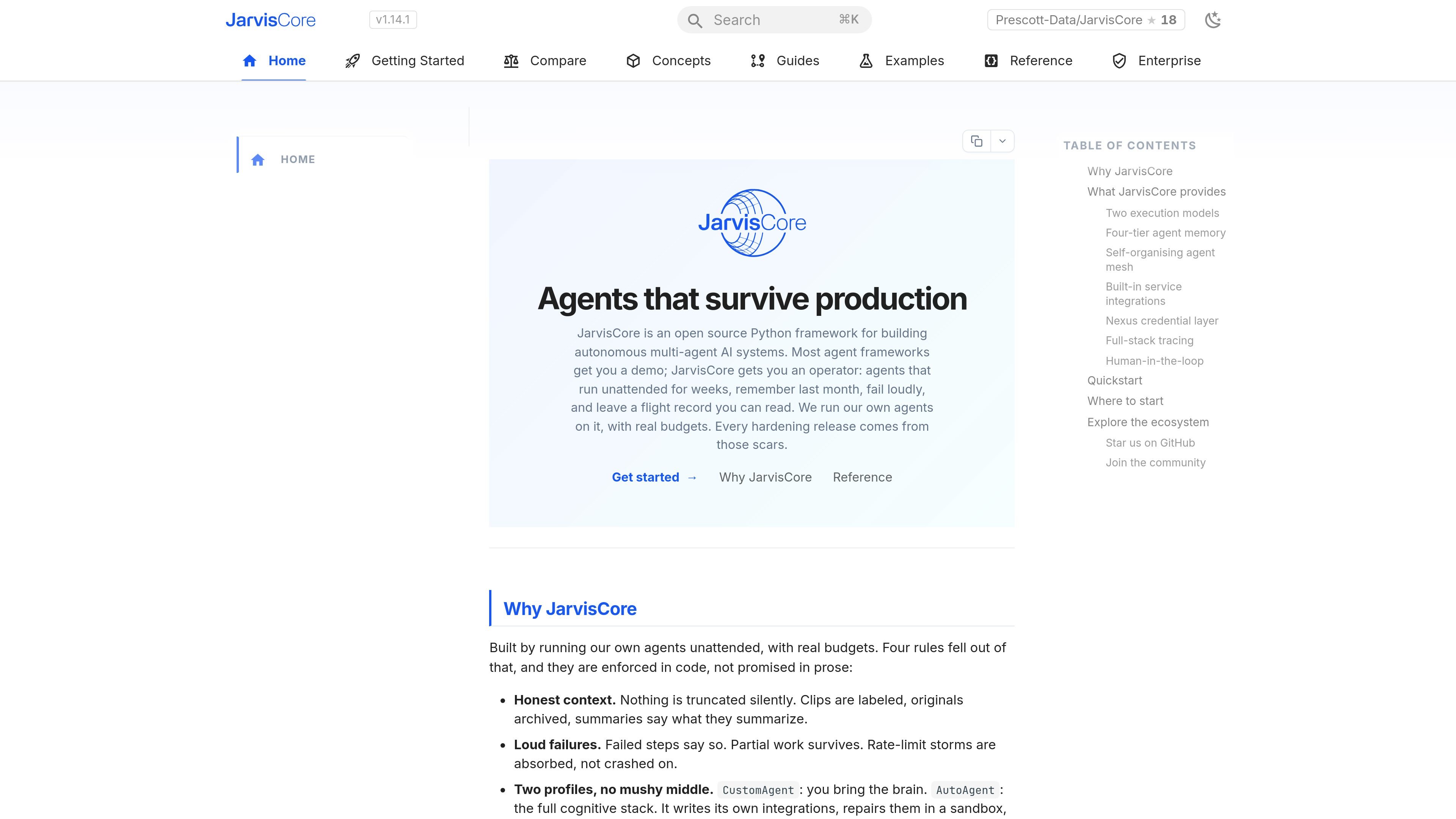
JarvisCore is an open-source Python framework for building autonomous multi-agent AI systems. It combines agent execution, peer-to-peer communication, memory, credential handling, human review, and tracing in a shared runtime for agents that may operate without continuous supervision.
The framework offers two operating models: AutoAgent manages the cognitive loop for tasks such as research, analysis, content work, and data extraction, while CustomAgent exposes execution to developers writing plain Python for API workers and deterministic pipelines. A minimal setup requires Python 3.10 or later and one configured LLM provider; additional capabilities are enabled through optional package extras and services.
Choose AutoAgent for a framework-managed observe, orient, decide, and act loop, or CustomAgent for direct, deterministic control over execution.
Working scratchpad, episodic ledger, compressed long-term summaries, and optional cross-session semantic memory preserve context across restarts. Athena MemOS can be connected through `ATHENA_URL`.
Agents discover and message one another through a PeerClient API over SWIM gossip and ZMQ, allowing nodes to join, fail, and rejoin without a central orchestrator.
Nexus manages OAuth2, API keys, and basic authentication so third-party credentials remain outside agent reasoning.
Agent turns, tool calls, and LLM requests are traced automatically, with Redis PubSub live streams, JSONL output for compliance workflows, and an optional Prometheus metrics endpoint.
HITLQueue can pause decisions that exceed configured confidence thresholds, send them to a review inbox, and resume execution after a human response.
Use AutoAgent to conduct research and analysis tasks with a role, capability list, and system prompt, while retaining context across sessions when memory services are configured.
Use CustomAgent to wrap existing APIs or services in explicit Python execution logic when predictable control matters more than framework-managed reasoning.
Run several specialized agents as a research or operations network. Peer discovery and messaging allow agents to coordinate across one process or distributed machines.
Connect service actions and third-party APIs through the integration catalog while keeping OAuth2, API keys, and basic authentication in the Nexus credential layer.
Add review checkpoints to workflows where selected decisions need human approval, then resume the agent after a response is submitted.
JarvisCore requires Python 3.10 or later. A minimal agent can run with only an LLM API key; Docker is optional unless you use local infrastructure or a containerized sandbox.
Install the package with pip, run `jarviscore init`, copy `.env.example` to `.env`, configure one supported LLM provider, and run `jarviscore check`. The site provides a first-agent example using `Mesh` and `AutoAgent`.
AutoAgent provides the framework's full cognitive loop, including LLM reasoning, sandboxed code generation, and self-repair. CustomAgent exposes the execution loop so developers can implement deterministic Python logic directly.
The framework can run agents in one process or across distributed machines. Distributed deployments use the SWIM gossip protocol and ZMQ transport, while Redis can support distributed workflows, cross-session state, and peer routing when configured.

CreateOS Sandbox is an isolated compute environment for running code and agent workloads inside Firecracker micro-VMs. It is designed for workflows that need machine-level isolation, private networking between sandboxes, and programmatic control through SDK, CLI, or MCP.

GitBot is a local browser-based workspace for creating reusable coding bots powered by Claude Code, Codex, or OpenCode. It helps developers run those agents across repository folders with persistent threads and configurable permissions.

AakarDev AI helps teams manage AI provider access, project-level setups, logs, and analytics from one dashboard. It supports BYOK workflows and lists providers including OpenAI, Google Gemini, Anthropic, Groq, Mistral AI, and Perplexity AI.

Trigger.dev chat agent is a durable AI chat backend for developers building stateful conversations that can survive refreshes, crashes, and long-running turns. It connects with the AI SDK `useChat` flow and runs on managed infrastructure with no timeout on a turn.

ByteAsk is a terminal-first AI coding agent for C and C++ that edits repositories and verifies changes with the real compiler, debugger, sanitizers, and tests before showing a diff. It offers a free tier plus paid plans, with editor connectors and zero-retention handling described in the source.

Codex Plugins bundle reusable skills, app integrations, and MCP servers into workflows you can install in the Codex app or use from Codex CLI. They help extend Codex with connected-service tasks, reusable instructions, and shared team workflows.