
SEO audits
Checks local Markdown and HTML trees and live sites against a shared registry of 58 stable rules covering areas such as crawlability, on-page content, links, structured data, AI access, performance, security, and canonicalization.

jev-seo is an open-source Rust command-line SEO and GEO tool with a 13-tool MCP server for developers, technical writers, founders, and coding agents. It audits local and live content, analyzes AI-citation readiness, tracks rank history, and supports reports and CI gates without a subscription on its documented free path.
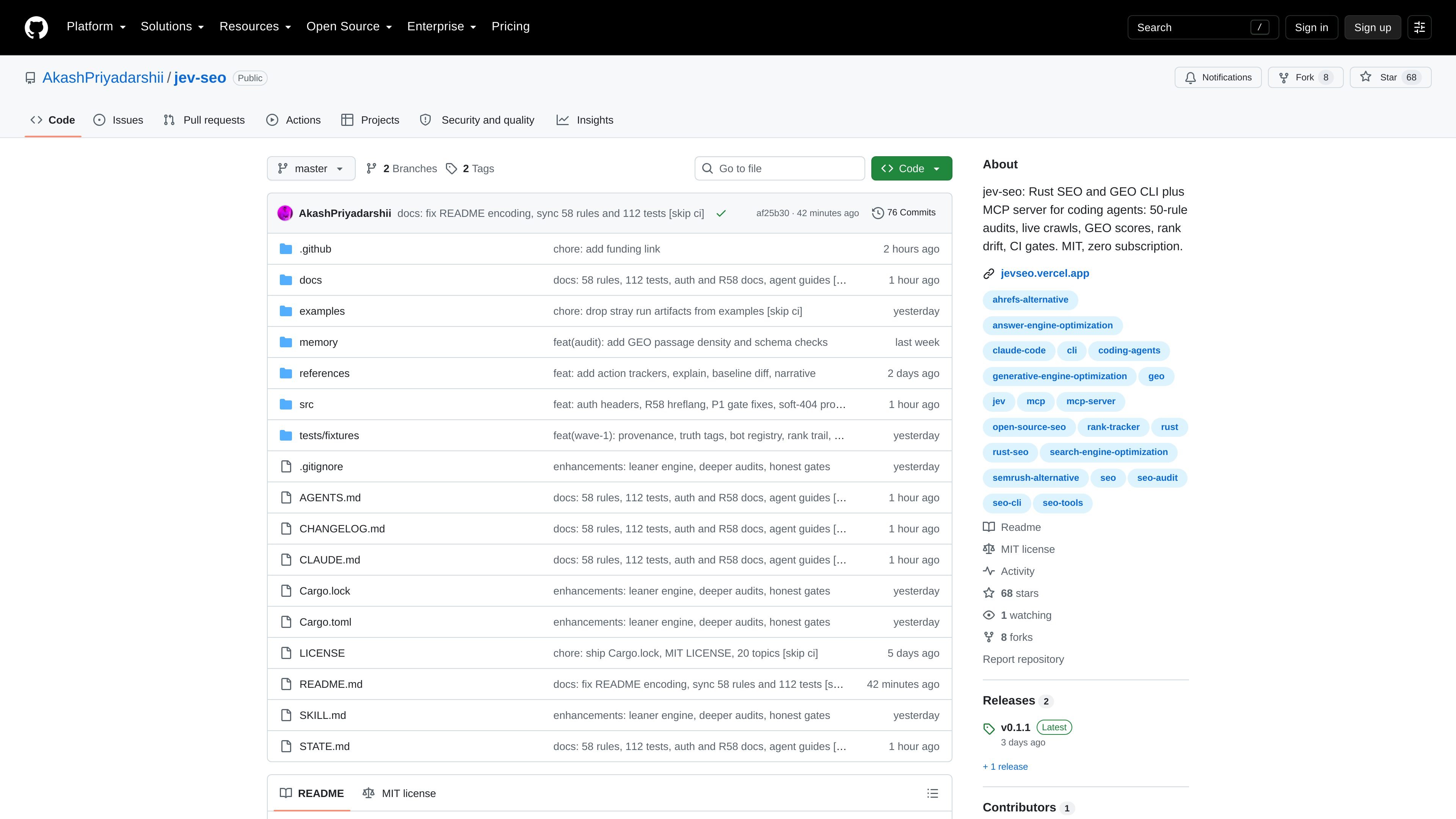
jev-seo is an open-source Rust CLI and MCP server for technical SEO, content checks, GEO analysis, and rank monitoring. It is designed for developers, technical writers, founders, and coding agents that need structured SEO evidence from the terminal or an automated build workflow rather than a hosted dashboard.
The tool audits local Markdown and HTML trees as well as live sites, uses a shared set of 58 rules, and can produce reports and action-oriented exports. It also combines local rank history with AI-citation analysis, while keeping the documented free path local and subscription-free. Semantic Jev calls are separately budgeted, and optional paid search backends do not run without an explicit flag and key.
Checks local Markdown and HTML trees and live sites against a shared registry of 58 stable rules covering areas such as crawlability, on-page content, links, structured data, AI access, performance, security, and canonicalization.
Crawls live hosts with robots.txt honored, reports crawl progress, and can compare a crawl with the previous snapshot using crawl --diff.
Scores pages for AI answer-engine citation readiness using TypeSafe AI Jev typed primitives, including an overall score, direct-answer assessment, and a primary content-gap classification.
Retrieves DuckDuckGo suggestions and HTML search results without an API key on the free search path, while optional providers remain disabled until explicitly enabled with a key.
Stores keyword positions and rank history in a local SQLite database, allowing users to review rank drift without a hosted project or dashboard.
Provides a 13-tool stdio MCP server with JSON-RPC 2.0, and supports CI thresholds such as audit --min-pass 40 that return a nonzero exit status below the configured floor.
Run an audit against a documentation or content directory before publishing. The CLI can inspect Markdown and HTML, identify rule findings, and export a report or action tracker for remediation.
Use a live crawl to inspect a site while respecting robots.txt, then compare the current crawl with the previous snapshot to identify changes that need attention.
Add an audit threshold to a repository workflow so changes that fall below the configured minimum pass score return a failing exit status before deployment.
Give Claude Code, Gemini CLI, Cursor, or another supported coding-agent setup access to structured SEO checks through the stdio MCP server during coding and refactoring loops.
Track keyword positions over time in the local SQLite database and review rank drift without creating a hosted project or subscribing to a rank-tracking dashboard.
jev-seo is a Rust command-line tool and MCP server. It audits local Markdown and HTML, crawls live sites, evaluates GEO signals, tracks rank history, and can expose the same capabilities to coding agents through MCP.
The repository describes a free path with no subscription for rules, crawls, reports, and local rank history. Jev semantic calls are budgeted with --jev-budget, whose documented default is $0.25 per run; optional paid data backends require an explicit flag and key.
The repository documents installation through crates.io with cargo install jev-seo or use of a release archive. It is distributed as a single Rust binary and does not require a SaaS dashboard login for the free path.
The CLI can audit local Markdown and HTML trees, crawl live hosts while honoring robots.txt, compare crawl results with a prior snapshot, and run a CI gate such as audit --min-pass 40. It can also generate HTML, PDF, Markdown, and CSV outputs.
The project documents a 13-tool stdio MCP server using JSON-RPC 2.0 for coding agents, including Claude Code, Gemini CLI, Cursor, and Antigravity. The repository also describes guarded file reads and SSRF protections for remote hops.

PromptScout tracks how ChatGPT, Gemini, Google AI Overviews, and Perplexity mention your brand or competitors, then pairs those results with source analysis and website audits. It helps teams decide what to fix in content, positioning, or site readiness next.

ClayHog ist eine KI-Sichtbarkeitsplattform für die Suche, die zeigt, wie Marken in ChatGPT, Gemini, Perplexity, Claude und Google AI Overviews erscheinen.

beehiiv is a newsletter platform for creators, publishers, and brands that want to build, grow, and monetize email newsletters and websites from one place. It offers a free Launch plan, plus paid tiers for more advanced growth, monetization, and support features.

Scribeist is an AI-powered writing platform with dedicated workspaces for novels, blogs, essays, and notes. It combines project-aware AI, fiction continuity tools, SEO-focused blog tools, and publishing integrations.

findloc.ai publishes public AI reports for local markets and checks individual business websites for AI visibility signals. It helps owners, marketers, and agencies see which businesses AI assistants recommend and what their own site may be missing.

LoupeKit is a browser panel that inspects live web pages for stack details, layout, SEO, accessibility, and AI-generated code smells. It works as an over-the-page extension with a free tier and Pro options for exports, reports, advisories, and server-side readings.