
Layout-aware parsing
Parse documents into structured data with layout-aware understanding. The product describes LLM-ready Markdown and preserved hierarchy for text, tables, and figures.

LandingAI provides agentic document extraction APIs that convert complex documents into structured, auditable data for enterprise workflows. It targets developer teams building automation for compliance, onboarding, loan processing, retrieval, and reporting.
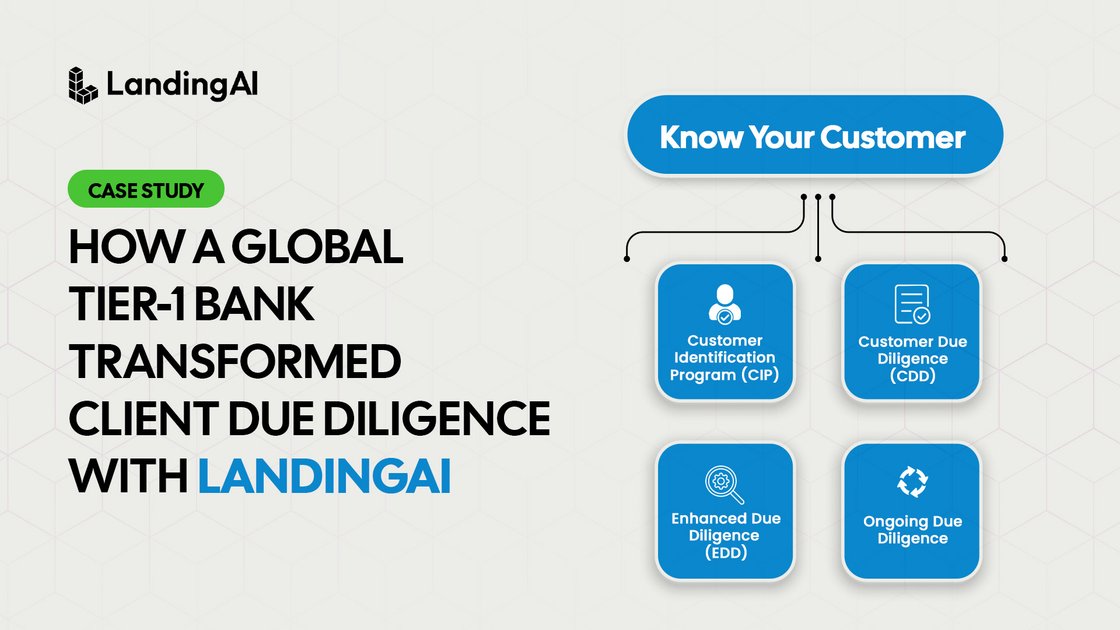
LandingAI provides Agentic APIs for intelligent document processing, centered on Agentic Document Extraction (ADE). The product is built to convert documents into structured, auditable data for enterprise workflows such as compliance review, onboarding, loan processing, and document-based retrieval.
Its core workflow covers parsing, splitting, and extracting data from complex, high-variance documents including multi-page files, dense tables, forms, and multilingual content. The site emphasizes traceability through page numbers, coordinates, bounding-box citations, and confidence scoring, so teams can verify outputs rather than treat them as opaque results.
Parse documents into structured data with layout-aware understanding. The product describes LLM-ready Markdown and preserved hierarchy for text, tables, and figures.
Split large files and mixed-document PDFs into classified sub-documents, including long multi-hundred-page batches and repeated identifiers such as invoice numbers or dates.
Extract flat or nested schemas, arrays, and large tables across many pages. The product also supports bounding-box citations for each extracted value.
Ground extracted results back to pages, coordinates, and table cells so teams can review where values came from and route uncertain items to humans.
Handle multilingual documents and confidence scoring for results that may need review. The home page emphasizes production use on complex layouts rather than template-heavy workflows.
Expose the system through REST APIs plus Python and TypeScript libraries so engineering teams can embed extraction into downstream automation.
Process KYC and client due diligence documents where analysts need structured outputs, traceability, and support for large, non-standard corporate files.
Extract borrower income and related fields from stacks of tax returns, paystubs, and bank statements to reduce manual loan review time.
Turn plan sets, code-related documents, and review packets into auditable structured data for compliance and issue-tracking workflows.
Build retrieval and analytics pipelines that need semantically chunked, grounded content from mixed document archives and long PDFs.
Automate downstream reporting, reconciliation, and approval workflows by sending structured document data into existing internal systems.
LandingAI’s Agentic Document Extraction is designed to parse, split, and extract structured data from documents through API-based workflows. The pricing page describes an Explore plan for developers validating a use case, a Team plan for teams shipping document workflows, and an Enterprise plan for custom infrastructure needs.
The pricing page says credits are the usage unit, and each document processing task consumes credits based on the number of pages processed. Explore is pay-as-you-go, while Team and Enterprise include monthly allotments.
The pricing page lists modular capabilities such as parsing, field extraction, visual grounding, document splitting and classification, and multilingual document handling. The home page also describes structured outputs with page-level and coordinate-level citations.
The site says LandingAI supports modular REST APIs and Python or TypeScript libraries. Case studies also show it integrating into existing workflows, including a KYC platform and AWS-based deployments.
The pricing page and home page indicate flexible deployment options, including cloud, on-premises, and virtual private deployment options. The site also mentions zero data retention options, HIPAA/BAA availability on Team, and VPC/on-prem support on Enterprise.

nolainocr is an AI OCR tool that extracts structured data from PDF invoices, receipts, forms, contracts, and bank statements. It helps teams move document data into Excel, Google Sheets, JSON, or CSV without manual entry.
司马阅是一款面向企业的AI文档智能体平台,帮助团队把分散在文档中的知识转成可用于问答、检索、写作和审查的结构化能力。它适合对准确性和数据安全要求较高、且有大量文档工作流程的企业。

PDFTools is a browser-based suite of free and premium PDF utilities for editing, conversion, and document handling. It helps users work on PDFs locally in the browser without uploading files to a server.

Artifacts by Samepage is a connected writing surface for product teams that turns signals and existing work context into drafts such as PRDs, release notes, feature requests, bug tickets, and status updates. It includes built-in AI editing and can publish work into tools like Jira, GitHub, Confluence, Slack, and Linear.

Capso is a native macOS screenshot and screen recording app for capturing, annotating, recording, and extracting text from screen content. It is free forever, open source, and positioned as an alternative to CleanShot X.
KlutterAI is an AI-powered expense tracker that helps people capture receipts, categorize spending, and monitor budgets from iOS or Android. The product also surfaces recurring charges, spending alerts, and exportable reports.