
Hybrid graph plus vector retrieval
Uses a shared pipeline for graph data and HNSW vector search instead of splitting storage across separate vector and graph databases.

LinkingMem is a graph-native RAG engine that combines vector search, graph traversal, and LLM reasoning in one pipeline. It supports OpenAI-compatible model backends and a pluggable HTTP or Unix-socket interface for custom embedding, extraction, or generation services.
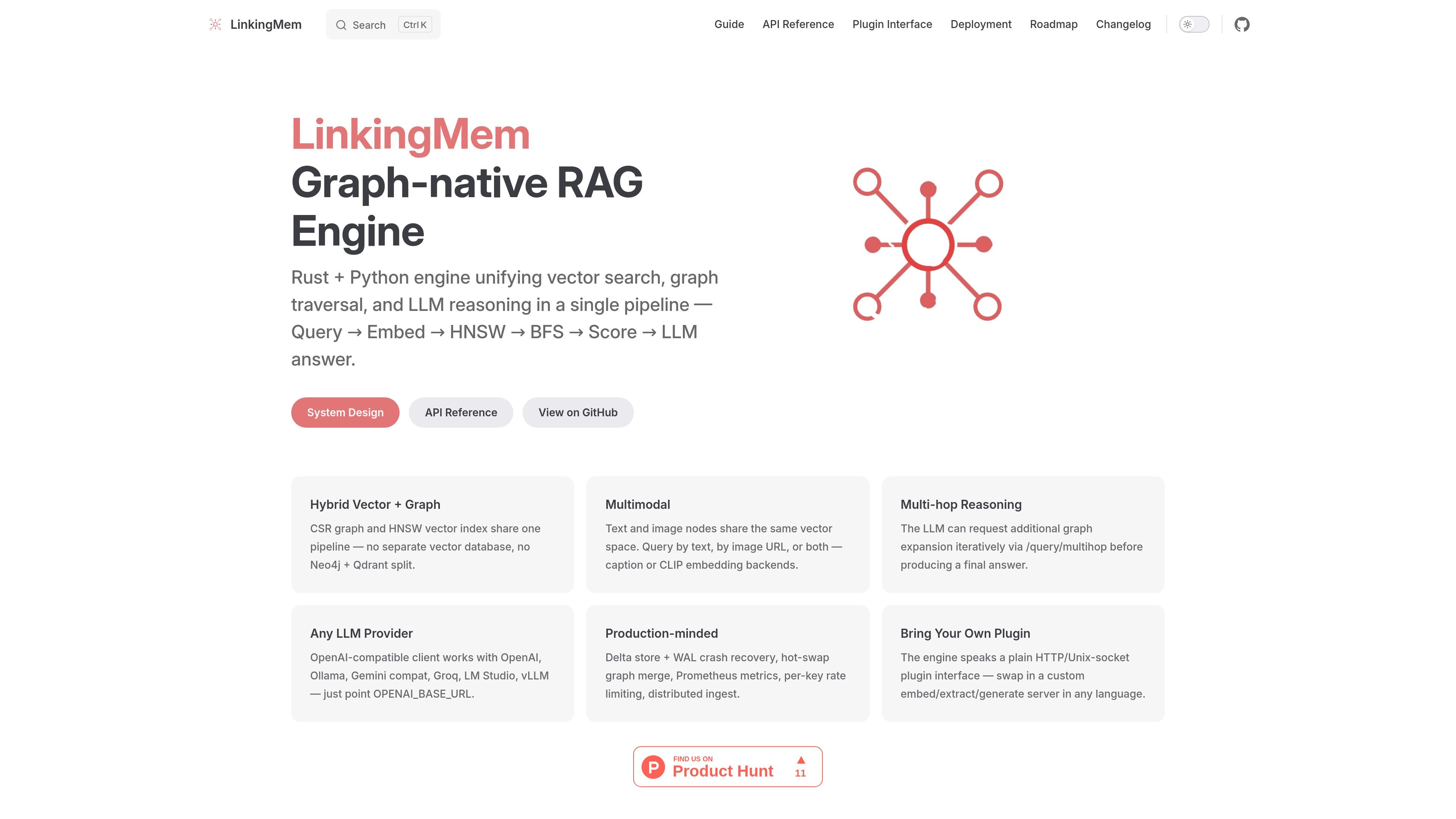
LinkingMem is a graph-native RAG engine built with Rust and Python. It combines HNSW vector search, graph traversal, and LLM reasoning in one system so retrieval and answer generation can happen without stitching together separate databases and services.
The site describes a single-process, same-machine pipeline that supports multimodal nodes, iterative multi-hop expansion, and OpenAI-compatible model backends. It is aimed at teams that want graph-aware retrieval with plugin-based extensibility and production features such as WAL recovery, metrics, and rate limiting.
Uses a shared pipeline for graph data and HNSW vector search instead of splitting storage across separate vector and graph databases.
Supports text and image nodes in the same vector space, with queries by text, image URL, or a combination of both.
Lets the LLM ask for additional graph expansion through /query/multihop before it produces a final response.
Accepts OpenAI-compatible clients and can connect to OpenAI, Ollama, Gemini-compatible servers, Groq, LM Studio, and vLLM through OPENAI_BASE_URL.
Includes delta store and WAL crash recovery, hot-swap graph merge, Prometheus metrics, per-key rate limiting, and distributed ingest.
Exposes a plain HTTP or Unix-socket plugin interface for custom embed, extract, or generate services written in any language.
Build retrieval systems that need graph-aware context, such as traversing entity relationships before answering a question.
Query documents or knowledge bases that mix text and images, using either modality as the entry point for retrieval.
Prototype or deploy with different LLM backends without rewriting the application around one provider SDK.
Extend embedding, extraction, or generation steps with a custom service while keeping a plain HTTP or Unix-socket interface.
Operate a production retrieval service that needs recovery, observability, rate limiting, and distributed ingest.
LinkingMem is a graph-native RAG engine that combines HNSW vector search, graph traversal, and LLM reasoning in one pipeline.
The source does not list a traditional hosted pricing page; the /pricing URL returns a 404, while the site footer references a License.md file and states the project is released under that license.
The homepage says LinkingMem can work with OpenAI-compatible clients including OpenAI, Ollama, Gemini-compatible setups, Groq, LM Studio, and vLLM by pointing OPENAI_BASE_URL at the desired endpoint.
The site describes a plain HTTP or Unix-socket plugin interface, which lets you swap in custom embed, extract, or generate servers in any language.
The documented system design emphasizes a single-process, same-machine pipeline with no network hops between compute steps, plus WAL-based crash recovery and distributed ingest.

CreateOS Sandbox is an isolated compute environment for running code and agent workloads inside Firecracker micro-VMs. It is designed for workflows that need machine-level isolation, private networking between sandboxes, and programmatic control through SDK, CLI, or MCP.

AakarDev AI helps teams manage AI provider access, project-level setups, logs, and analytics from one dashboard. It supports BYOK workflows and lists providers including OpenAI, Google Gemini, Anthropic, Groq, Mistral AI, and Perplexity AI.

Trigger.dev chat agent is a durable AI chat backend for developers building stateful conversations that can survive refreshes, crashes, and long-running turns. It connects with the AI SDK `useChat` flow and runs on managed infrastructure with no timeout on a turn.

ByteAsk is a terminal-first AI coding agent for C and C++ that edits repositories and verifies changes with the real compiler, debugger, sanitizers, and tests before showing a diff. It offers a free tier plus paid plans, with editor connectors and zero-retention handling described in the source.

Codex Plugins bundle reusable skills, app integrations, and MCP servers into workflows you can install in the Codex app or use from Codex CLI. They help extend Codex with connected-service tasks, reusable instructions, and shared team workflows.

hob is an independent workspace for coding agents that keeps agent sessions, terminals, history, and follow-up work organized around the tools and providers you already use. It is aimed at developers who want local control over routing, history, and workspace structure rather than a bundled model stack.