
First-user discovery
Turn a product description or link into a small shortlist of developers who show a relevant problem through public technical activity. Results include a profile, fit rationale, and opening line.

Morsa Signals helps developer-tool founders and outreach teams find technically relevant contacts, identify first users, monitor competitor activity, and assess whether AI search systems can understand and recommend their products. It uses product-specific analysis of public developer signals and provides fit reasoning, outreach angles, visibility findings, and actionable prompts.
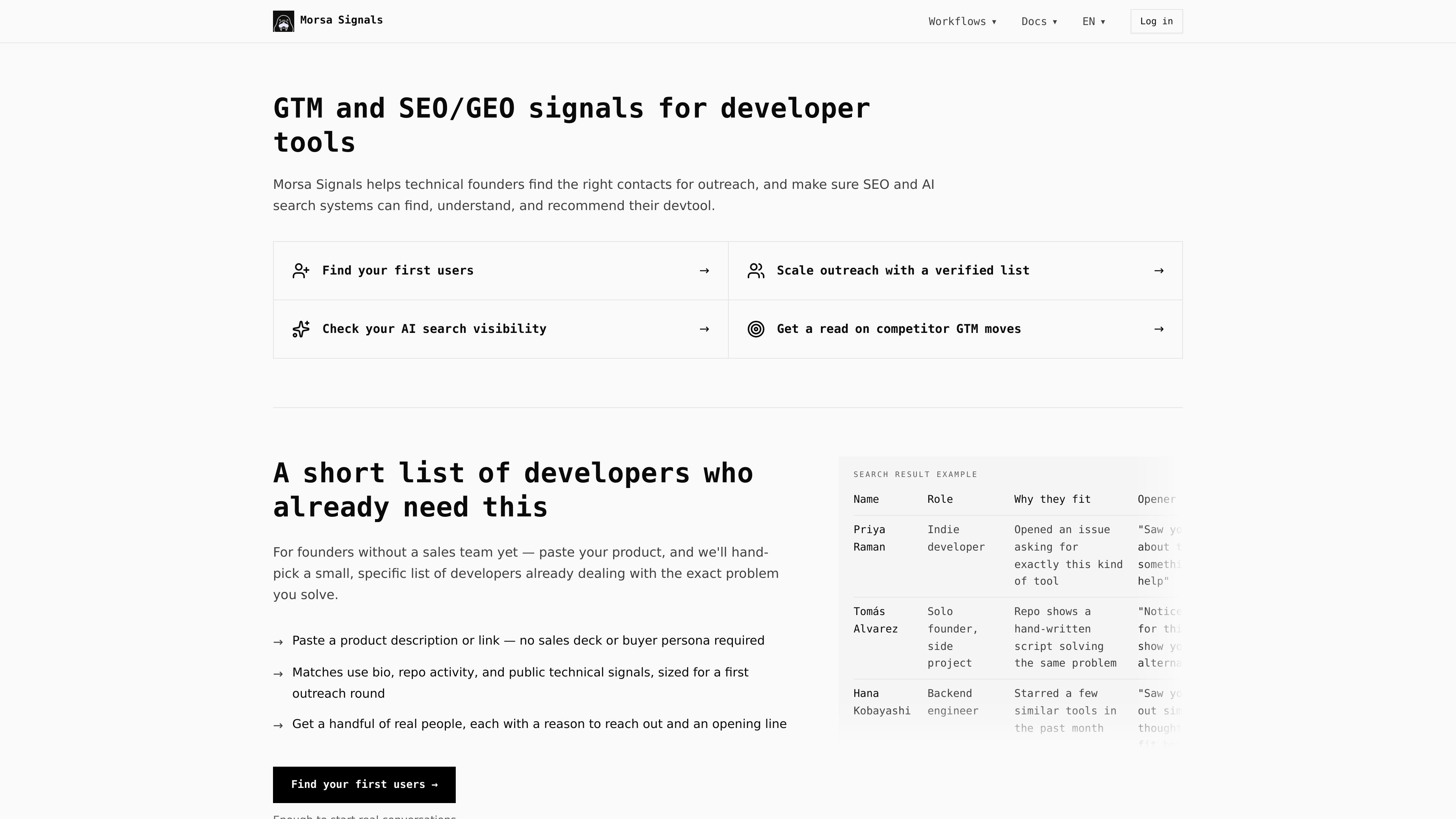
Morsa Signals is a GTM and AI-search visibility service for developer-tool founders and teams. It combines developer-focused contact discovery, first-user research, competitor monitoring, positioning review, and an AI visibility audit in workflows that start from a product description or website URL.
For outreach, the service searches GitHub and other public technical sources for people whose code, issues, repository activity, comparisons, or public questions indicate a relevant problem. For search visibility, it evaluates whether AI systems can understand the product's category, audience, workflow, and proof, then points to gaps and recommended fixes.
Turn a product description or link into a small shortlist of developers who show a relevant problem through public technical activity. Results include a profile, fit rationale, and opening line.
Build a larger, vetted contact list for an existing outreach pipeline using GitHub-backed reasons for fit, personalized openers, and a product-specific outreach template.
Assess whether ChatGPT, Perplexity, Claude, and Google AI Overviews have enough context to classify, compare, and recommend a devtool. The audit covers crawlability, metadata, positioning, public footprint, and comparison context.
Track comparable developer tools across GitHub activity, releases, pricing changes, and launches or mentions on Reddit, Hacker News, and Product Hunt, then identify competitors worth monitoring.
Convert vague product language into clearer category, ICP, buyer-context, workflow, and proof statements that buyers and AI systems can repeat more accurately.
Surface questions, complaints, and launches in GitHub, Reddit, Hacker News, and other developer channels, ranked by relevance. The workflow identifies conversations to join but does not post or reply on the user's behalf.
A solo or technical founder can submit a product page and receive a small, hand-picked set of developers already showing the problem through an issue, repository workaround, comparison, question, or similar public signal. Each person comes with an opening angle for starting a conversation.
A team already doing outreach can order a larger shortlist and compare it with its current source. The delivered contacts include GitHub-backed fit reasoning, personalized openers, and a GTM template tailored to the product.
A developer-tool team can check whether its site gives AI search systems enough information to place and recommend the product. The audit highlights missing category, comparison, ICP, metadata, or public-footprint context and supplies a remediation prompt.
A founder can use competitor monitoring to identify comparable tools and inspect changes such as new hosted pricing, release activity, GitHub movement, or launches and mentions on developer-focused platforms.
A small GTM team can review relevant questions, complaints, and launches across developer channels, then decide which conversations are worth joining based on product fit. Morsa Signals does not send the replies for them.
Paste a product description or a link to a page explaining the devtool. Morsa Signals turns that information into search angles based on the product's audience, workflows, and pain patterns, so you do not need to provide a separate sales deck or buyer persona for the first-users workflow.
The contact workflows return a shortlist containing a public GitHub profile, the specific reason the person appears to fit, and a personalized opening angle. Contact-search orders also include a GTM outreach template built around the product.
The AI visibility audit checks crawlability, metadata, product positioning, public footprint, and comparison context. It produces an AI Visibility Score, identifies gaps that may make a product harder for AI systems to classify or recommend, and provides a prompt that can be copied into Claude Code, Cursor, or another coding agent.
The contact workflows use public GitHub activity and other public technical sources, including profiles, repositories, commit history, issue and pull-request threads, and public tool comparisons. The first-users and contact-search pages say that each match is reviewed before it is delivered.
The site presents Morsa Signals as a workflow for developer-tool founders and teams. The first-users workflow is aimed at founders without a sales team, while the larger contact-search workflow is designed for teams that already run outreach. Contact results are licensed for the buyer's own outreach, not for resale or building a shared list.

Growth Brain is an AI growth-operations platform that connects a team’s existing data, marketing, and customer tools to identify audiences, activate approved workflows, and measure results. It is designed for growth and go-to-market teams that want an always-on decision loop without replacing their current stack.

PromptScout tracks how ChatGPT, Gemini, Google AI Overviews, and Perplexity mention your brand or competitors, then pairs those results with source analysis and website audits. It helps teams decide what to fix in content, positioning, or site readiness next.

SaveMRR is a Stripe retention tool for SaaS teams that scans billing data for churn and MRR leaks, then automates recovery through dunning, cancel-save offers, win-back emails, and onboarding nudges. It is built for founders and bootstrapped teams using Stripe.

Hype is a web tool for finding trending YouTube topics by category, time range, and scoring mode. It helps creators spot emerging ideas, inspect source videos, and decide what to cover next.

Sleek Analytics is a privacy-friendly web analytics tool with real-time visitor tracking, Core Web Vitals, and revenue attribution. It helps site owners understand traffic and conversions without cookie banners or a heavy setup.

Topple.lol is a public pay-to-rank leaderboard where listings start at $1 and their bid balance decays over time and with clicks. It helps makers and marketers buy short-term visibility for product sites or X profiles while tracking live board stats.