
Hybrid-capacity MoE design
Uses a 120B-parameter mixture-of-experts architecture that activates 12B parameters per token, balancing total model capacity with more selective computation.

NVIDIA Nemotron 3.5 Super VL is an open, customizable multimodal model for developers building specialized AI agents. It combines reasoning, tool use, and understanding of text, images, documents, and video, with support for post-training through NVIDIA NeMo.
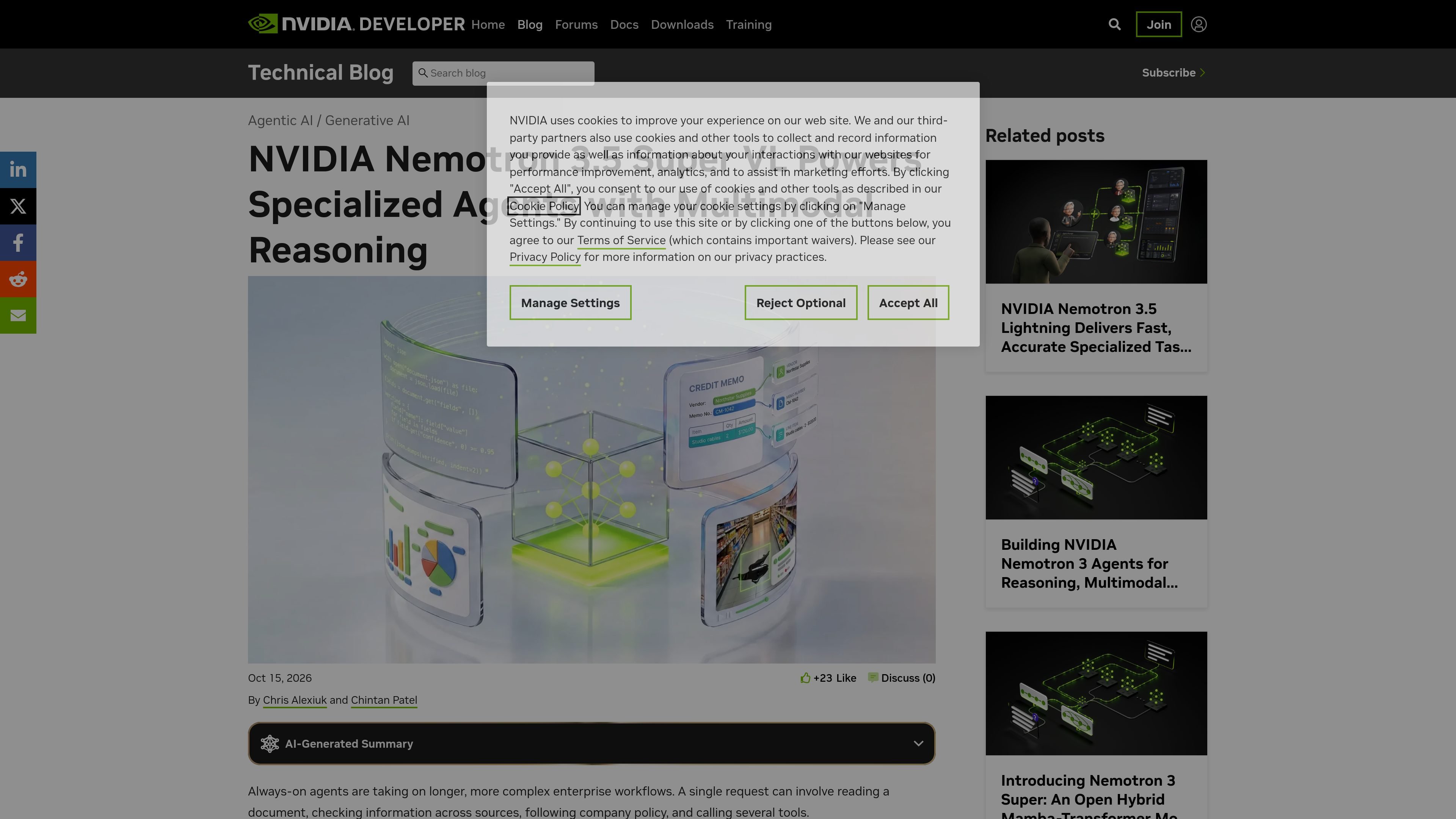
NVIDIA Nemotron 3.5 Super VL is an open, customizable multimodal model for specialized AI agents. It is designed for multistep enterprise workflows that may require reasoning, tool calls, policy following, and interpretation of text, images, documents, and video.
Its 120B-parameter mixture-of-experts architecture activates 12B parameters per token. The model can serve as the multimodal reasoning component in a broader Nemotron system, alongside smaller models for high-volume text tasks and larger models for complex planning and orchestration. Developers can adapt it with NVIDIA NeMo for domain-specific data, tools, and operating procedures.
Uses a 120B-parameter mixture-of-experts architecture that activates 12B parameters per token, balancing total model capacity with more selective computation.
Combines reasoning, instruction following, and tool use with understanding of text, images, documents, and video in one model.
Supports document workflows that interpret tables, charts, and page layouts, as well as video search, review, and incident analysis.
Can be post-trained on an organization’s data, tool interfaces, operating procedures, and policies using NVIDIA NeMo.
Uses LiLiCorr speculative decoding, NVFP4 quantization with quantization-aware distillation, multi-token prediction, and context reuse to improve inference efficiency.
The launch article reports over 600 output tokens per second on an Artificial Analysis Intelligence Index agentic-task endpoint and up to 5x higher throughput than other open models in its size category on a single GPU; results depend on the stated benchmark and deployment conditions.
Test and validate code, analyze errors, and recommend fixes in workflows that combine reasoning with tool use.
Search across websites, connect information from multiple sources, and verify answers before producing a result.
Read tables, charts, and page layouts to extract information and generate summaries or reports from complex documents.
Identify vulnerabilities and triage security threats so teams can prioritize remediation work.
Extract information from video for search, content review, and incident analysis.
Nemotron 3.5 Super VL is intended for specialized, multistep agent workflows that combine reasoning, tool use, and understanding of text, images, documents, or video. Examples include coding, web research, document intelligence, cybersecurity, and video analysis.
The model can be post-trained with NVIDIA NeMo using organizational data, tools, policies, and workflows. The source also identifies supervised fine-tuning, low-rank adaptation, and reinforcement learning as customization methods, with open datasets released on Hugging Face.
The model combines reasoning, instruction following, tool use, and multimodal understanding in one model, so a workflow can process text and visual inputs without requiring separate text and vision-language models for those capabilities.
The source describes deployment optimization through techniques including LiLiCorr speculative decoding, NVFP4 quantization with quantization-aware distillation, multi-token prediction, and context reuse. It points developers to NVIDIA NIM for optimized deployment, but the supplied evidence does not specify a complete deployment configuration or supported platform matrix.

AakarDev AI helps teams manage AI provider access, project-level setups, logs, and analytics from one dashboard. It supports BYOK workflows and lists providers including OpenAI, Google Gemini, Anthropic, Groq, Mistral AI, and Perplexity AI.

Benchspan is an AI agent security platform that discovers agents, blocks prompt injection and data exfiltration in real time, and supports pre-launch red teaming. It is aimed at teams running agents in production and includes Python and TypeScript SDKs.

CreateOS Sandbox is an isolated compute environment for running code and agent workloads inside Firecracker micro-VMs. It is designed for workflows that need machine-level isolation, private networking between sandboxes, and programmatic control through SDK, CLI, or MCP.

GitBot is a local browser-based workspace for creating reusable coding bots powered by Claude Code, Codex, or OpenCode. It helps developers run those agents across repository folders with persistent threads and configurable permissions.

Codex Plugins bundle reusable skills, app integrations, and MCP servers into workflows you can install in the Codex app or use from Codex CLI. They help extend Codex with connected-service tasks, reusable instructions, and shared team workflows.

Grok 4.7 is an xAI model for software development and knowledge work, including extended coding tasks and professional analysis. It is available through Grok Build, Cursor, the Grok API, and other developer platforms, with token pricing starting at $2 per million input tokens and $6 per million output tokens.