
Path-scoped context routing
Stores team knowledge as memories, rules, and skills, then routes only the relevant pieces into an AI session based on the path you are working in.

Pathrule routes a team’s rules, decisions, conventions, memories, and skills into AI coding assistants like Claude Code, Cursor, Codex, Windsurf, and GitHub Copilot. It scopes that context to the files being worked on and offers a free Solo plan plus paid team and enterprise options.
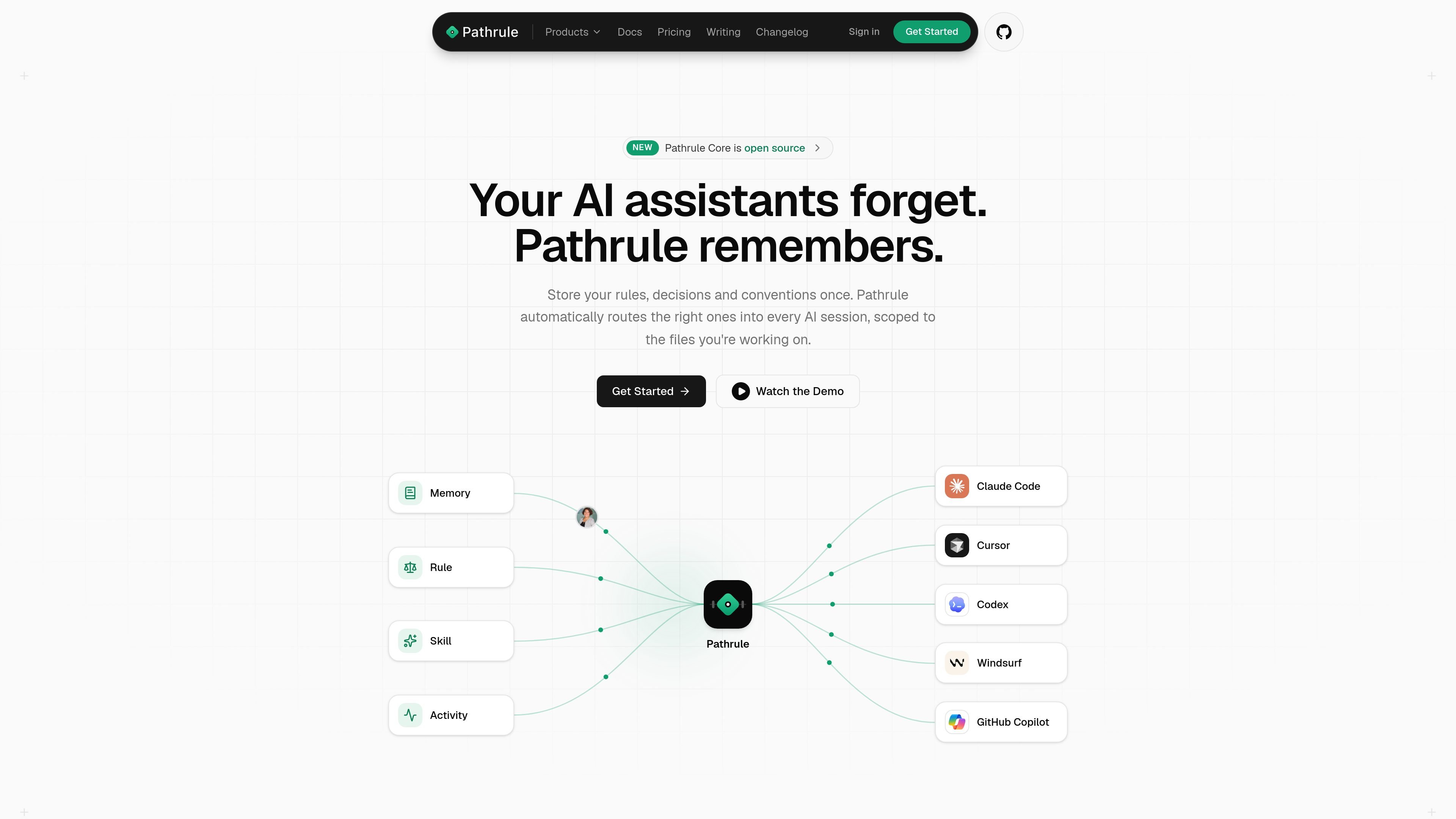
Pathrule is a context layer for AI coding assistants. It routes a team’s rules, decisions, conventions, memories, and skills into tools like Claude Code, Cursor, Codex, Windsurf, and GitHub Copilot, scoped to the files and folders being worked on.
The product is built to keep project knowledge close to the code without storing source code itself. Teams can capture context once, attach it to paths in a workspace tree, and let Pathrule deliver the most relevant pieces at hook time before an agent starts working.
Stores team knowledge as memories, rules, and skills, then routes only the relevant pieces into an AI session based on the path you are working in.
Supports Claude Code, Cursor, Codex, Windsurf, and GitHub Copilot, with the docs describing hook-time delivery before the first tool call.
Ranks candidate context by location, recent changes, semantic meaning, and how files change together, so the assistant gets a smaller, more relevant slice.
Lets you pin knowledge to folders and inherit context from parent paths, so shared conventions can apply across a repo without one global file.
Includes patterns, which are curated packages of pre-scoped memories, rules, and skills for common stacks and workflows.
Supports real-time collaboration with version-aware writes, presence, and conflict handling so multiple teammates or agents can work on the same knowledge safely.
Use Pathrule when a team wants the same architecture notes, naming conventions, or review rules delivered to every AI session that touches a particular folder or service.
Use the workspace tree and inherited context when different parts of a monorepo need different guidance, such as frontend, backend, billing, or infra paths.
Use patterns to seed a new project with pre-scoped memories, rules, and skills for a known stack instead of writing everything from scratch.
Use real-time collaboration and version-aware writes when multiple developers or agents are editing the same knowledge and need conflict detection instead of silent overwrites.
Use the open-source core locally when an individual developer wants path-scoped context delivery without adopting the full cloud collaboration layer.
Pathrule is designed to route path-scoped memories, rules, and skills into Claude Code, Cursor, Codex, Windsurf, and GitHub Copilot at hook time, before the first tool call. Its docs and product pages describe Quickstart, core concepts, and MCP tools for getting started.
The pricing page says Solo is free for individual developers. Team and Business are paid plans, and Enterprise is sold through sales with higher limits, SSO, audit logs, dedicated support, and self-hosted deployment in your own VPC.
Pathrule is built around memories, rules, and skills that are scoped to paths in a workspace tree. The docs point to a quickstart that installs a runtime, creates a workspace, and writes the first memory so Claude Code can pick it up through the hook.
Pathrule’s patterns are curated bundles of memories, rules, and skills. The patterns catalog says they are pre-scoped to the right paths, free, Apache-2.0, and importable by token into a workspace.
The pricing FAQ says memories and rules are the team-authored context objects Pathrule routes into AI sessions, and source code is not stored.

ByteAsk is a terminal-first AI coding agent for C and C++ that edits repositories and verifies changes with the real compiler, debugger, sanitizers, and tests before showing a diff. It offers a free tier plus paid plans, with editor connectors and zero-retention handling described in the source.

Goldfish is an AI memory app for macOS that helps you reply, write, summarize, and continue using the context already on your Mac. It stores memory locally and writes in your tone.

ArtDeck is a visual reference board app for iPhone, iPad, and Mac that lets artists collect mixed reference material on one canvas and study it with ToolBox lenses. It works offline, supports optional iCloud sync, and is sold as a one-time purchase with no account required.

garden-md is an open-source Node.js CLI that turns meeting transcripts into a local company wiki. It links entities across transcripts, keeps the original text intact, and renders the result as a browsable wiki.

Ghost ist ein terminalbasierter KI-Assistent für Chats, Code-Generierung und Aufgaben direkt in der Kommandozeile. Mit kostenlosen Modellen, Linux, macOS und Windows. Open Source.

Lasso is an ecommerce product data platform for enriching catalog records, processing supplier files, generating product content, and monitoring competitors. It combines a web app with a REST API, SDK, and MCP server for teams and developers.