
AI visibility research
Radar identifies market questions where competitors are named instead of the customer, tracks up to 10 competitors, and ranks topics by opportunity.

RankControl is an AI SEO and search visibility platform that helps teams discover content gaps, publish approved articles on their own domain, and monitor citations across major AI search platforms and Google. It also connects to MCP-compatible assistants, the CLI, and API for agent-driven SEO workflows with approval controls.
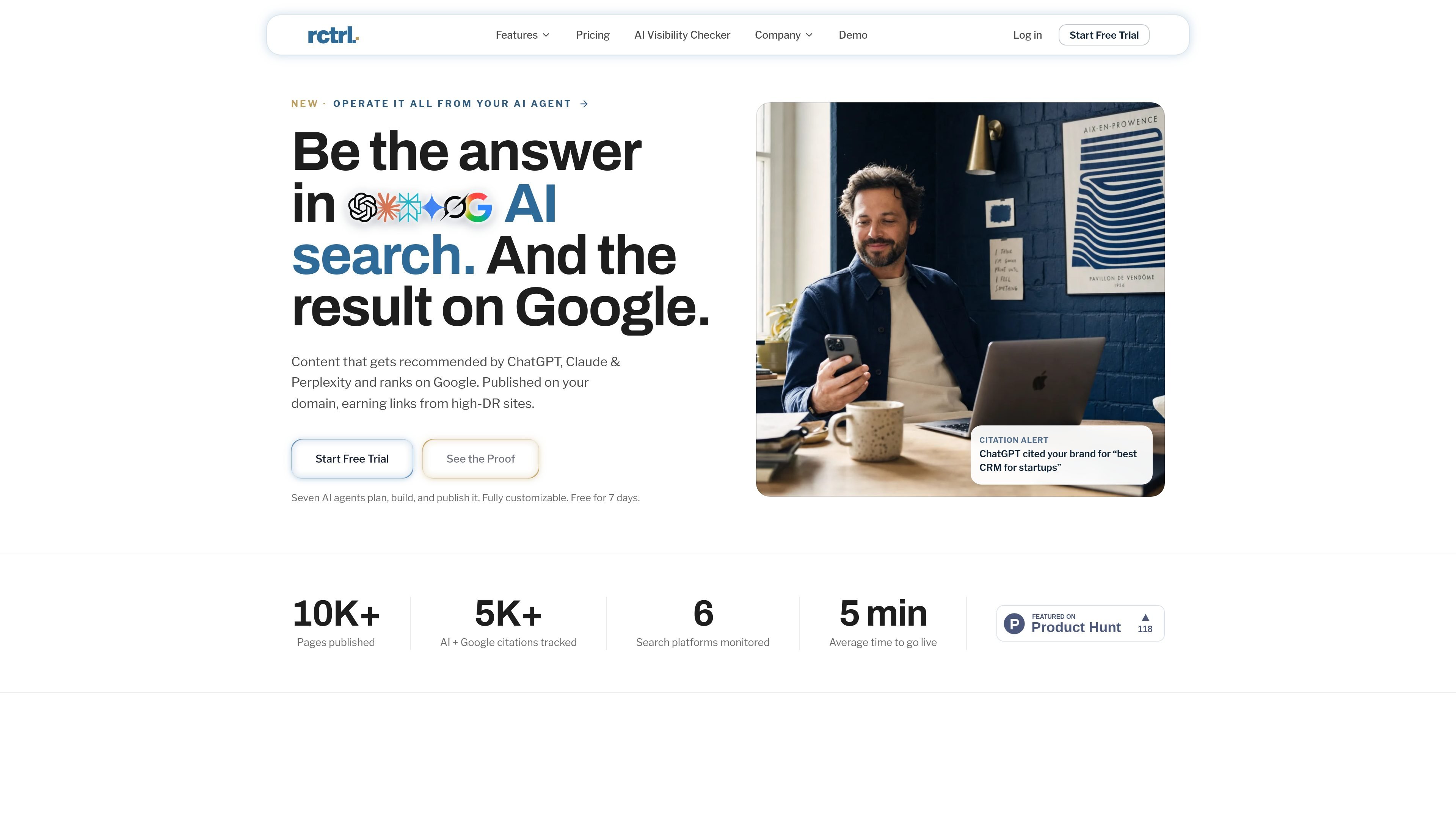
RankControl is an AI search optimization platform for teams that want their content to appear in answers from conversational search tools as well as in Google results. It combines query discovery, brand-matched content production, on-domain publishing, backlink workflows, and monitoring for AI citations and search traffic.
The platform’s workflow moves from finding unanswered market questions to drafting and reviewing content, publishing approved articles on a customer’s own domain, and measuring how AI systems and Google respond. It also exposes the workspace through a dashboard, CLI, API, and MCP connection so compatible assistants can inspect visibility data and propose or prepare work within the same approval rules.
Radar identifies market questions where competitors are named instead of the customer, tracks up to 10 competitors, and ranks topics by opportunity.
Forge produces brand-matched guides described as 1,500–4,000+ words and supports 26 content formats designed to address discovered questions.
Approved drafts can be published as native posts on the customer’s domain through a CMS plugin. Review and comments are supported, and auto-publish is off by default.
The platform checks ChatGPT, Perplexity, Claude, Gemini, Grok, and Google AI Mode, including Google AI Overviews, for tracked queries and competitor visibility.
Citation Signals notifies users when AI engines cite their brand or a competitor. Citation Sources shows which brands, sites, Reddit, or YouTube sources are cited, while Brand Perception records positive, neutral, or negative wording.
The platform includes backlink tracking, AI-drafted outreach emails, content refresh prompts, AI crawler visibility, and an agent pipeline with an audit trail.
Use Radar and competitor tracking to find questions in a market where other brands are cited, then prioritize topics by opportunity before commissioning content.
Create long-form, brand-matched guides in different formats, review the drafts, and publish approved articles as native CMS posts on the company’s domain.
Monitor tracked queries across six AI platforms and Google AI Mode to see when a brand, competitor, or third-party source is cited and how the wording is classified.
Use the MCP server or CLI from Claude, Cursor, Codex, a terminal, or CI to check visibility, plan titles, inspect jobs, and prepare publishing actions without changing the workspace’s access rules.
Track backlinks, prepare AI-drafted outreach, identify citation sources, and refresh pages when rankings or citations decline.
RankControl connects to Claude, Cursor, Codex, or another MCP-compatible agent through its hosted MCP option or the RankControl npm server. The site says browser approval takes about two minutes, while the CLI connection uses one command.
No. Publishing through MCP or the CLI is a dry run by default and waits for confirmation. Auto-publish is also off by default in the dashboard workflow.
RankControl publishes approved articles as native posts on the customer’s own domain through a CMS plugin. The site describes a five-minute, no-code plugin setup and says no subdomain is required.
The platform monitors ChatGPT, Perplexity, Claude, Gemini, Grok, and Google AI Mode. It tracks whether tracked queries cite the brand, competitors, or other sources, and can report citation wording and sentiment.
The source describes a free seven-day trial. The pricing page content provided does not include a complete breakdown of plans, limits, billing terms, or team usage.

PromptScout tracks how ChatGPT, Gemini, Google AI Overviews, and Perplexity mention your brand or competitors, then pairs those results with source analysis and website audits. It helps teams decide what to fix in content, positioning, or site readiness next.

ClayHog ist eine KI-Sichtbarkeitsplattform für die Suche, die zeigt, wie Marken in ChatGPT, Gemini, Perplexity, Claude und Google AI Overviews erscheinen.

beehiiv is a newsletter platform for creators, publishers, and brands that want to build, grow, and monetize email newsletters and websites from one place. It offers a free Launch plan, plus paid tiers for more advanced growth, monetization, and support features.

Scribeist is an AI-powered writing platform with dedicated workspaces for novels, blogs, essays, and notes. It combines project-aware AI, fiction continuity tools, SEO-focused blog tools, and publishing integrations.

findloc.ai publishes public AI reports for local markets and checks individual business websites for AI visibility signals. It helps owners, marketers, and agencies see which businesses AI assistants recommend and what their own site may be missing.

LoupeKit is a browser panel that inspects live web pages for stack details, layout, SEO, accessibility, and AI-generated code smells. It works as an over-the-page extension with a free tier and Pro options for exports, reports, advisories, and server-side readings.