
URL-based slop scoring
Users paste a website URL and receive a Slop Score on a 0–100 scale that reflects how slop-like the site appears.

Slopdar scans a website URL and returns a 0–100 Slop Score with receipts explaining the result. It is aimed at people who want to inspect whether a public site looks hand-coded or assembled with AI or template tools.
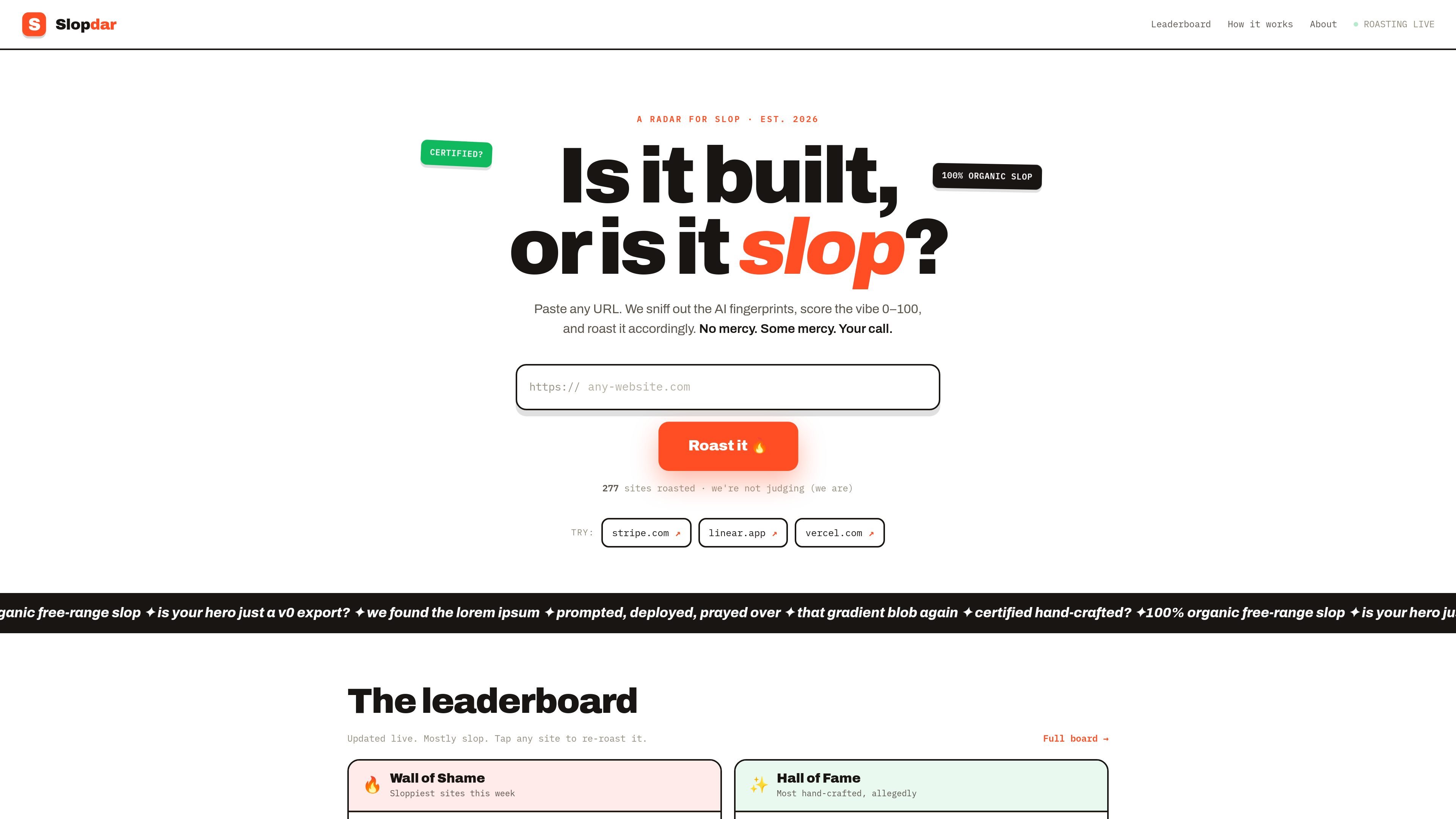
Slopdar is a website analyzer that scores a page from 0 to 100 based on how likely it is to have been built with templates, AI tools, or other low-touch workflows. It is presented as “a radar for slop” that lets you paste a URL, inspect the site, and get a roast with supporting evidence.
The product focuses on visible site signals rather than private project data. Its homepage says it checks markup, stack, copy, and assets for fingerprints such as v0, Lovable, Bolt, and Replit markers, default UI components, common stack choices, centered hero layouts, and leftover placeholder text.
Users paste a website URL and receive a Slop Score on a 0–100 scale that reflects how slop-like the site appears.
The product says it scans markup, stack, copy, and assets to look for AI and template signals rather than relying on a single clue.
The homepage says results include receipts, so the score is paired with the signals that triggered it.
The site lists telltale patterns it checks for, including tool fingerprints, default assets, common stack choices, layout tropes, and leftover junk copy.
A public leaderboard highlights the sloppiest and most hand-crafted sites and lets visitors tap entries to re-roast them.
Paste a live site to see whether it appears hand-built or assembled with common AI and template patterns, then review the receipts for the score.
Use the leaderboard to compare sites already scored by Slopdar and browse examples that were labeled more or less hand-crafted.
Run a competitor, client, or portfolio site through the scanner when you want a quick read on whether the design and markup show template-heavy patterns.
Share the score and receipts when you want to point to specific evidence behind a critique instead of relying on a general impression.
Slopdar takes a website URL, scans the page for common AI or template fingerprints, and returns a Slop Score from 0 to 100 with receipts. The homepage describes it as a way to see whether a site looks hand-coded or vibe-coded/AI-generated.
Yes. The homepage says you can paste any URL, including your own site, a competitor's, or another site you want to inspect.
The site says the result includes a score and the receipts behind it, so users can see what signals influenced the roast.
The rendered homepage includes a leaderboard with Wall of Shame and Hall of Fame sections, and the leaderboard page says sites can be tapped to see their receipts.
The pricing page at /pricing returned a 404 in the collected source, so no confirmed pricing details were available from the provided evidence.

Writecream AI Content Detector & Checker is a free web tool for checking whether pasted text appears to be written by AI or a human. It returns an AI content percentage and is presented for use in SEO, academia, publishing, and review moderation.

ByteAsk is a terminal-first AI coding agent for C and C++ that edits repositories and verifies changes with the real compiler, debugger, sanitizers, and tests before showing a diff. It offers a free tier plus paid plans, with editor connectors and zero-retention handling described in the source.

Manta AI is an autonomous web app testing tool for teams that want to map application behavior, catch regressions, and generate tests without writing scripts or maintaining selectors. It works from a URL and supports plain-English test flows, run results with screenshots, and scheduled or deployment-triggered checks.

EAS Observe is a production performance monitoring tool for Expo and React Native apps. It shows startup metrics, session timelines, release markers, and errors inside the Expo dashboard.

Traccia is an agent observability and governance platform that adds OpenTelemetry-native tracing, policy enforcement, prompt evaluation, and compliance evidence for AI workflows. It supports frameworks including LangChain, CrewAI, OpenAI Agents SDK, AutoGen, and LlamaIndex.

Hoplite is a cloud coding agent platform for teams that want to run software tasks in isolated sandboxes with repository context and imported local setup. It offers published Pro, Scale, and Enterprise plans.