
AI contribution attribution
Links AI coding sessions to the pull requests they produced, returns matching evidence, and abstains with a reason when the evidence is too thin.

tetriz-engineering-intelligence is a Go module of libraries for evidence-based analysis of AI-assisted software delivery. It helps engineering teams attribute contributions, assess pull requests, trace defect lineage, measure ROI, link delivery records, and evaluate AI development maturity using supplied data.
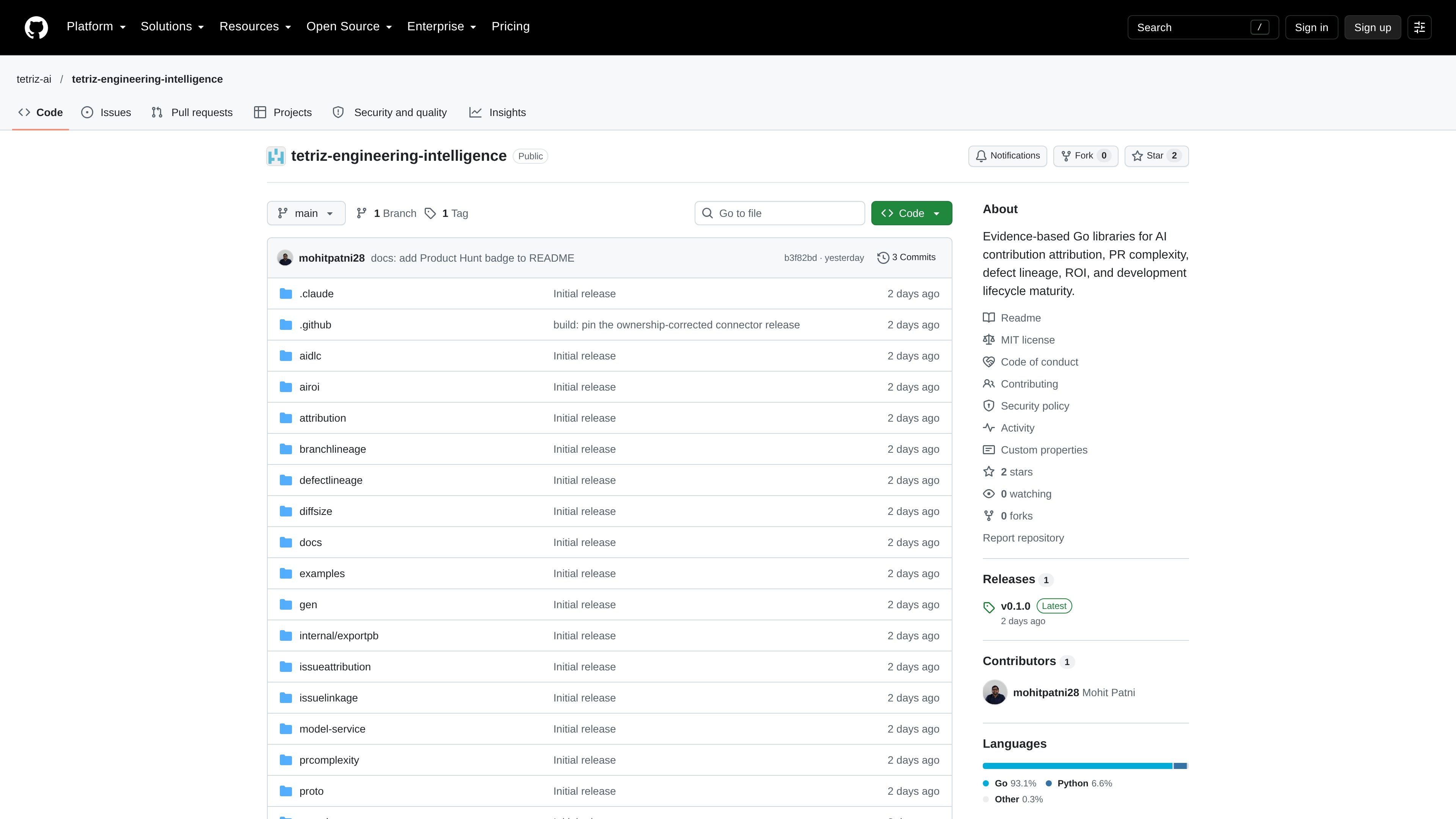
tetriz-engineering-intelligence is a Go module of evidence-based libraries for analyzing AI-assisted software delivery. It connects supplied session logs, pull requests, tracker issues, diffs, and promotion records to produce attribution, work, quality, value, and maturity outputs.
The repository is built for teams that want traceable engineering measurements rather than unqualified scores. Results can include matching methods, confidence, supporting evidence, abstention reasons, ranked defect candidates, issue-link coverage, and maturity constraints. Most packages run without a network service; pull-request work-type classification is the documented exception because it uses a companion model service.
Links AI coding sessions to the pull requests they produced, returns matching evidence, and abstains with a reason when the evidence is too thin.
Scores a pull request from 1.0 to 10.0 against recent merged pull requests in its own repository, while diffsize supplies effective lines of code by language.
Traces a merged bug fix to likely introducing changes, ranks candidates, and retains the evidence behind each result; its in-memory workflow runs offline, with PostgreSQL available for persistence.
Calculates class-corrected, quality-discounted ROI from AI-attributed and non-AI pull-request cohorts, reporting recovered hours and read-time dollars or abstaining when the data cannot support a claim.
Links pull requests to tracker issues, measures the share of completed issues delivered by AI-assisted pull requests, records branch promotions, and labels pull-request type and domain through a rules-to-model cascade.
Places an organisation on a grid of nine AI development lifecycle stages and five autonomy levels, identifying what holds each stage back.
Ingest agent session exports and pull-request records to determine which pull requests a coding session contributed to, while retaining evidence or an explicit abstention reason for review.
Compare pull-request size and relative complexity against recent merged work, then use the resulting work-type and domain labels when the companion model service is available.
Investigate a merged bug fix by ranking earlier changes that may have introduced the defect, with the evidence and confidence context needed for human follow-up rather than treating the result as proof of causation.
Join pull requests to tracker issues and branch promotions to measure delivery coverage, AI-assisted issue share, and which changes reached a tracked branch.
Evaluate an organisation across AI development lifecycle stages and autonomy levels, using the reported bottlenecks to guide maturity planning instead of treating unmeasured stages as zero.
It is a Go module containing libraries for evidence-based engineering analysis, including AI contribution attribution, pull-request complexity, defect lineage, ROI, issue attribution, branch lineage, and lifecycle maturity.
The attribution workflow accepts AI coding-session evidence and pull-request data supplied by the user. The repository provides adapters for session-extractor exports and connector records, but it does not fetch sessions or pull requests itself.
Most packages are designed to run offline with supplied data. The exception is prworktype: its rules, embedding, and LLM cascade uses the companion model-service over HTTP, so it is not pure Go or fully offline.
The repository documents Go 1.25.2 or newer for its quick start. Attribution can use in-memory or SQLite reference stores; the in-memory store suits tests and first runs, while SQLite persists across restarts.

ByteAsk is a terminal-first AI coding agent for C and C++ that edits repositories and verifies changes with the real compiler, debugger, sanitizers, and tests before showing a diff. It offers a free tier plus paid plans, with editor connectors and zero-retention handling described in the source.

Epherem is a static security scanner for web apps built with AI coding tools such as Lovable, Bolt, v0, Replit, Cursor, and Claude Code. It checks source files and dependencies for common security mistakes, then provides categorized findings and suggested fixes without running the app.

CreateOS Sandbox is an isolated compute environment for running code and agent workloads inside Firecracker micro-VMs. It is designed for workflows that need machine-level isolation, private networking between sandboxes, and programmatic control through SDK, CLI, or MCP.

GitBot is a local browser-based workspace for creating reusable coding bots powered by Claude Code, Codex, or OpenCode. It helps developers run those agents across repository folders with persistent threads and configurable permissions.

hob is an independent workspace for coding agents that keeps agent sessions, terminals, history, and follow-up work organized around the tools and providers you already use. It is aimed at developers who want local control over routing, history, and workspace structure rather than a bundled model stack.

Ably Chat is a chat API platform for building custom realtime chat applications. It supports room-based messaging, typing indicators, presence, reactions, and message updates, with usage-based pricing options for different deployment stages.