
Project setup around your existing prompt and metric
Paste the system prompt you already use and select the evaluation metric that matters for the workflow, such as accuracy, BLEU, or structured-output validity.

TuneLLM is an enterprise platform that distills recurring Claude- or GPT-style workflows into smaller fine-tuned models inside your infrastructure. It is aimed at teams that want benchmarked quality on narrow LLM tasks at lower inference cost.
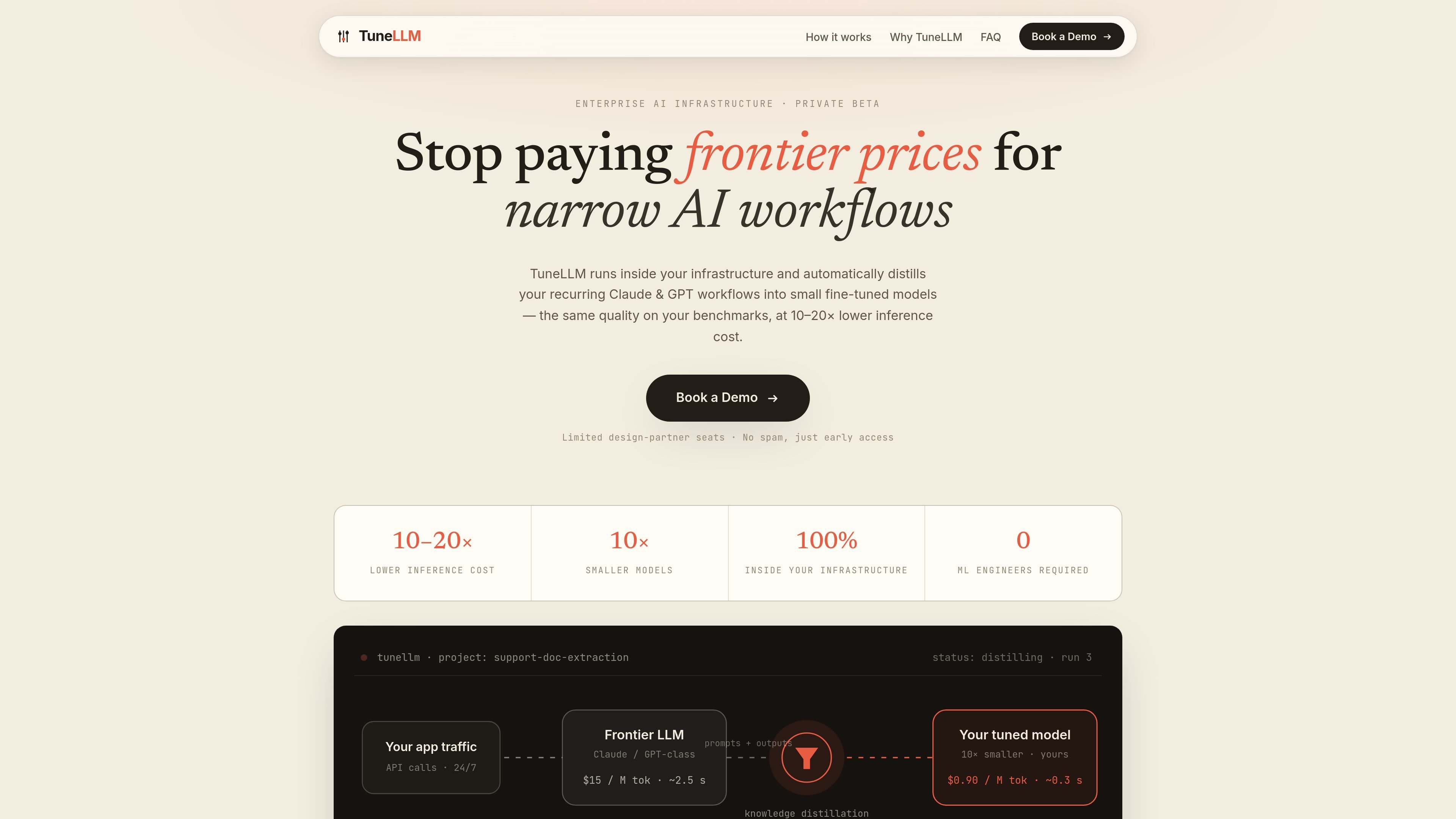
TuneLLM is an enterprise AI infrastructure product for turning expensive, recurring LLM workflows into smaller fine-tuned models. The site positions it as a way to keep the quality of a frontier model on a narrow task while lowering inference cost, latency, and operational overhead.
The product is designed to run inside your own infrastructure. It starts by proxying existing Claude- or GPT-class calls, captures request and response traffic, and then uses that workflow data to automatically distill a smaller model that can be benchmarked against the frontier model before you switch traffic over.
Paste the system prompt you already use and select the evaluation metric that matters for the workflow, such as accuracy, BLEU, or structured-output validity.
TuneLLM proxies your current API calls to the frontier model first, so the product can capture real requests and responses without changing your workflow immediately.
Once enough traffic accumulates, the platform automatically fine-tunes a smaller model on that workflow inside your infrastructure.
Every tuned model is benchmarked side by side against the frontier model on your chosen metric before you switch over.
The homepage says the platform deploys on-premise or in a private cloud and keeps prompts, responses, training data, and weights inside your network.
The workflow is presented as end-to-end automation across data capture, training, evaluation, and serving, without requiring an ML team to operate it.
Teams that run translation at high volume can use TuneLLM to distill a smaller model on their actual traffic, then compare quality against the frontier provider before changing routing.
For document parsing and extraction, the platform can learn a stable, structured-output workflow and keep outputs benchmarked against the existing model on a validity or accuracy metric.
Operations or content teams that tag or classify incoming items can use the system prompt they already rely on and convert that repeated task into a lower-cost in-network model.
Teams using template-driven creative generation or summarization can treat the current frontier workflow as the benchmark and switch only after the distilled model matches the chosen measure.
Enterprise platform teams that want to reduce API spend without building their own ML pipeline can keep the current provider in place while TuneLLM captures traffic, trains, evaluates, and serves the tuned model.
Yes, for narrow, well-defined workflows the product is designed to distill the system prompt and real traffic into a smaller model that is benchmarked against the frontier model you already use. The switch only happens if the distilled model matches your chosen metric.
TuneLLM deploys inside your cloud account or data center. The site says prompts, responses, training data, and model weights stay inside your network, and nothing is sent to the vendor.
The best fit is a recurring workflow that runs at high volume with a stable system prompt, such as translation, document parsing and extraction, classification and tagging, summarization, or template-driven creative generation.
It is meant to sit in front of your current provider first. TuneLLM proxies requests to the existing frontier model, captures request and response data, and later lets you switch routing to the distilled model when the benchmark results justify it.
The pricing page was not available in the collected sources. The homepage says the company is onboarding early design partners first and that pricing scales with the inference savings it unlocks, so a demo is required for current commercial details.

ByteAsk is a terminal-first AI coding agent for C and C++ that edits repositories and verifies changes with the real compiler, debugger, sanitizers, and tests before showing a diff. It offers a free tier plus paid plans, with editor connectors and zero-retention handling described in the source.

Manta AI is an autonomous web app testing tool for teams that want to map application behavior, catch regressions, and generate tests without writing scripts or maintaining selectors. It works from a URL and supports plain-English test flows, run results with screenshots, and scheduled or deployment-triggered checks.

AakarDev AI helps teams manage AI provider access, project-level setups, logs, and analytics from one dashboard. It supports BYOK workflows and lists providers including OpenAI, Google Gemini, Anthropic, Groq, Mistral AI, and Perplexity AI.

CreateOS Sandbox is an isolated compute environment for running code and agent workloads inside Firecracker micro-VMs. It is designed for workflows that need machine-level isolation, private networking between sandboxes, and programmatic control through SDK, CLI, or MCP.

hob is an independent workspace for coding agents that keeps agent sessions, terminals, history, and follow-up work organized around the tools and providers you already use. It is aimed at developers who want local control over routing, history, and workspace structure rather than a bundled model stack.

Ably Chat is a chat API platform for building custom realtime chat applications. It supports room-based messaging, typing indicators, presence, reactions, and message updates, with usage-based pricing options for different deployment stages.