
One-card swipe deck
Visitors see one indie startup at a time and swipe right if they would pay based on the first impression, or left if they would not.

Would you pay? is a web-based validation deck where people swipe right if they would pay for an indie startup and left if they would not. Makers can submit products for free and review pay-intent results, audience breakdowns, and site click-throughs after sufficient responses.
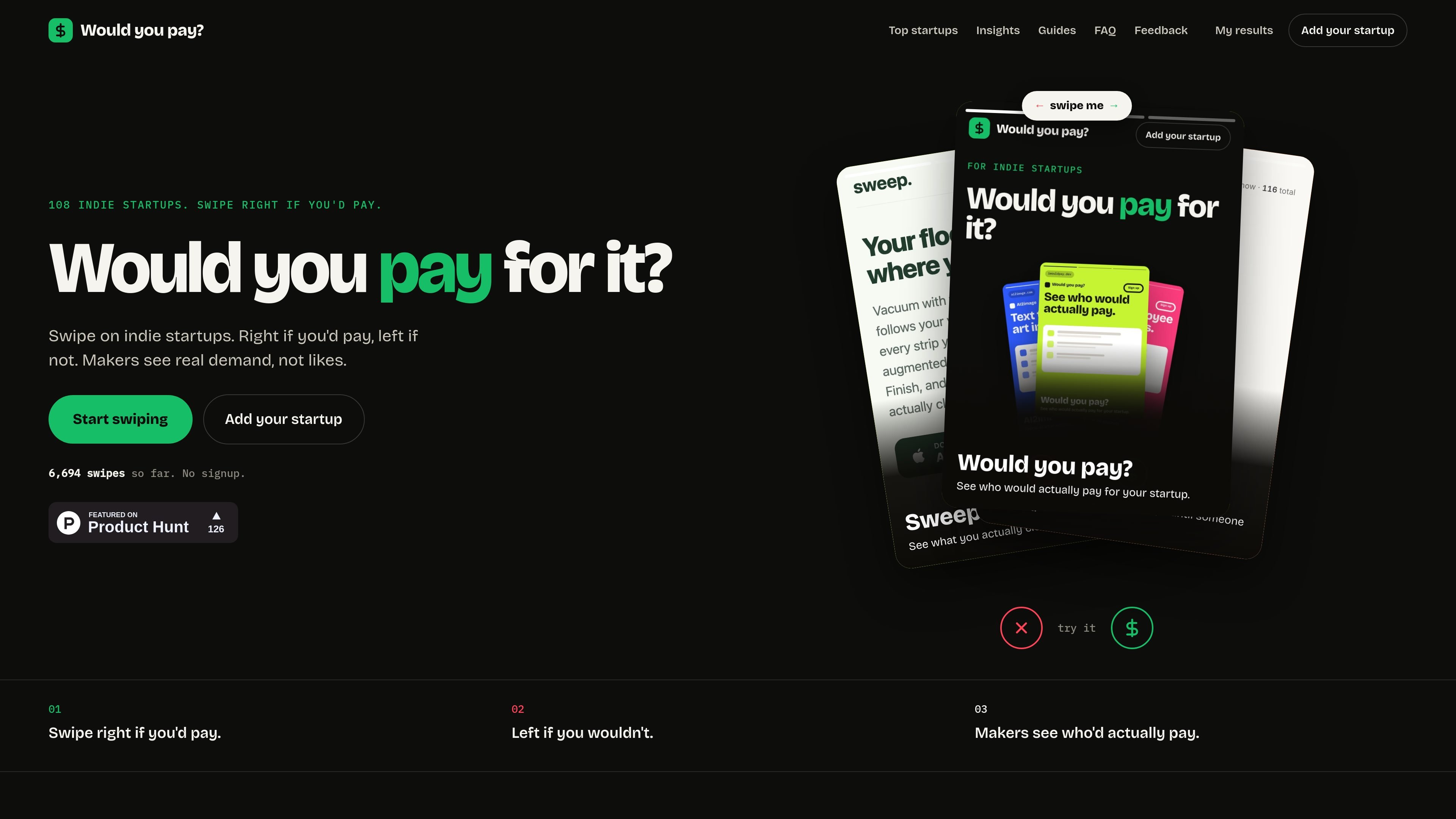
Would you pay? is a web-based product validation deck for indie startups. Visitors review one startup at a time and swipe right if they would pay for it based on the first impression, or left if they would not. Swiping is free, requires no account, and does not create a purchase or charge.
Startup makers can submit a product for free with its website and a one-line description. The platform collects pay-intent responses and shows the maker a percentage after 10 swipes, plus audience breakdowns for developers, founders, and marketers and the number of site click-throughs. The purpose is to give makers an early demand signal based on the way their product is presented, rather than treating likes as equivalent to buying intent.
Visitors see one indie startup at a time and swipe right if they would pay based on the first impression, or left if they would not.
Startup makers can add a card with a website and a one-line explanation of what the product does. The submission flow uses the maker's site to fill in additional details.
Makers receive a pay-intent percentage once a card has collected 10 swipes, reducing the effect of one or two early responses.
Results include response shares from developers, founders, and marketers, allowing makers to see which audience groups are most receptive.
The results include the number of people who clicked through to the startup's site, alongside swipe responses.
An optional $9-at-launch Boost places a card at the front of the deck for 24 hours, with continued boosting if it does not reach 100 swipes in that period.
Submit a product before investing more development time and use the initial pay-intent response to decide whether the one-line pitch needs work.
Compare several positioning statements or product ideas by presenting each as a startup card and reviewing how the same deck audience responds.
Inspect whether developers, founders, or marketers are the most receptive audience, then use that distinction to focus early outreach.
Share a public result page once the card has passed the 10-swipe threshold when posting early validation evidence on X or elsewhere.
No. Visitors can open the deck and swipe without creating an account. Makers sign in with a one-time email link rather than a password.
Swiping right means the person would pay for the startup based on its first impression. It is an intent signal, not a purchase, and no charge is made.
Adding a startup and viewing its results are free. An optional Boost costs $9 at launch and places a card at the front of the deck for 24 hours. If the card does not reach 100 swipes during that period, the site says it will continue boosting it for free until it does.
Boost increases exposure, not positive votes. Up to five cards can be boosted at once, and boosted cards share the front position in random order. People still decide independently whether they would pay.
Makers can see the share of people who would pay, the responses by developer, founder, or marketer, and the number of people who clicked through to the startup site. The percentage appears after 10 swipes; the full breakdown is private to the maker, while the public share page can show the headline percentage after that threshold.

MacSpoof ist ein MAC-Adressenwechsler für macOS: WLAN-MAC ändern oder randomisieren, um Verbindungen zu erneuern und die Protokollierung auf öffentlichem WLAN zu reduzieren.

DemoTV is an audience-ranked station for discovering and comparing independent product demos. Founders can submit videos, embed approved demos on their websites, collect viewer inquiries and optionally commission demo production or labelled promotion without buying ranking.

Ship It: Idle Dev Tycoon is an iPhone incremental simulation game about building apps, managing a software studio, and selling it for lasting progression benefits. It supports offline play, automated builds, adviser collection, and optional in-app purchases.

NomNak ist eine kostenlose Restaurant-Discovery-App für iPhone, mit der du Orte über Empfehlungen von Freunden statt über anonyme Bewertungen findest.
CAPTA is a mobile GPS waypoint app for quickly saving, organizing, and revisiting locations. It supports offline use, camera-based coordinate capture, optional cross-device synchronization, and GPX export for fishermen, explorers, and field professionals.

Ctrl+Shift+3 is a calm, text-first community platform with a chronological feed, profiles, RSS, and private groups called Clicks. It is built for reading, posting, and joining smaller communities without algorithmic ranking or vanity counts.