
Embodied Real-Time Driving
Generates a 3D digital human’s speech, expressions, gaze, gestures, and body movements from text in real time, making interactions feel closer to human conversation.

魔珐星云是一个面向开发者的 3D 具身智能数字人开放平台,提供实时驱动、视频生成和语音合成能力。它帮助应用把文本快速转成可交互的数字人体验,并支持 API 接入。
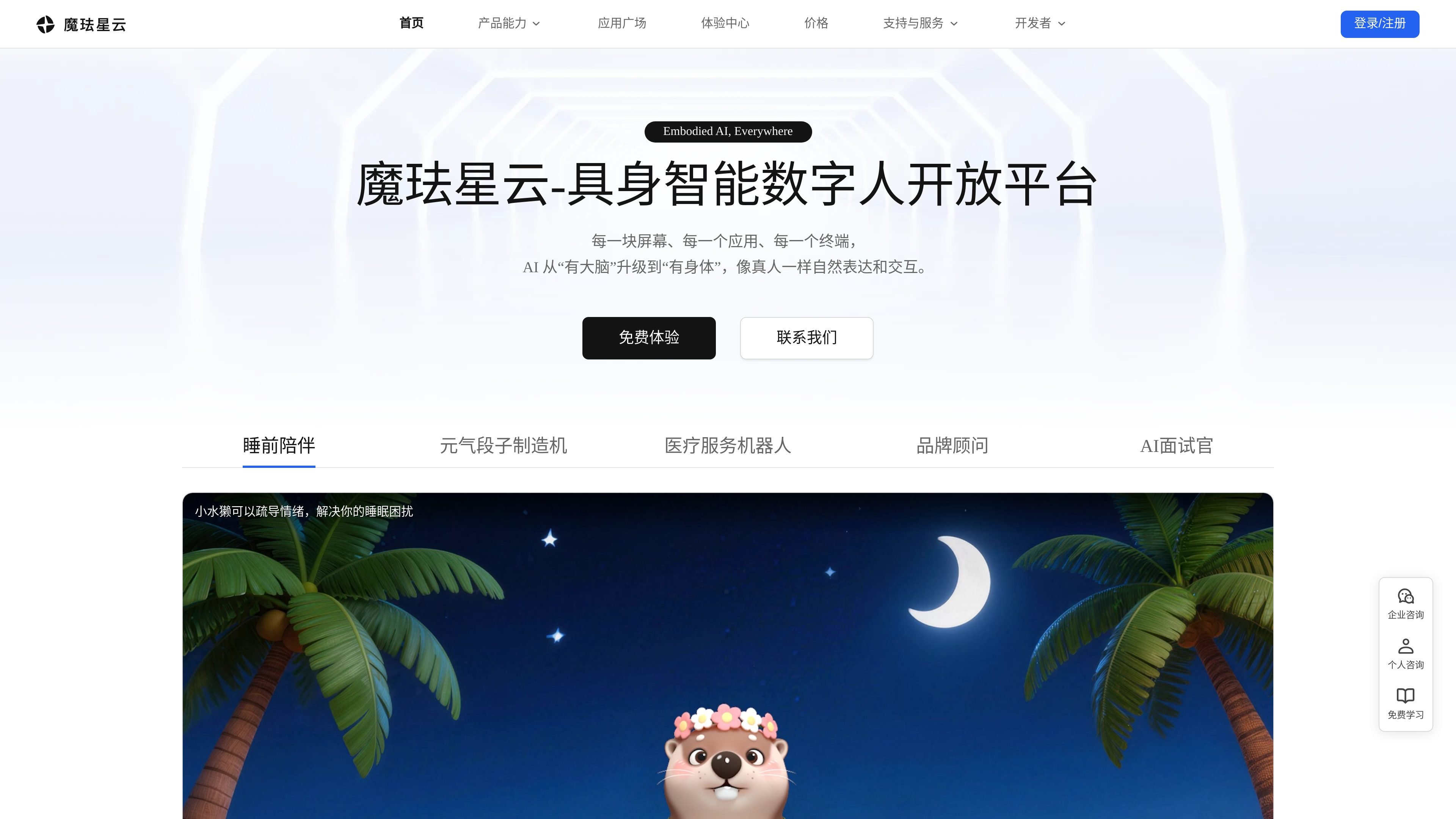
Xingyun is a developer-focused 3D embodied digital human open platform centered on three core capabilities: real-time driving, video generation, and speech synthesis. It helps applications combine text, voice, and motion into interactive digital human experiences. The official site positions it as an infrastructure platform and emphasizes rapidly building digital human intelligent agent applications through APIs.
From the public pages, the platform covers three common digital human workflows: real-time interaction, video content generation, and speech output. The real-time driving capability can turn text into speech, expressions, and actions; the video capability supports generating 3D digital human videos from text or PPT; and speech synthesis is aimed at terminals and applications that need natural, human-like audio output.
The platform also emphasizes multi-device support and low-barrier deployment. The pages mention adaptation to environments such as Web, App, mobile phones, in-car systems, tablets, PCs, TVs, and large displays, and support for mainstream systems including Android, iOS, and HarmonyOS. The pricing page adds points-based billing, concurrency limits, and commercial authorization notes, showing that it is both a callable technical platform and one with clear usage boundaries.
Generates a 3D digital human’s speech, expressions, gaze, gestures, and body movements from text in real time, making interactions feel closer to human conversation.
Supports one-click generation of 3D digital human videos from text or PPT, covering an automated workflow from script to finished video.
Converts text into natural speech in real time, with support for multiple languages, voices, and emotional controls.
Provides voice cloning capabilities to customize a dedicated speaking style from relatively short audio samples.
Supports editing video elements such as scenes, characters, voice timbre, actions, and camera angles for finer-grained content control.
Supports deployment across Web, App, and other devices, and mentions compatibility with mainstream systems such as Android, iOS, and HarmonyOS.
In customer service, guidance, or Q&A applications, replace plain text chat boxes with digital humans so answers, expressions, and gestures are presented together to users.
Turn product introductions, training courses, knowledge explanations, or PPT content into 3D digital human videos for batch content production.
In livestreaming, voice assistants, in-vehicle systems, or accessibility services, convert text into natural speech in real time to provide stable audio output.
Use in scenarios that require real-time interaction, such as interviewers, companion roles, education assistants, or virtual IPs, to strengthen emotional expression and motion feedback.
For platform providers, integrators, or terminal manufacturers, embed digital human capabilities into existing products as a differentiated human-machine interaction layer.
Xingyun provides three core capabilities — real-time digital human driving, video generation, and speech synthesis — making it suitable for development teams that need to turn text into interactive digital human experiences. The official site clearly offers API access, but it does not publicly disclose full SDK, authentication, or deployment workflow details on the page.
Based on the page, the capabilities can be used for real-time interaction, text-to-video generation, and voice output scenarios. The video feature supports generating 3D digital human videos from text or PPT; real-time driving supports generating speech, expressions, and actions from text; and speech synthesis converts text into natural-sounding speech.
The pricing page shows that the platform uses a points-based billing model, and different capabilities and options consume different amounts of points. Real-time driving is billed by interaction duration, video generation consumes points based on factors such as resolution and complexity, and speech synthesis is billed by audio duration.
The pricing page states that related services are limited to non-commercial purposes such as personal learning, trial use, and code debugging unless written authorization is obtained in advance. Commercial use requires prior authorization.
The official site lists different user types, including developers, enterprise application teams, system integrators, terminal manufacturers, and content tool vendors, but it does not provide detailed public information about team collaboration, permission management, or multi-account workflows.

Wallie is an open-source AI streamer that watches your screen, hears chat, and generates live commentary in a configurable persona. It runs locally on your machine with your own keys and is aimed at faceless content, autonomous streams, and real-time reactions.

VIDEOAI.ME is an AI video generator for making spokesperson-style videos, ads, explainers, and social content from a script. It is aimed at founders, marketers, agencies, and creators who want to produce videos without filming.

Official HeyGen API documentation for building AI avatar videos, translations, lipsync, and interactive video-agent sessions. It supports direct API use plus MCP and CLI-style workflows for developers and AI agents.

Fylom is an AI podcast generator that turns a topic or question into a researched narrated episode. It supports typed or spoken prompts, voice selection, and recurring show-style listening.

BeFreed is a personalized audio learning app that turns books and other knowledge sources into narrated listening experiences. It helps people learn on demand through interactive audio, voice selection, and built-in learning tools.

艺映AI is a free AI video creation tool for generating video from text, images, or existing footage. It is positioned for short-form social content, promotional clips, and stylized AI video projects.