续构 icon

续构

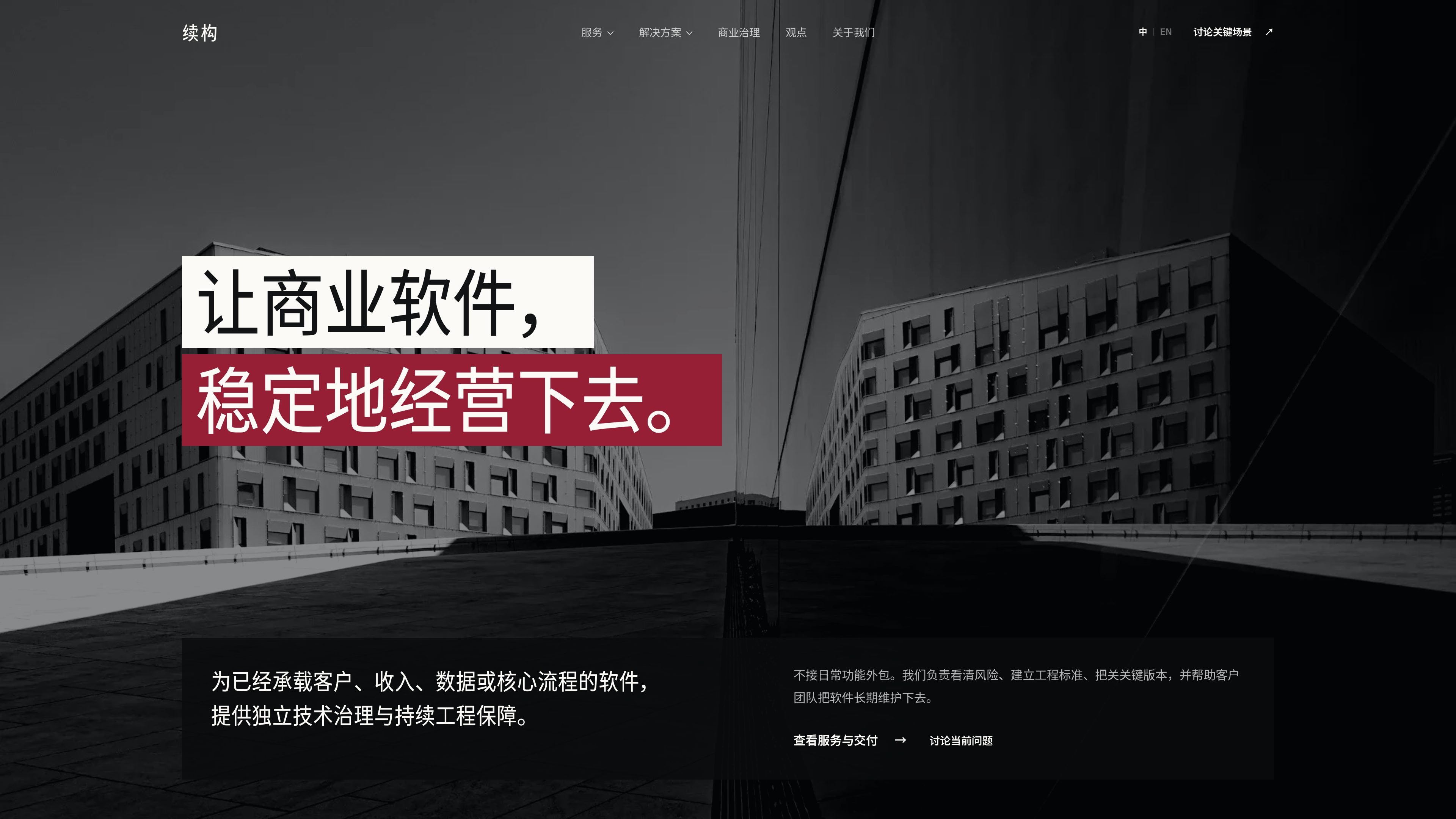
续构为已经承载客户、收入、数据或核心流程的软件提供长期工程治理与持续技术保障。它帮助客户团队建立工程标准、管理关键版本和长期风险,同时保留产品与技术决策在客户侧。

续构

What is 续构?

续构 provides long-term engineering governance and continuous technical support for business software that already carries customers, revenue, data, or core workflows. Its core goal is not to take over day-to-day feature development, but to help the client team see system risks clearly, establish engineering standards, and embed key releases, incident improvements, and long-term maintenance mechanisms into actual business operations.

The page divides the service into several categories: long-term governance for business software, continuous engineering support, and specialized services around Agent commercialization. Regardless of the category, the collaboration emphasizes jointly establishing a baseline, participating in key reviews and decisions on a fixed cadence, and delivering outputs that the client team can continue to use.

Core Capabilities

Establish a shared system baseline

Through interviews, material review, and system checks, confirm the responsibility boundaries between the client business, product, technology, and vendors, as well as the business impact of system outages or data errors.

Map architecture and dependency risks

Review code repositories, deployment environments, data flows, and third-party dependencies to identify architecture boundaries, single points of failure, coupling relationships, and constraints for future phases.

Define engineering and release standards

Organize code review, testing, change approval, release readiness, and rollback conditions into a minimum launch standard that the team can execute, and validate it in real releases.

Assess stability and recovery capabilities

Focus on monitoring, logs, alerts, backups, recovery, and capacity management to clarify the requirements for detection, response, rollback, and restoration across critical paths.

Participate in key decisions and incident closure

Provide independent judgment, written opinions, and follow-up tracking for major releases, architecture changes, vendor selection, data migration, and incident postmortems.

Create searchable governance records

Organize operating events, risks, technical debt, cost changes, and the next round of investment priorities into a maintainable record that the team can keep using.

Applicable Scenarios

  • Existing software carrying core business

    When the system already has real customers, revenue, and data, but the team is hesitant to make changes, start with baseline review, risk grading, and release standard setup before moving into continuous governance.

  • Long-term governance across multiple teams

    When internal teams and vendors are both delivering features, but architecture, technical debt, major releases, and long-term risk do not have a single owner, use a fixed cadence of reviews and roadmap alignment to unify responsibility and standards.

  • Post-incident governance and recovery reinforcement

    When incidents are handled only through ad hoc reaction and monitoring, rollback, postmortems, and remediation have not become a formal mechanism, strengthen the operating and recovery manuals, postmortem closure, and governance records.

  • Agent commercialization and productionization

    When a team is turning an Agent into a paid product, or bringing an Agent into real enterprise workflows, first clarify customer tasks, product boundaries, production architecture, permissions, and evaluation, then move into pilots and launch.

  • Ongoing external senior technical judgment

    When long-term senior technical judgment is needed but building a large expert team is not desired, introduce continuous engineering support on a monthly or annual cadence to participate in key decisions, release assurance, and management technical briefings.

Pros and Cons

Pros

  • The service focuses on software that already supports real business, with a clear objective.
  • It delivers actionable engineering standards, governance roadmaps, and recovery manuals rather than only advice.
  • It emphasizes that the client team retains the product, code, and final decision-making authority.
  • It covers the full governance chain from architecture, quality, and releases to incident reviews and long-term planning.

Cons

  • It does not take on routine feature development, and it is not intended as a staffing supplement.
  • It does not provide 24/7 operations coverage or unlimited emergency response.
  • Large-scale refactoring, migration, or on-site incident handling require separate scope confirmation.

FAQ

How does the collaboration usually start?

续构 first establishes a shared baseline for the business, system, and team, then moves into a fixed governance cadence. This usually includes kickoff interviews, material review, key reviews, and written conclusions to clarify architecture, quality, release, stability, security, and data risks.

Which situations are suitable for this service?

It is intended for software that already carries customers, revenue, data, or core workflows, as well as software preparing for long-term commercial operation. If a system only needs one-time feature development or additional day-to-day staffing, the page clearly states that this is outside the service scope.

How long does a typical engagement last?

For long-term governance of commercial software, the baseline phase usually takes 2–3 weeks; continuous engineering support is typically engaged on a monthly basis, usually for at least 6 months, and complex systems are recommended to follow an annual governance cycle.

Does it include day-to-day development or on-call operations?

No. The page clearly states that it does not take on routine feature development, does not serve as an outsourced development team, and does not provide 24/7 monitoring coverage or unlimited emergency response.

What deliverables are usually provided?

It delivers actionable, maintainable outputs such as responsibility maps, governance baseline reports, engineering standards, release checklists, technical decision records, runbooks and recovery manuals, or monthly health briefings and opinions on key releases.

Quick Facts

Category
Software Governance
Primary users
Business owners, product leads, technical leads, internal teams and suppliers
Service model
Long-term governance and continuous support
Source domain
slop-fix-preview.vercel.app
Homepage language
Chinese (zh)
Typical engagement
2–3 week baseline; 6+ month ongoing support