
Workspace-based setup
Create a siloed workspace for a company, team, or use case, then keep the data that powers apps and agents in one place.

Zaro is an AI workspace platform for building agents, apps, and workflows on company data. It uses shared, usage-based credits and offers a free trial with no credit card required.
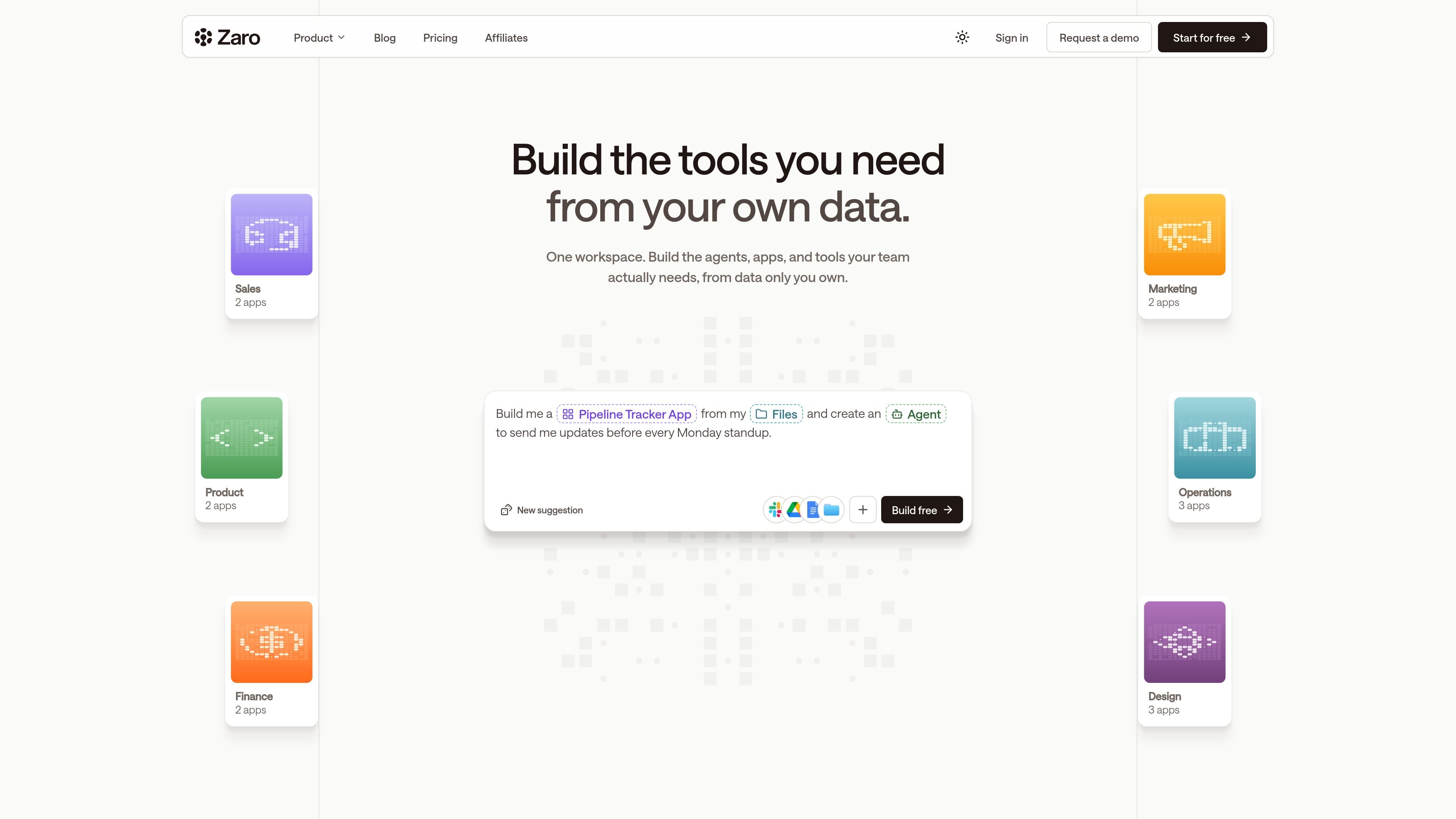
Zaro is a workspace for building internal intelligence systems from your own company data. It combines captured context, agents, and generated apps so teams can run workflows, track information, and surface answers in one place.
The product is positioned as an alternative to assembling separate tools. The site describes a shared workspace where files, calls, CRM records, Slack threads, and other company data feed agents and apps that read from the same context and write back to it.
Create a siloed workspace for a company, team, or use case, then keep the data that powers apps and agents in one place.
Connect files, calls, CRM records, Slack threads, and specifications so Zaro can use the context your team already produces.
Run agents on demand, on a schedule, or from triggers, with each run reading from and writing back to the workspace.
Describe the app you need and Zaro generates workspace-connected tools such as dashboards, trackers, and briefings.
Use a shared credit pool with no per-seat fees, plus top-ups, spend alerts, hard caps, and auto top up controls.
Share apps through public links or a custom domain on the Launch plan, with enterprise options for SSO, SAML, and audit logs.
Create dashboards, trackers, or briefings that stay connected to workspace data and update as underlying files or records change.
Run agents that monitor workspace information, gather updates, and send recurring digests or alerts before meetings and workday starts.
Store company context in one workspace so teams can search documents, call notes, and decisions without moving between separate tools.
Set up team- or use-case-specific silos for data that should stay separate, such as company-wide, department, or project workspaces.
Top up credits when usage rises, then keep automations running without waiting for the next monthly reset.
Zaro is priced per organisation, not per seat. All members in a workspace share one credit pool, so adding teammates does not change the billing model.
A credit is a fixed slice of compute. Zaro uses credits to meter agent runs, app generation, and integration calls.
The free trial gives you 5,000 credits when you sign up, with no credit card required. The trial credits are valid for 30 days.
Monthly plan credits refill each cycle and do not roll over. Top-up credits do roll over and stay valid for 12 months.
Enterprise includes SSO, SAML, audit logs, dedicated model inference or BYOK, SLA and dedicated support, invoicing, and security review.

Goldfish is an AI memory app for macOS that helps you reply, write, summarize, and continue using the context already on your Mac. It stores memory locally and writes in your tone.

Lasso is an ecommerce product data platform for enriching catalog records, processing supplier files, generating product content, and monitoring competitors. It combines a web app with a REST API, SDK, and MCP server for teams and developers.

CreateOS Sandbox is an isolated compute environment for running code and agent workloads inside Firecracker micro-VMs. It is designed for workflows that need machine-level isolation, private networking between sandboxes, and programmatic control through SDK, CLI, or MCP.

Codex Plugins bundle reusable skills, app integrations, and MCP servers into workflows you can install in the Codex app or use from Codex CLI. They help extend Codex with connected-service tasks, reusable instructions, and shared team workflows.

Struere is an AI-native platform for turning spreadsheet data into structured operational software with dashboards, alerts, and automations. It is aimed at teams that want to replace manual spreadsheet workflows without building custom tools from scratch.

garden-md is an open-source Node.js CLI that turns meeting transcripts into a local company wiki. It links entities across transcripts, keeps the original text intact, and renders the result as a browsable wiki.